'Constant danger': Life after leprosy, a long neglected disease / Photo: Manan VATSYAYANA - AFP/File

 AFP photo shows Trump examining image of Kennedy Center apparent demolition

 Andersson vows to take Sweden in 'new direction' after election win

 Turkey's Erdogan to run again in early 2028 vote, top adviser says
 Sweden's Andersson: a trusted, no-nonsense political operator

 Canada's Carney pushes 'new alliance' with EU despite Trump threats

 Ireland to boycott Eurovision 2027 over Gaza

 India's Tata Sons reappoints N. Chandrasekaran as chairman

 Sweden's left-wing wins election thriller

 Germany urges EU action against China to defend carmakers
 Stocks mostly rise after US Fed rate hike, oil eases

 Palestinians turn rugged caves into homes after Israeli demolitions

 Two unseen Monet paintings to be sold in Paris: auction house

 Klopp wants German team to help reclaim national pride from far-right

 Ninth woman found dead in South Africa killing spree

 Smog scuppers Japan force helping fight Indonesia wildfires

 King Charles to call on tech giants for 'reassurances' over AI

 Lebanon security talks in Paris focus on replacing UN mission

 Most stocks rise as Fed hikes and oil prices drop

 'Vande Mataram': Why is India's freedom song in spotlight?

 Counterculture pop artist Peter Max dies at 88: US media

 Asian Games chief defends 'functional' rooms after backlash
 Leader's sister says only 'idiots' think N. Korea to give up nukes

 World's water cycle becoming more unpredictable, UN warns

 Where the US-China tariff row stands ahead of White House summit

 Croc-habitat gets green light for 2032 Olympic rowing

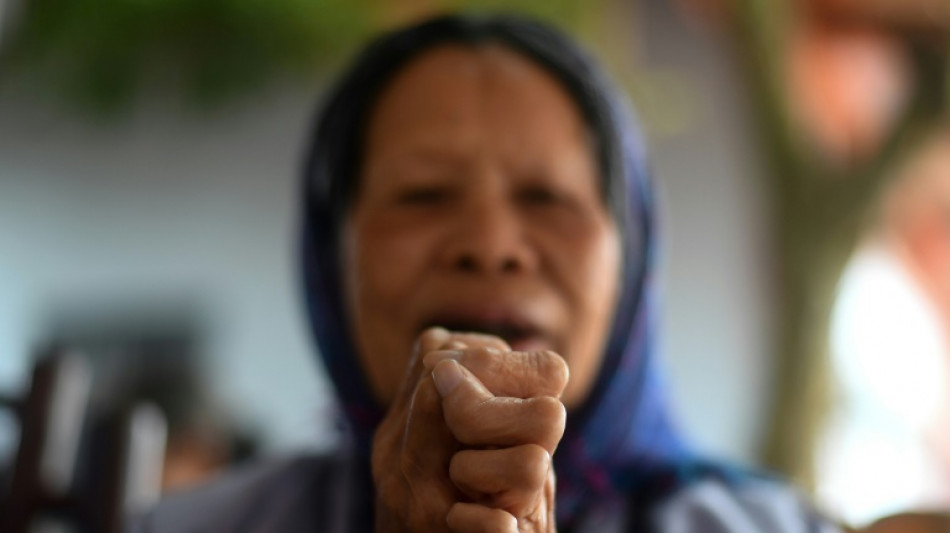
Dan Izzett has lived with leprosy's effects on his body for 70 years, and has lost much to what he calls an "ancient, fascinating, very unkind disease".
The Zimbabwean former civil engineering technician and pastor was diagnosed at the age of 25 in 1972, but first contracted the disease when he was just five.
That long incubation period gave the bacteria that causes leprosy, Mycobacterium leprae, lots of time to spread through his body.
His right leg was amputated in 1980 in Zimbabwe's capital Harare. Now 75, Izzett has no feeling above his elbows, below his knees or in 70 percent of his face.
That lack of feeling poses a "constant danger," Izzett told AFP in a phone call from his home in southwest England.
In October 2020, "I put my hands on a hot plate and hadn't noticed it until I could smell my flesh burning," he said, leading to the amputation of the middle finger of his right hand.
The following year, the little toe on his left foot was amputated. Last month, he lost another toe.
Izzett said he chose to speak out about his experience because millions of survivors who were less well off were unable to, partly because of the stigma and discrimination that still surrounds the disease.
- The 'forgotten' patients -
Leprosy, also known as Hansen's disease, has been haunting humanity for at least 4,000 years, often affecting the poorest communities.
It is a considered a neglected tropical disease by the World Health Organization, and remains under researched and little discussed compared to many other illnesses.
In 2021, more than 140,500 new cases were detected worldwide, nearly three quarters of them in Brazil, India and Indonesia, according to the WHO.
However pandemic-related disruptions have led to nearly 40 percent fewer cases being detected a year, with fears that tens of thousands have gone undiagnosed.
Even before the pandemic, the official numbers likely did not reflect reality.
"We know the number of patients who have been tested, but we do not count the forgotten, undetected patients," said Bertrand Cauchoix, a leprosy specialist at the Raoul Follereau Foundation in France.
This is in part because the disease's incubation period can last up to 20 years. Testing and diagnosis also takes time, during which patients could potentially infect their family members.
Before he received his diagnosis, said Izzett, "my wife got the disease from me".
Back in the 1970s, Izzett was given the antibiotic Dapsone, which was then a lifetime treatment.
In the mid-80s, a combination of drugs including Dapsone known as multidrug therapy (MDT) became available. It can cure leprosy over a 12-month course -- though nerve damage and other remnants of the disease remain.
Mathias Duck, a former chaplain in Paraguay's capital Asuncion, only needed six-months of MDT after being diagnosed with leprosy in 2010.
"I consider myself the luckiest person affected by leprosy because I was diagnosed and treated in time and so I have no impairments whatsoever," the 44-year-old told AFP.
The WHO provides MDT to patients worldwide for free, with Swiss pharmaceutical giant Novartis donating doses since 2000.
However there has been little progress for new treatments.
"There is no money for leprosy, only charitable donations," Cauchoix said.
- Don't use the 'L word' -
Alexandra Aubry, a specialist at the Centre for Immunology and Infectious Diseases in France, evaluates whether every new antibiotic developed for other illnesses could also be used for leprosy.
Her laboratory is one of the few in the world able to carry out tests on the leprosy bacteria, which does not survive in a petri dish.
They are trying to find a way to "simplify" treatment so it can take less than six months, she said.
There are also a couple of vaccines being developed, though they remain in early phases of human testing.
"It is very complex to get funding for this," Aubry said.
"To assess the effectiveness of a vaccine, you have to follow the vaccinated population for 10 to 15 years," with the timeframe extended further by the disease's long incubation period, she said.
In comparison to how swiftly the world responded to Covid, leprosy efforts are "a drop in the bucket," Duck said, calling for far more research and political action.
But he added that there is something everyone can do for World Leprosy Day on Sunday -- stop using the word "leper".
"We call it the 'L word'," Duck said, describing it as discriminatory.
"It's a little step that most people can do," he added, "to give people affected by leprosy "the dignity they deserve".
O.Gutierrez--AT