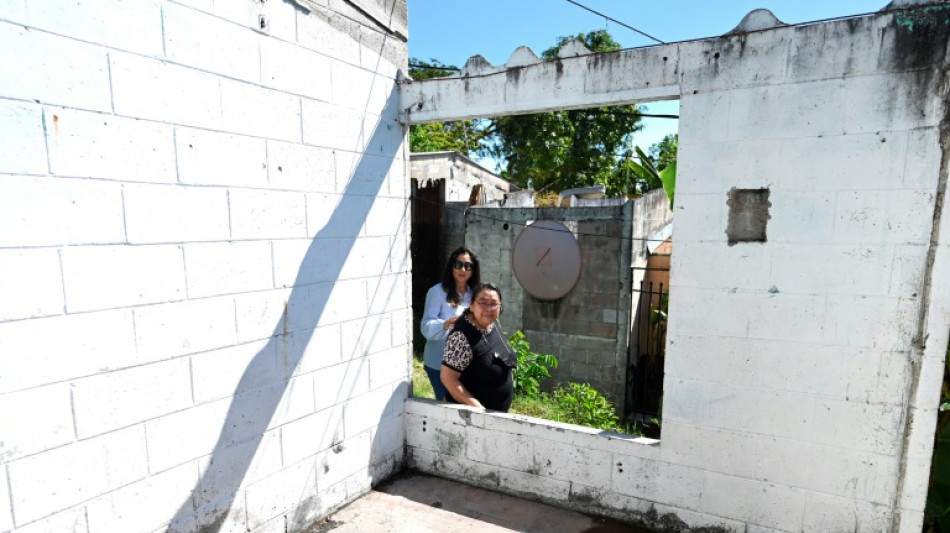
Joy as Salvador families recover homes from gang control / Photo: Marvin RECINOS - AFP

 AFP photo shows Trump examining image of Kennedy Center apparent demolition

 Andersson vows to take Sweden in 'new direction' after election win
 Turkey's Erdogan to run again in early 2028 vote, top adviser says

 Sweden's Andersson: a trusted, no-nonsense political operator

 Canada's Carney pushes 'new alliance' with EU despite Trump threats

 Ireland to boycott Eurovision 2027 over Gaza

 India's Tata Sons reappoints N. Chandrasekaran as chairman

 Sweden's left-wing wins election thriller

 Germany urges EU action against China to defend carmakers

 Stocks mostly rise after US Fed rate hike, oil eases

 Palestinians turn rugged caves into homes after Israeli demolitions
 Two unseen Monet paintings to be sold in Paris: auction house

 Klopp wants German team to help reclaim national pride from far-right

 Ninth woman found dead in South Africa killing spree

 Smog scuppers Japan force helping fight Indonesia wildfires

 King Charles to call on tech giants for 'reassurances' over AI

 Lebanon security talks in Paris focus on replacing UN mission

 Most stocks rise as Fed hikes and oil prices drop

 'Vande Mataram': Why is India's freedom song in spotlight?

 Counterculture pop artist Peter Max dies at 88: US media

 Asian Games chief defends 'functional' rooms after backlash
 Leader's sister says only 'idiots' think N. Korea to give up nukes

 World's water cycle becoming more unpredictable, UN warns

 Where the US-China tariff row stands ahead of White House summit

 Croc-habitat gets green light for 2032 Olympic rowing

For two painful decades, going home was not an option for Ana Vilma Cuellar. But at long last, the 62-year-old has recovered her house in La Campanera, a neighborhood on the outskirts of San Salvador that had been completely taken over by armed gangs.
Her husband had bought the property back in 2002, but the couple was never able to live in it.
"It's a joy," said Cuellar, who hopes to finally be able to move in soon.
"I've been through a lot," said the former textile worker. Without access to her own home, she had to rent accommodation in Ilopango, a suburb controlled by a rival gang.
The last time Cuellar tried to visit La Campanera was in 2003, but the bus she was on was shot at by gang members, and several people were injured.
Now, after years of brutal control by the Barrio 18 gang, the small working-class town feels safe again.
Cuellar's return home comes almost a year after President Nayib Bukele launched a frontal "war" against violent gangs he said had control over four fifths of the Central American country.
Up until a month and a half ago, anarchy and fear reigned in La Campanera.
Many families had abandoned their homes, which were later taken over by the Barrio 18 gang. Even municipal cleaning trucks or food delivery motorcycles could not enter the neighborhood, and many homes had illegal electricity and cable TV connections.
The situation in La Campanera was mirrored across the country, where the government estimates at least 6,000 homes had been taken over by gang members.
- Military siege -
But everything began to change on December 3, when Bukele ordered thousands of soldiers and police to surround the municipality of Soyapango, where La Campanera is located.
To escape, gang members tore through the walls of many houses and removed numbers that identified them.
As part of the crackdown launched by Bukele in March last year, El Salvador's Congress approved an emergency regime that allows detention without a warrant -- leading to the arrest of some 62,000 suspected gang members. Some 3,000 people have since been released.
On January 12, the legislature extended the state of emergency for another 30 days.
- 'Forced displacement' -
Now that most gang members have either fled La Campanera or been arrested, people are arriving daily to recover their homes. Many were built by the state social fund for housing, which is now facilitating homeowners' return.
Housing Minister Michelle Sol, who is overseeing the recovery of houses in La Campanera, said she was moved by the testimony of dozens of families who for years had been deprived of their homes.
"We are putting an end to forced displacement," Sol said.
The process of recovering homes is ongoing, with 3,400 residences in the capital San Salvador. In La Campanera, 500 homes are being returned.
"The number will continue to increase," the minister added, while inspecting a house that gang members had dismantled, ripping off its doors, windows, the roof and even the toilet.
- Young people in prison -
But the relative peace has come at a high cost in El Salvador, and human rights groups have criticized the state of emergency, citing concern about the powers it grants authorities to make arrests without warrants.
La Campanera resident Maritza Maribel Gutierrez, acknowledged that normality had returned to her neighborhood -- but also noted that there are no young people on the streets anymore.
Everyone "is being held [in prison]," Gutierrez said. Her only son, she said, was detained although he is not a gang member.
She said she hopes her son will be released soon so that he can go back to his job as a driver.
But Bukele's crackdown has widespread popular support among a population long-terrorized by gang violence -- one of the main factors driving migration out of the country.
A survey published last week by the Central American University found that at the end of last year, almost nine out of 10 Salvadorans reported feeling safe.
"Today people can go out freely," Roberto Morales, 55, who survived with his family in La Campanera during the years of gang control, told AFP.
"Everything is going well now...," he said, "the people have returned."
M.White--AT