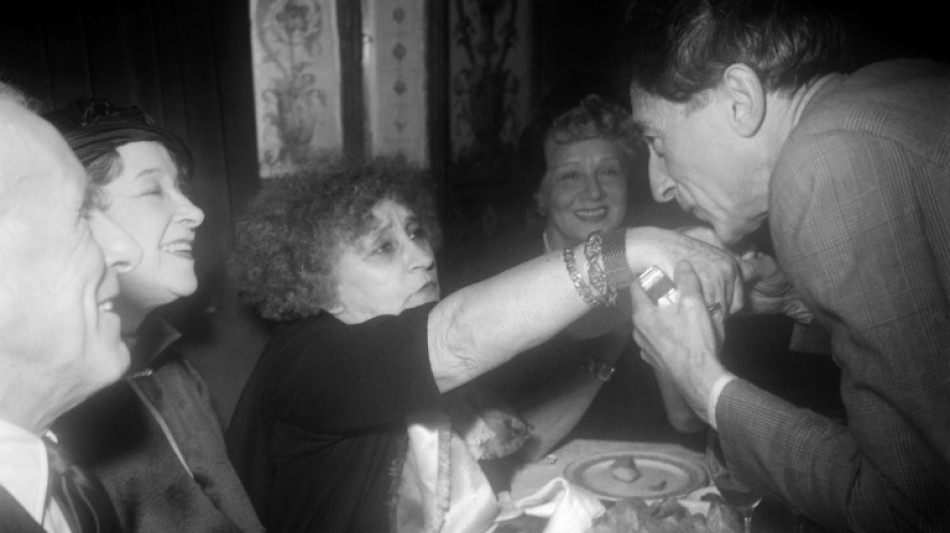
Why French novelist Colette still matters / Photo: - - AFP

 Abhishek hits record T20 ton as India post 221-7 against Afghanistan

 Macron hosts Lebanon security talks to back 'indispensable' army

 Final rally of season in Saudi Arabia cancelled due to Middle East conflict

 Gaza documentary sparks political storm in Israel

 King Charles warns tech bosses of 'existential dangers' of AI

 French fishermen block ports over petrol prices

 AFP photo shows Trump examining image of Kennedy Center apparent demolition

 Andersson vows to take Sweden in 'new direction' after election win

 Turkey's Erdogan to run again in early 2028 vote, top adviser says

 Sweden's Andersson: a trusted, no-nonsense political operator

 Canada's Carney pushes 'new alliance' with EU despite Trump threats

 Ireland to boycott Eurovision 2027 over Gaza

 India's Tata Sons reappoints N. Chandrasekaran as chairman

 Sweden's left-wing wins election thriller

 Germany urges EU action against China to defend carmakers

 Stocks mostly rise after US Fed rate hike, oil eases

 Palestinians turn rugged caves into homes after Israeli demolitions

 Two unseen Monet paintings to be sold in Paris: auction house

 Klopp wants German team to help reclaim national pride from far-right

 Ninth woman found dead in South Africa killing spree

 Smog scuppers Japan force helping fight Indonesia wildfires

 King Charles to call on tech giants for 'reassurances' over AI

 Lebanon security talks in Paris focus on replacing UN mission

 Most stocks rise as Fed hikes and oil prices drop

 'Vande Mataram': Why is India's freedom song in spotlight?

She caused a riot when she kissed her lesbian lover on stage and dared to talk about faking orgasms and domestic violence.
French novelist Colette is an icon of transgression and liberated womanhood whose work still remains bracingly relevant 150 years after her birth.
Her life and writing "resonate more than ever with our time", insisted Professor Diana Holmes of Britain's Leeds University as France prepares to mark the anniversary next week.
Colette's novels tackled fraught mother-daughter relationships, maternity, homosexuality, abortion and even menopause, long before these were considered appropriate subjects for public discussion.
But in some ways she is taken more seriously abroad these days, despite being the first woman to receive a state funeral in France in 1954.
In British and US universities, Colette has been part of the canon of French literature and feminism courses since the 1970s.
New translations of her best-known novel "Cheri" (1920) -- a love story between an older woman and a younger man -- and its sequel "The Last of Cheri" (1926), have recently been published in English.
- Reappraisal -
But back home there are signs of a reappraisal. Two of her books were for the first time included on the school curriculum this year: "Sido" (1930), an autobiographical account of her relations with her mother, and "The Tendrils of the Vine" (1908), in which she returns to her childhood village.
"The more we read her, the more we are convinced of her timelessness and especially of her modernity," French literature professor Dominique Brechemier told AFP.
This has helped make her a popular subject for cinema, from the Oscar-winning "Gigi" in 1958 through an adaption of "Cheri" with Michelle Pfeiffer in 2009 to a biopic, "Colette", in 2018 where Keira Knightley played the writer.
Her many careers -- novelist, journalist, cabaret dancer, actress -- and vivid love-life (three husbands, multiple male and female lovers) mark her out as a prototype of the modern emancipated woman.
"What fascinates is her story, her colourful life, full of transgressions," said Holmes.
Colette herself -- born Sidonie-Gabrielle Colette in rural Burgundy -- rejected the feminist label. She even famously said suffragettes (who campaigned for women's right to vote) deserved "the whip and the harem".
That may have been posturing with an eye on the bottom line, said Kathleen Antonioli of Kansas State University.
Colette was born relatively poor and could not rely on private wealth like her contemporaries Marcel Proust or Gustave Flaubert if the public and publishers turned against her,
Her actions speak louder.
"Throughout her life, she never stopped working for the freedom of women," said Brechemier.
"Let her have some complexity."
N.Mitchell--AT