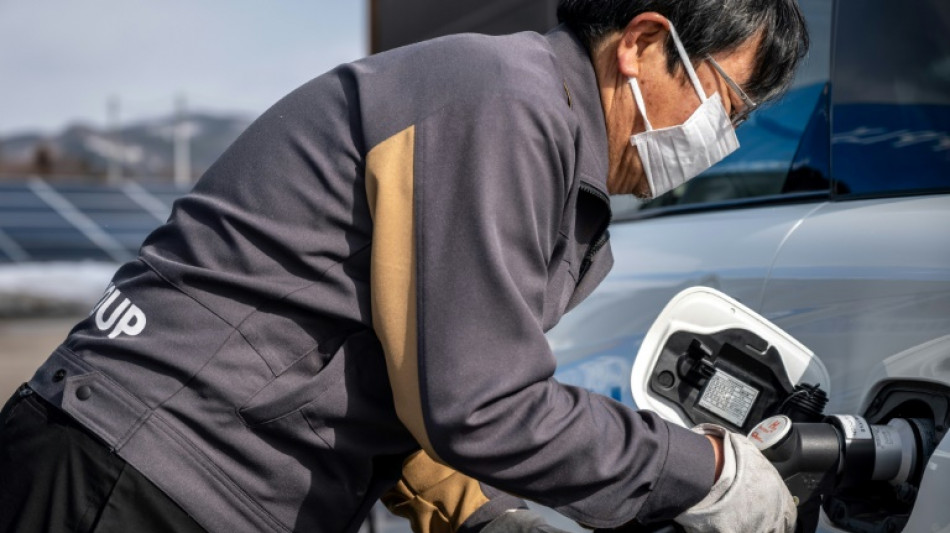
Sakhalin exception: the Russian energy Japan can't quit / Photo: Philip FONG - AFP/File

 Abhishek hits record T20 ton as India post 221-7 against Afghanistan

 Macron hosts Lebanon security talks to back 'indispensable' army

 Final rally of season in Saudi Arabia cancelled due to Middle East conflict

 Gaza documentary sparks political storm in Israel

 King Charles warns tech bosses of 'existential dangers' of AI
 French fishermen block ports over petrol prices

 AFP photo shows Trump examining image of Kennedy Center apparent demolition

 Andersson vows to take Sweden in 'new direction' after election win
 Turkey's Erdogan to run again in early 2028 vote, top adviser says
 Sweden's Andersson: a trusted, no-nonsense political operator

 Canada's Carney pushes 'new alliance' with EU despite Trump threats
 Ireland to boycott Eurovision 2027 over Gaza

 India's Tata Sons reappoints N. Chandrasekaran as chairman

 Sweden's left-wing wins election thriller

 Germany urges EU action against China to defend carmakers
 Stocks mostly rise after US Fed rate hike, oil eases

 Palestinians turn rugged caves into homes after Israeli demolitions

 Two unseen Monet paintings to be sold in Paris: auction house
 Klopp wants German team to help reclaim national pride from far-right
 Ninth woman found dead in South Africa killing spree

 Smog scuppers Japan force helping fight Indonesia wildfires
 King Charles to call on tech giants for 'reassurances' over AI

 Lebanon security talks in Paris focus on replacing UN mission

 Most stocks rise as Fed hikes and oil prices drop
 'Vande Mataram': Why is India's freedom song in spotlight?

This year's Group of Seven president Japan has joined the bloc's condemnation of Russia's Ukraine invasion, imposing sanctions and agreeing on an oil price cap, with one exception: Moscow's Sakhalin energy projects.
Sakhalin-1 and 2 in Russia's far east are an anomaly in Tokyo's otherwise lockstep efforts with allies to reduce reliance on Moscow's hydrocarbons.
It's a contradiction that Japanese officials, and some experts, feel is unavoidable for a country that is by far the least energy self-sufficient in the G7.
But others warn the decision is a "vulnerability" for Tokyo, that "undermines" its diplomacy.
Last year, Japan pledged to phase out Russian coal imports and gradually decrease its energy dependence on Moscow.
Government data released on Thursday showed that oil imports from Russia fell around 56 percent last year, while coal imports were reduced by 41 percent.
But imports of Russian liquefied natural gas (LNG) were up more than four percent in 2022.
Sakhalin-1 produces oil, while Sakhalin-2 produces both crude and LNG, and experts say access to Russian gas is what Japan is most concerned about protecting.
Last year, 9.5 percent of Japan's total LNG imports came from Russia, up from 8.8 percent in 2021 -- most of it from Sakhalin-2.
So when Japan joined a price cap on Russian oil last year with its G7 allies, the European Union and Australia, it obtained an exemption for Sakhalin-2.
And while US and British firms ExxonMobil and Shell have relinquished their stakes in Sakhalin-1 and 2 respectively, Tokyo has stayed put, even complying with new Russian rules.
It's a purely pragmatic position, said Hiroshi Hashimoto, head of the gas group at the Institute of Energy Economics.
"They are geographically so close to the country and have significant energy resources," he told AFP. "The projects were developed to diversify energy sources."
- 'Notably contradictory' -
Japan has never forgotten the oil shock of the 1970s, and energy security threats "are ingrained in the mindset of the Japanese government", said James Brown, a political science professor at Temple University's Japan campus.
The country's energy supplies would be particularly at risk "in the case of a crisis in the Middle East or in the South China Sea, through which much of Japan's energy is shipped", he added.
Still, Japan got only 1.46 percent of its oil imports from Russia in 2022, and not all came from Sakhalin.
Its main interest is protecting access to Sakhalin-2's LNG, said Yuriy Humber, founder of Japan NRG, a platform analysing energy and electricity markets in Japan.
"If you put an embargo on the oil, but the project is still producing both oil and gas... you make it very difficult on an engineering and economic basis to keep the project going," he told AFP.
The war means competition for alternatives to Russian LNG has increased, along with prices, and Japan has little storage capacity, making Sakhalin's proximity key.
"The alternatives aren't really very easy and they are very expensive," he noted, with long-term contracts recently agreed with the United States and Oman unlikely to be delivered for years.
Japanese officials frame the continued use of Sakhalin as an energy security imperative, and warn that withdrawing could see China enter the projects.
But Brown believes the projects are a "vulnerability" that leave Japan at risk of retaliation from Moscow.
"The Russian government has been very clear that they view Japan as an 'unfriendly state'," he said.
"There is every reason to think that they could also manipulate exports from the Sakhalin projects to retaliate against Japan."
Several eastern European countries have secured exemptions to the bloc's oil ban and price cap, but as this year's G7 president, Japan's Sakhalin exception stands out.
"The decision to keep stakes in Sakhalin-1 and 2, and exempt its actions from the G7 oil price cap, is notably contradictory," Wrenn Yennie Lindgren, a researcher for the Norwegian and Swedish Institutes of International Affairs, told AFP.
It "undermines the moral and values-based diplomacy that it is pledging to strengthen during its (G7) presidency", she added.
But Japan NRG's Humber believes Japan has little alternative.
"You can only afford to be moral when you have a pragmatic solution."
M.O.Allen--AT