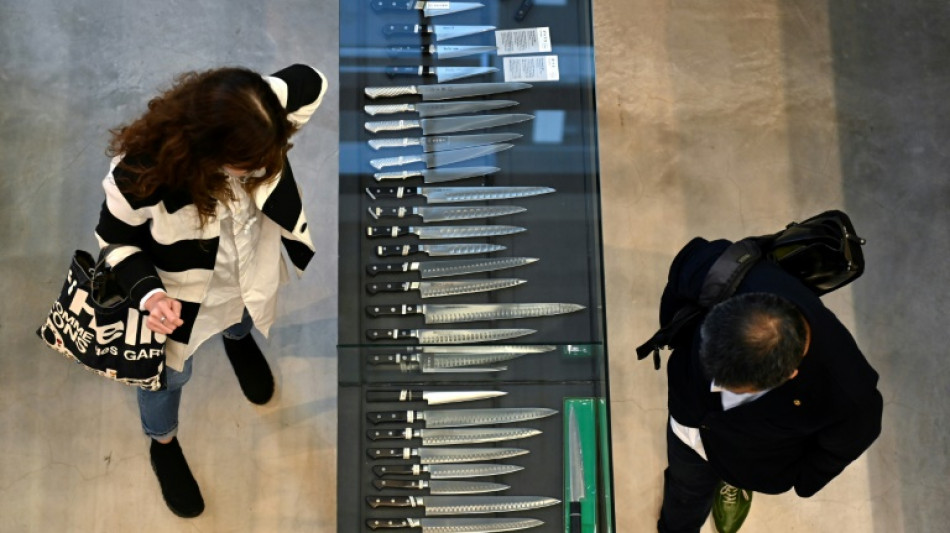
'Can't keep up': pandemic cooking boom sharpens Japan knife sales / Photo: Kazuhiro NOGI - AFP

 Oversight Board blasts 'inadequate' Meta safeguards for AI deepfakes

 The Easter Island origins of buzzy Malkovich drama 'Wild Horse Nine'

 Third body recovered after Grand Canyon flash flood

 Harry makes first public appearance since return to UK

 Abhishek hits record T20 ton as India sweep series 3-0

 Abhishek hits record T20 ton as India sweep T20 series 3-0

 English FA calls for Infantino to release World Cup sell-off documents

 GM delivers first components for US interceptor missiles

 Trump admin overhauls key protection for endangered species

 Abhishek hits record T20 ton as India post 221-7 against Afghanistan

 Macron hosts Lebanon security talks to back 'indispensable' army

 Final rally of season in Saudi Arabia cancelled due to Middle East conflict

 Gaza documentary sparks political storm in Israel

 King Charles warns tech bosses of 'existential dangers' of AI

 French fishermen block ports over petrol prices

 AFP photo shows Trump examining image of Kennedy Center apparent demolition

 Andersson vows to take Sweden in 'new direction' after election win

 Turkey's Erdogan to run again in early 2028 vote, top adviser says

 Sweden's Andersson: a trusted, no-nonsense political operator

 Canada's Carney pushes 'new alliance' with EU despite Trump threats
 Ireland to boycott Eurovision 2027 over Gaza

 India's Tata Sons reappoints N. Chandrasekaran as chairman

 Sweden's left-wing wins election thriller

 Germany urges EU action against China to defend carmakers

 Stocks mostly rise after US Fed rate hike, oil eases

In a Japanese city once famous for forging samurai swords, craftsmen sharpen and polish kitchen knives, but even at full tilt their small factory can't keep up with global demand.
The export value of knives and other bladed tools like scissors hit a record high in Japan last year, partly thanks to a home-cooking boom sparked by the pandemic.
Japanese knives are also winning more converts among aspiring and professional chefs, who prize their delicate precision, sleek finish and long lifespan.
Katsumi Sumikama, head of Sumikama Cutlery in the central city of Seki, puts the popularity down to a "combination of technology and traditional craftsmanship".
To achieve the formidably sharp edge needed to make perfect sushi or cut precise slices of Wagyu beef, the company uses machines that guarantee accuracy to one-thousandth of a millimetre, then artisans finish the job by hand.
But even at full capacity, "we can't keep up", Sumikama told AFP.
"We're seeing demand stronger than pre-pandemic levels in all countries."
Seki's renowned blade expertise dates back to the 14th century, when the city became a major producer of swords thanks to its rich natural environment.
"The clean water, charcoal and raw materials were ideal for sword-making," Sumikama said.
High-quality iron made from ironsand was forged into a tough sword by folding red-hot metal multiple times, and moulded into a curved shape by plunging it into cool water.
When samurai were ordered to abandon their swords in 1876, the industry faltered, but after World War II the city began producing pocket knives for export.
Business boomed at first, with the fixed yen-to-dollar rate a boon for mass exports to the United States.
But when that policy ended in the 1970s and China began making cheaper products, Japan could no longer compete.
- 'Truly worldwide' -
"There were difficult times," Sumikama said.
"Seki's blade-makers decided they needed a new direction."
At the time, German products, including knives by Zwilling, dominated the market for high-end knifeware, and luxury Japanese offerings were few and far between.
In the 1990s, Sumikama went all in -- launching a full line-up of top-of-the-range kitchen knives that cost up to several hundred dollars each.
To emphasise their made-in-Japan pedigree, his company adds a wavy two-tone finish to the metal that evokes the traditional appearance of samurai blades, and a kanji-character logo.
Despite their elegant appearance, Sumikara said he faced scepticism from both within and outside the company that his expensive knives would sell.
"We were trapped in the idea that Japanese products... would not be accepted by consumers unless they were cheaper than German products," he said.
But the line was a success and the company now sells their luxury knives in more than 50 countries.
The export value of kitchen bladed tools hit a record 12 billion yen ($90 million) in 2021, a 30 percent jump from around nine billion yen the previous year, according to Japan Customs.
French chef Olivier Oddos, whose Tokyo restaurant boasted a Michelin star between 2014 and 2021, has been a devotee for more than two decades.
Japanese kitchen knives now have a "truly worldwide" reputation, he told AFP in his restaurant's small kitchen.
"I know a lot of French chefs who have come to Japan, and every time they buy Japanese knives. Sometimes they even buy them for their whole team," he said.
- 'Essence of the knife' -
Oddos says the formidable sharpness of the Japanese blades makes all the difference.
"It cuts perfectly. It cuts straight. It's regular," he said, adding it "changes the quality of the cooking".
Japanese knives have to be maintained regularly with sharpening stones, but "if you take good care of them, they have a pretty exceptional lifespan", Oddos said.
Daisuke Kumazawa owns Kama-Asa, a shop that has operated on Tokyo's famous Kappabashi kitchenware street for over a century.
He says Japanese knives have exploded in popularity overseas in the last decade along with a growing interest in Japanese food.
Chefs want quality blades to do "delicate work", he said.
The products are so popular that he opened a Paris branch four years ago.
But he has also noted a pandemic rise in interest.
"Probably because they were at home more often, more people wanted to take time to cook, and cook better," he said.
At Kama-Asa, assistants explain dozens of different knives to a steady stream of Japanese and foreign customers.
Kumazawa wants buyers to think about Japanese knives as more than a simple kitchen tool.
"We want them to know why they are good -- the essence of the knife, the thoughts of the craftspeople behind the knife."
A.Taylor--AT