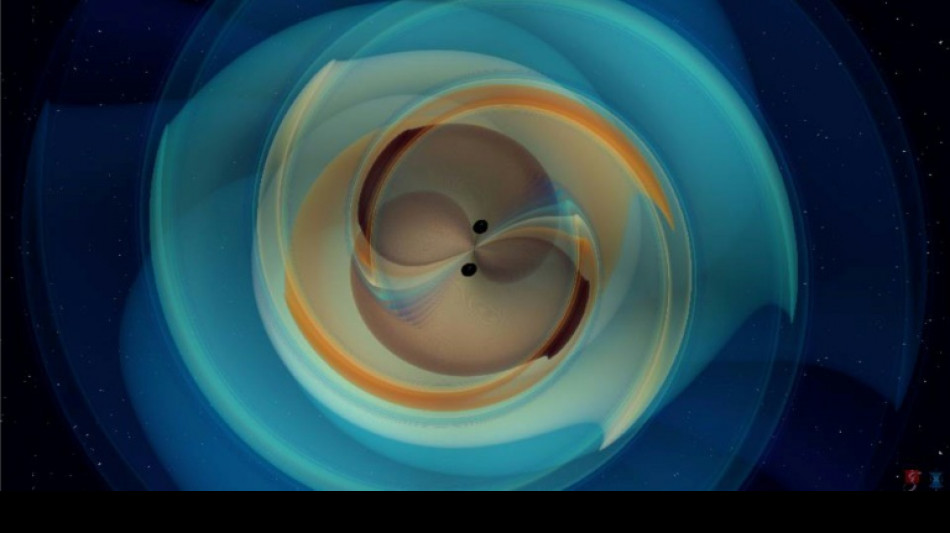
Rate of scientific breakthroughs slowing over time: study / Photo: N. Fischer, H. Pfeiffer, A. Buonanno - MAX PLANCK INSTISTUTE FOR GRAVITATIONAL PHYSICS/AFP/File

 Oversight Board blasts 'inadequate' Meta safeguards for AI deepfakes

 The Easter Island origins of buzzy Malkovich drama 'Wild Horse Nine'

 Third body recovered after Grand Canyon flash flood

 Harry makes first public appearance since return to UK

 Abhishek hits record T20 ton as India sweep series 3-0

 Abhishek hits record T20 ton as India sweep T20 series 3-0

 English FA calls for Infantino to release World Cup sell-off documents

 GM delivers first components for US interceptor missiles

 Trump admin overhauls key protection for endangered species

 Abhishek hits record T20 ton as India post 221-7 against Afghanistan

 Macron hosts Lebanon security talks to back 'indispensable' army

 Final rally of season in Saudi Arabia cancelled due to Middle East conflict

 Gaza documentary sparks political storm in Israel

 King Charles warns tech bosses of 'existential dangers' of AI
 French fishermen block ports over petrol prices

 AFP photo shows Trump examining image of Kennedy Center apparent demolition

 Andersson vows to take Sweden in 'new direction' after election win

 Turkey's Erdogan to run again in early 2028 vote, top adviser says

 Sweden's Andersson: a trusted, no-nonsense political operator

 Canada's Carney pushes 'new alliance' with EU despite Trump threats

 Ireland to boycott Eurovision 2027 over Gaza

 India's Tata Sons reappoints N. Chandrasekaran as chairman

 Sweden's left-wing wins election thriller

 Germany urges EU action against China to defend carmakers

 Stocks mostly rise after US Fed rate hike, oil eases

The rate of ground-breaking scientific discoveries and technological innovation is slowing down despite an ever-growing amount of knowledge, according to an analysis released Wednesday of millions of research papers and patents.
While previous research has shown downturns in individual disciplines, the study is the first that "emphatically, convincingly documents this decline of disruptiveness across all major fields of science and technology," lead author Michael Park told AFP.
Park, a doctoral student at the University of Minnesota's Carlson School of Management, called disruptive discoveries those that "break away from existing ideas" and "push the whole scientific field into new territory."
The researchers gave a "disruptiveness score" to 45 million scientific papers dating from 1945 to 2010, and to 3.9 million US-based patents from 1976 to 2010.
From the start of those time ranges, research papers and patents have been increasingly likely to consolidate or build upon previous knowledge, according to results published in the journal Nature.
The ranking was based on how the papers were cited in other studies five years after publication, assuming that the more disruptive the research was, the less its predecessors would be cited.
The biggest decrease in disruptive research came in physical sciences such as physics and chemistry.
"The nature of research is shifting" as incremental innovations become more common, senior study author Russell Funk said.
- Burden of knowledge -
One theory for the decline is that all the "low-hanging fruit" of science has already been plucked.
If that were the case, disruptiveness in various scientific fields would have fallen at different speeds, Park said.
But instead "the declines are pretty consistent in their speeds and timing across all major fields," Park said, indicating that the low-hanging fruit theory is not likely to be the culprit.
Instead, the researchers pointed to what has been dubbed "the burden of research," which suggests there is now so much that scientists must learn to master a particular field they have little time left to push boundaries.
This causes scientists and inventors to "focus on a narrow slice of the existing knowledge, leading them to just come up with something more consolidating rather than disruptive," Park said.
Another reason could be that "there's increasing pressure in academia to publish, publish, publish, because that's the metric that academics are assessed on," he added.
The researchers called on universities and funding agencies to focus more on quality, rather than quantity, and consider full subsidies for year-long sabbaticals to allow academics to read and think more deeply.
"We're not getting any less innovative as a species," Park emphasised, pointing to recent breakthroughs such as the use of mRNA technology in Covid-19 vaccines, or the measurement of gravity waves in 2015.
Jerome Lamy, a historian and expert in the sociology of science at France's CNRS research agency, who was not involved in the research, said it showed that "ultra-specialisation" and the pressure to publish had increased over the years.
He blamed a global trend of academics being "forced to slice up their papers" to increase their number of publications, saying it had led to "a dulling of research."
T.Perez--AT