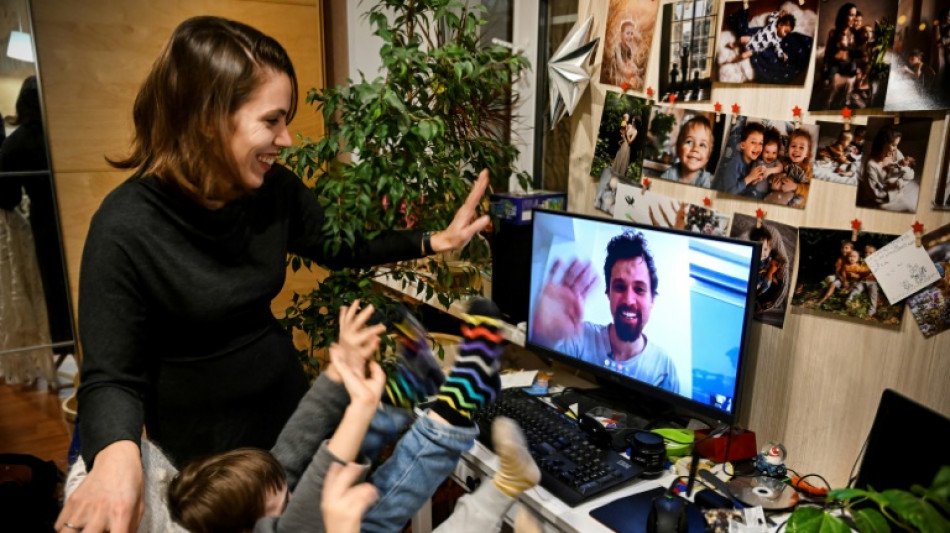
'It all fell on me': Russian mothers alone as draft exiles dads / Photo: Alexander NEMENOV - AFP

 South Korea makes Asian Games complaint over Japan warlord ceremony

 US aid cuts are killing Kenyan sex workers

 October 7 survivors, families take centre stage in Israel vote
 Captain Mat Ryan axed from Socceroos squad for Brazil games

 US approves sale of 48 F-35 jets to Saudi Arabia
 Juventus, Palace cruise to Europa League wins, Bournemouth beat Sociedad

 Stocks climb as oil retreats, Fed calms inflation fears

 Russians begin voting in controlled election as war drags

 Hispanics feel 'betrayed' on immigration, Republican warns Trump

 High-scoring Bears face Vikings in battle of NFL unbeatens

 'In our lane': Fed's Warsh defies Trump but still fighting for credibility
 Trump admin makes major cut to endangered species protections

 Princess Diana's brother makes new explosive claims against Charles

 Ovechkin on Russian political video: 'I support my country'
 Can we shut down AI?
 Teenager Sullivan named in new-look US squad
 Travis Scott and Keith Richards feature on GTA VI soundtrack

 AFP photo shows Trump examining image of apparent Kennedy Center razing
 Pochettino rings changes for USA friendlies
 Alonso says Chelsea ambition 'very clear' after end of Boehly era

 Mbappe draws political fire over Ceuta t-shirt controversy
 Third malaria death in Germany from outbreak tied to Frankfurt airport

 AtlasClear Holdings Reports Preliminary Fiscal 2026 Revenue of Approximately $20.1 Million, Up 85%; Revenue Plus Interest Income of Approximately $21.9 Million

 Alonso says Chelsea ambition clear after end of Boehly era
 Micron's Taiwan workers say 68 months' bonus not enough
Wrapped up in brightly coloured snowsuits, Yekaterina Filimonova cycles through Moscow's snow-blanketed streets with her three sons to their nursery.
Her husband used to drop them off but not anymore. Now living in exile abroad, he fled after President Vladimir Putin announced in September that Russian men were being drafted en masse to fight in Ukraine.
"He left and I got sick the next day. I was so stressed I didn't recover for a month," Filimonova, 34, told AFP.
Days after the call-up her husband Yaroslav Leonov grabbed his bike, took a train 1,500 kilometres (930 miles) to a city close to neighbouring Kazakhstan and cycled over the border.
"He didn't want to leave us," Filimonova said.
But she is not the only one facing the new burden of raising children alone. The chaotic and hurried exodus of tens of thousands of military-aged men has torn apart families and piled pressure on mothers across Russia.
There are no figures on the numbers of families impacted, but one nursery employee in Moscow told AFP on the condition of anonymity that around a third of the fathers in one group were abroad.
"The first month was very sad of course. It was very hard for me and it was hard for the kids," Filimonova said.
"When I'm upset, they get hysterical, they cry and they cry at night. And I realised that I have to pull myself together."
- Looking to history -
The splintering in her family has got her thinking about her grandmother, who was separated from her geologist husband when he was sent to Mongolia for work.
"I'm beginning to understand how she felt," Filimonova said. "I'd never thought about it before."
Now in the Serbian capital Belgrade -- a hub for exiled Russian IT workers -- Leonov is struggling too.
The software developer saw no other choice than to leave Russia in September, fearing he could be drafted.
"I didn't want to play Russian roulette," he said. "Most likely, you'll win but there's a small chance of quite a dramatic end."
In Belgrade, he reunited with an old maths teacher who left Russia shortly after Putin sent troops to Ukraine on February 24. They are now renting an apartment together.
But the relief of being safe has not eased the pain of separation.
"Remote children are not the same as remote colleagues," he said, half-joking. "You cannot play with children remotely."
In their cosy family apartment in Moscow, Filimonova gathers her sons so their father can read them a bed-time story in a video call.
She sent him photos of pages to read, while their young offspring hold the book, making faces at the computer.
"I hope my children understand that their daddy is here, he loves them -- even from Belgrade," he told AFP.
Russia announced the end of mobilisation in late October but many abroad fear a second wave and Yaroslav sees "risks" in returning.
He is also questioning if there's "even anything to return to", with authorities imposing controls over the tech sector and "all aspects of reality."
- 'Life and death' choice -
Anastasia Arsenicheva, co-founder of a charity supporting mothers, said her organisation received a surge in calls after the mobilisation.
She said many women encouraged partners to leave, seeing it as a "choice between life and death", but now are struggling.
"When a woman is in a vacuum completely alone, this is very scary," Arsenicheva, a psychologist, said.
IT workers like Leonov can still support their families from abroad but this isn't always the case, Arsenicheva added.
"There are some families where the man was the main breadwinner and it's unclear how to support your life now," she said.
Alexandra, a 32-year-old full-time mother in Moscow, had to quickly find a way to get by after her husband, who works in cinema and advertising, left.
He first went to a small mountainous city in ex-Soviet Tajikistan and then onwards to neighbouring Uzbekistan, which has also become a centre for men evading the draft.
Alexandra previously did the occasional freelance knitting project that would cover the odd food shop while she looked after her seven-year-old daughter.
"When he left, it all fell on me," she said, "and the family budget fell apart."
She began to take on more projects and recently received an order to make more than 200 toys for the New Year, allowing her to employ several other women. She has also been restoring furniture and reselling it online.
She said she had "forgotten how to be self-sufficient... but when the guys left, we just had no choice!"
While she said she understood the decision of many men to leave -- and even though the family's future is uncertain -- she is determined to stay put.
"I'm from Russia. I want to live in Russia. I never wanted to leave."
P.Smith--AT