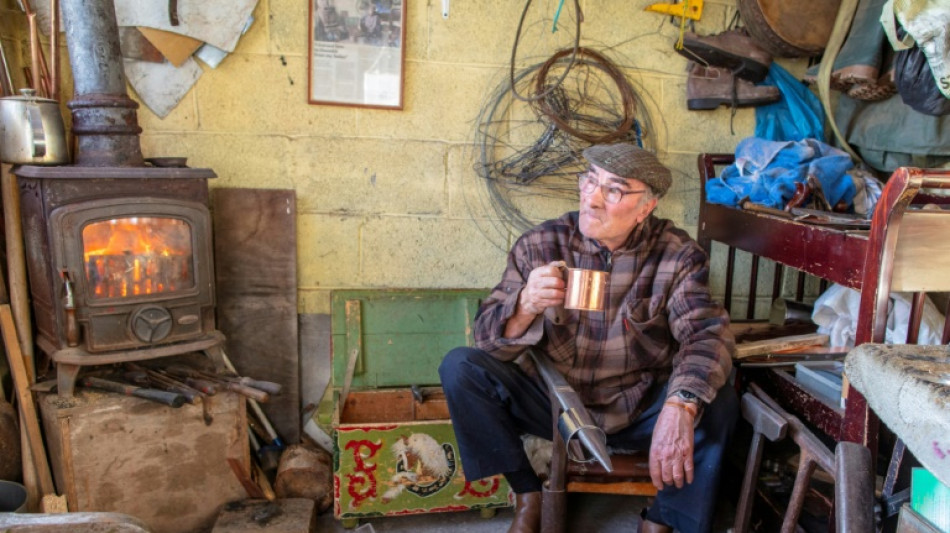
One of Ireland's last Traveller tinsmiths mourns lost way of life / Photo: Paul Faith - AFP

 Real Madrid fan group wants Mbappe apology over Ceuta shirt snub

 Nepal floods among 'most challenging' disasters: WFP

 Doubts as Italy eyes electric future for steel plant
 'One of the kindest people': Taraneh, 21, facing execution in Iran
 Japan eyes changing prostitution law to punish sex buyers
 After record rain, typhoon threatens new challenge to Asian Games
 Kids and social media: what would change under new EU law
 Modi pitches India as global chipmaking hub
 Ukraine plans record defence spending in 2027

 Klopp calls up 44 players in huge first Germany squad

 STARPRIME Responds to Diverging Gold Market Demand with AM/PM Fixing and XAU24/7

 Ukrainian fashion designer debuts art between air raids
 Gambian businesses struggle under prolonged blackouts
 Fiji declares national HIV crisis

 Australia to cut migration to fix housing crisis: minister

 NASA scan discovers new, 'once in a century' Moon crater

 Most stocks rise as Fed hikes and indicates drive to curb inflation
 US again denies Palestinian leader Abbas visa to attend UN assembly
 Lula says he will go to UN to tell Trump to 'stay out' of Brazil's elections
 Messi heads Inter Miami to Campeones Cup triumph
 AI looms large ahead of Xi, Trump summit

 Smith still haunted by 'Sandpapergate' as he prepares for South Africa Tests
 UK-Sudanese author pens book to give children 'African history of Africa'

 Boehly and Walter sell Chelsea stake to Clearlake Capital

 Banyan Gold Intersects 1.05 g/t Gold over 52.8 metres and Bonanza-Grade Gold at Powerline Deposit, AurMac, Yukon, Canada

Warmed by a wood-burning stove and thinking of the past, James Collins often works with tin late into the evening, the passing of time punctuated by the steady tap of his hammer.
Collins, 73, is one of Ireland's last remaining Traveller tinsmiths, a traditional craft passed from generation to generation which now has all but died out.
"My father done it and his father before him done it," Collins told AFP in his Dublin workshop.
"There was hundreds of tinsmiths. Nearly every Traveller was a tinsmith. There's only two tinsmiths that's left."
Collins grew up in a nomadic culture practised by Ireland's Traveller ethnic minority that is itself little more than a memory.
He was born in a tent by the side of the road in the Irish midlands in 1949.
In a time of deep deprivation even for Ireland's settled communities, Collins lived with his family on the road until his mid-twenties.
He learnt tinsmithing from his father when he was 14, swapping the buckets, mugs and the wire-handled cooking pots or billycans he made for food.
The family also offered casual labour on the land, working at the same locations seasonally.
"It was a good life but it was a hard life," Collins said. "You'd hate the winter time of the year with the cold, frost and snow.
"But you wouldn't pass much heed to it because you were brought up with it."
- Roots -
Collins set down roots in the 1970s, moving to a Traveller housing scheme in Avila Park in northwest Dublin where he raised a family.
Most Travellers living in the Republic of Ireland now live in a permanent location, according to European Union research.
Those who do travel tend to do so only in the summer.
When he arrived, Collins said the few houses on the estate were surrounded by fields on every side.
Now the scheme, a cramped cul-de-sac of four adjoining streets, is hemmed in by walls and fences topped with spikes and barbed wire.
The move gave Collins' children the chance to learn to read and write and have the formal education he never had.
In the 1970s the tin items Collins made were replaced with plastic and what little could be earned from the craft disappeared.
"I have five sons and none of them are interested in the tinsmithing because there's (no money) to be made out of it," he said.
Alone in his workshop with his father's antique tools, the tinsmith says the craft now is little more than a hobby and he thinks of the past often as a happier time.
"There's not a day that passes, it always goes through (my) mind. Because you knew so many settled people and settled people knew you," Collins said.
"We used to camp outside their gates and there was no problem or no hassle."
- Prejudice -
But discrimination against Travellers and friction with the settled communities is centuries old in Ireland, according to Collins' nephew Martin Collins, who is director of Pavee Point Traveller and Roma Centre.
"It's very well documented that Travellers continue to be... one of the most persecuted groups in Irish society," he explained.
According to census data, there were 30,987 Travellers in Ireland in 2016 representing 0.7 percent of the general population.
But despite recognition as a distinct ethnic minority since 2017, Travellers still face obstacles in virtually every area of life.
"(Travellers) experience discrimination and racism... in the education system in accessing employment and accessing accommodation, healthcare, and support," said Martin Collins.
EU research in 2019 showed Irish Travellers experience some of the worst deprivation and discrimination of any minority group in the bloc.
Martin Collins said that while state rhetoric was for pluralism, there remained a "subtext when it comes to Travellers defining my people as backward, as uncivilised".
- Mental health -
The challenge facing the community has been underlined in recent years by a growing mental health crisis.
A 2021 Irish parliament report showed suicide accounted for 11 percent of Traveller deaths -- seven times higher for Traveller men and six times higher for Traveller women than the general population.
Geraldine McDonnell, a mental health worker with Pavee Point, said the deaths touch every part of the tight-knit Traveller community.
"We see, unfortunately, a lot of families would have multiple suicides within that family."
Pavee Point has launched an online service to give Traveller-tailored mental health advice, especially to children.
But Martin Collins says discrimination is the root cause of the crisis.
"We need to create conditions where Travellers can be proud and confident of their Traveller identity."
E.Rodriguez--AT