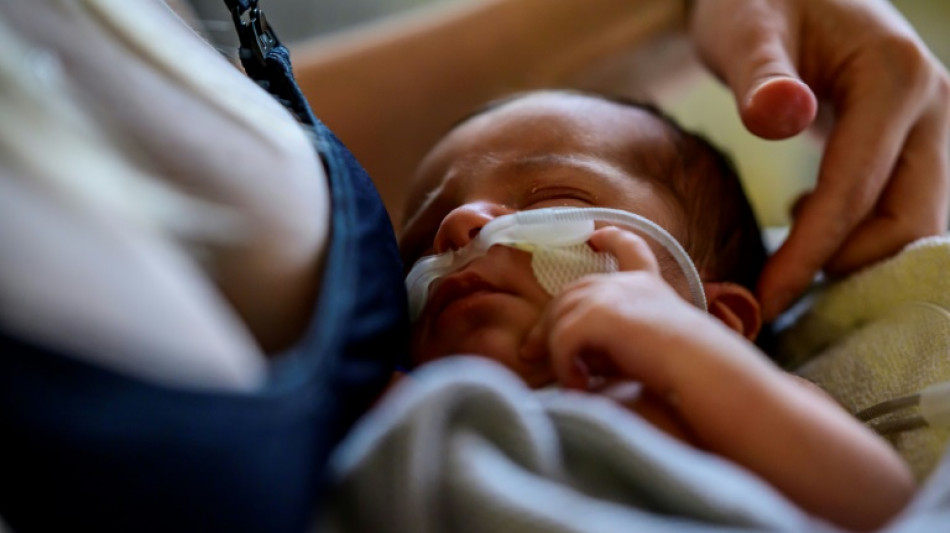
'No space': German hospitals overwhelmed by sick kids / Photo: John MACDOUGALL - AFP

 Real Madrid fan group wants Mbappe apology over Ceuta shirt snub

 Nepal floods among 'most challenging' disasters: WFP

 Doubts as Italy eyes electric future for steel plant
 'One of the kindest people': Taraneh, 21, facing execution in Iran

 Japan eyes changing prostitution law to punish sex buyers
 After record rain, typhoon threatens new challenge to Asian Games

 Kids and social media: what would change under new EU law

 Modi pitches India as global chipmaking hub
 Ukraine plans record defence spending in 2027

 Klopp calls up 44 players in huge first Germany squad

 STARPRIME Responds to Diverging Gold Market Demand with AM/PM Fixing and XAU24/7

 Ukrainian fashion designer debuts art between air raids

 Gambian businesses struggle under prolonged blackouts
 Fiji declares national HIV crisis
 Australia to cut migration to fix housing crisis: minister

 NASA scan discovers new, 'once in a century' Moon crater

 Most stocks rise as Fed hikes and indicates drive to curb inflation

 US again denies Palestinian leader Abbas visa to attend UN assembly
 Lula says he will go to UN to tell Trump to 'stay out' of Brazil's elections

 Messi heads Inter Miami to Campeones Cup triumph

 AI looms large ahead of Xi, Trump summit

 Smith still haunted by 'Sandpapergate' as he prepares for South Africa Tests

 UK-Sudanese author pens book to give children 'African history of Africa'

 Boehly and Walter sell Chelsea stake to Clearlake Capital

 Banyan Gold Intersects 1.05 g/t Gold over 52.8 metres and Bonanza-Grade Gold at Powerline Deposit, AurMac, Yukon, Canada

When Debora Zilz rushed her baby son Andreas to a Berlin hospital because of a serious respiratory illness, she got a shock.
"There was no space," she recalled. Medics desperately rang other hospitals in the German capital and neighbouring Brandenburg state in an effort to find a bed for the 13-day-old.
"Finally, after a night in the accident and emergency department, we were able to stay here," said the 33-year-old mother.
Her son, whose weight at one point dropped to below his birth weight of 3.1 kilos (6.8 pounds) before recovering, is now in intensive care.
The baby is battling bronchiolitis, as Germany faces a winter wave of cases of the chest infection in infants, putting already strained hospitals under extra pressure.
After two years of the coronavirus pandemic which brought measures like face mask-wearing that shielded the country's youngest from exposure to respiratory viruses, several European countries are seeing a surge in bronchiolitis.
The situation is particularly bad in 2022 as newborns and infants are exposed to the respiratory syncytial virus (RSV), which commonly causes bronchiolitis, for the first time.
The paediatric care team at Saint Joseph's in Berlin, where the youngster was being treated, is struggling to handle the surge with a smaller number of staff than ever before.
"We are underwater," Beatrix Schmidt, head of the hospital's paediatric and neonatology department, told AFP.
A perfect storm of factors have contributed to the problem, Schmidt said -- "an incredible number of sick children, infected caregivers, and all that at the same time as chronic staff shortages".
- 'Children pay the price' -
In the down-at-heel neighbourhood of Tempelhof, close to central Berlin, Saint Joseph's normally has 80 beds for sick children. But due to staff shortages, only 51 can currently be used.
Even in the intensive care unit, beds have had to be closed -- and all 18 that remain are occupied.
As in Andreas's case, medics are frequently finding they have no space for new patients and have to call around to other hospitals.
Many sick children have even had to be transported by helicopter to regions further afield, such as the northeastern state of Mecklenburg-West Pomerania, and the coastal state of Lower Saxony.
According to figures from the Robert Koch health institute, 9.5 million people in Germany were last week affected by some sort of respiratory illness, across all age groups, in a country of 84 million.
The figure is well above that during the same period in 2021, and is higher than at the peak of the 2017-18 flu epidemic.
Schmidt believes many problems are caused by cost-cutting.
"For years, we have made savings when it comes to our health system. And children are the first to pay the price," said the 63-year-old.
- Low salaries, underinvestment -
Currently there are 18,000 hospital beds for children in Germany, down from 25,000 in 1995, according to the federal statistics agency.
Germany, with an ageing population and fewer children than even many of its European neighbours, has been investing little in paediatric care, according to Schmidt.
Children "don't vote and we don't make money treating kids", she said.
Health care reforms aimed at reducing costs have been particularly damaging for paediatric care, while medical professions are struggling to attract new entrants, critics say.
"Many paediatricians are going to retire in the coming years," said Schmidt, who is herself preparing to leave her position.
The younger generation want to combine work and family, a challenge in a profession that often requires long and unpredictable hours, she said.
And in an affluent country like Germany, salaries of caregivers often leave a lot to be desired.
"In my opinion, they are underpaid," said Schmidt. "They work a lot -- at nights, on weekends."
A.Taylor--AT