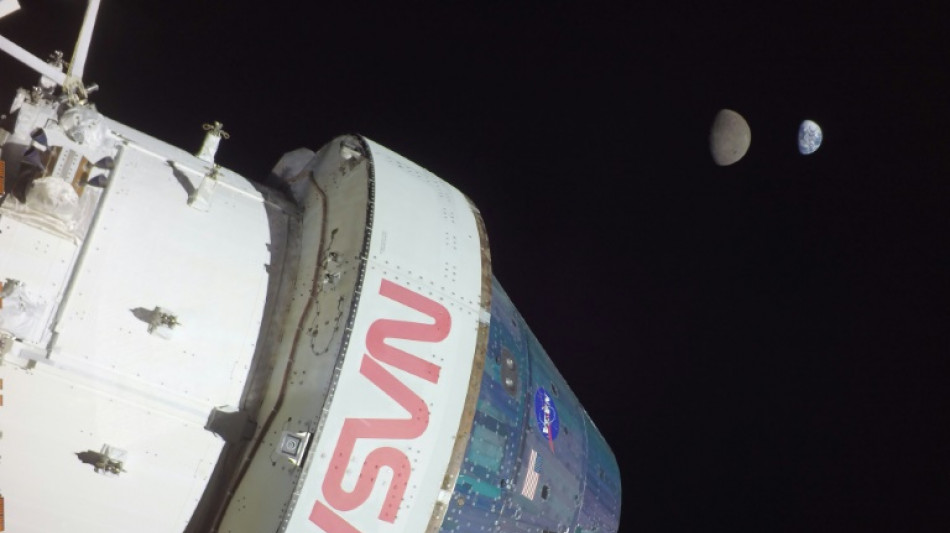
NASA Moon capsule Orion due to splash down after record-setting voyage / Photo: Handout - NASA/AFP

 Ukrainian fashion designer debuts art between air raids

 Gambian businesses struggle under prolonged blackouts

 Fiji declares national HIV crisis

 Australia to cut migration to fix housing crisis: minister

 NASA scan discovers new, 'once in a century' Moon crater

 Most stocks rise as Fed hikes and indicates drive to curb inflation
 US again denies Palestinian leader Abbas visa to attend UN assembly

 Lula says he will go to UN to tell Trump to 'stay out' of Brazil's elections

 Messi heads Inter Miami to Campeones Cup triumph

 AI looms large ahead of Xi, Trump summit

 Smith still haunted by 'Sandpapergate' as he prepares for South Africa Tests

 UK-Sudanese author pens book to give children 'African history of Africa'

 Boehly and Walter sell Chelsea stake to Clearlake Capital

 US House backs data center power cost bill amid midterm backlash

 US Congress passes sweeping Russia sanctions bill

 Barca hit Racing for seven as Atletico crush Osasuna

 US Fed raises rates to tackle 'too high' inflation, irking Trump

 Man Utd misery mounts after League Cup collapse against Brighton

 Turkey releases 106 protesters, jails more LGBTQ activists

 US Fed raises rates to tackle 'too high' inflation in move sure to rile Trump

 England were 'waiting for death' in World Cup semi-final defeat: Tuchel

 NFL star fined for displaying name of slain Palestinian girl

 Witsel retires from internationals after 18-year Belgium career

 US Fed raises rates to battle inflation in move likely to rile Trump

 Fitzpatrick 'not comfortable' over Dubai golf finale

After making a close pass at the Moon and venturing further into space than any previous habitable spacecraft, NASA's Orion capsule is due to splash down Sunday in the final test of a high-stakes mission called Artemis.
As it hurtles into Earth's atmosphere at a speed of 25,000 miles (40,000 kilometers) per hour, the gumdrop-shaped traveler will have to withstand a temperature of 2,800 degrees Centigrade (5,000 Fahrenheit) -- about half that of the surface of the sun.
Splashdown in the Pacific off the Mexican island of Guadalupe is scheduled for 1739 GMT (9:39 am local time).
Achieving success in this mission of just over 25 days is key for NASA, which has invested tens of billions of dollars in the Artemis program due to take people back to the Moon and prepare for an onward trip, someday, to Mars.
So far the first test of this uncrewed spacecraft has gone very well.
But it is only in the final minutes of this voyage that the true challenge comes: seeing if Orion's heat shield, the biggest ever built, actually holds up.
"It is a safety-critical piece of equipment. It is designed to protect the spacecraft and the passengers, the astronauts on board. So the heat shield needs to work," said Artemis mission manager Mike Sarafin.
A first test of the capsule was carried out in 2014 but that time the capsule stayed in Earth's orbit, so it came back into the atmosphere at a slower speed of around 20,000 miles per hour.
- Choppers, divers and boats -
A US Navy ship, the USS Portland, has been positioned in the Pacific to recover the Orion capsule in an exercise that NASA has been rehearsing for years. Helicopters and inflatable boats will also be deployed for this task.
The falling spacecraft will be slowed first by the Earth's atmosphere and then a web of 11 parachutes until it eases to a speed of 20 miles (30 kilometers) per hour when it finally hits the blue waters of the Pacific.
Once it is there, NASA will let Orion float for two hours -- a lot longer than if astronauts were inside -- so as to collect data.
"We'll see how the heat soaks back into the crew module and how that affects the temperature inside," said Jim Geffre, NASA's Orion vehicle integration manager.
Divers will then attach cables to Orion to hoist it onto the USS Portland, which is an amphibious transport dock vessel, the rear of which will be partly submerged. This water will be pumped out slowly so the spacecraft can rest on a platform designed to hold it.
This should all take about four to six hours from the time the vessel first splashes down.
The Navy ship will then head for San Diego, California where the spacecraft will be unloaded a few days later.
When it returns to Earth, the spacecraft will have traveled 1.4 million miles since it took off November 16 with the help of a monstrous rocket called SLS.
At its nearest point to the Moon it flew less than 80 miles (130 kilometers) from the surface. And it broke the distance record for a habitable capsule, venturing 268,000 miles (432,000 kilometers) from our planet.
- Artemis 2 and 3 -
Recovering the spacecraft will allow NASA to gather data that is crucial for future missions.
This includes information on the condition of the vessel after its flight, data from monitors that measure acceleration and vibration, and the performance of a special vest put on a mannequin in the capsule to test how to protect people from radiation while flying through space.
Some components of the capsule should be good for reuse in the Artemis 2 mission, which is already in advanced stages of planning.
This next mission planned for 2024 will take a crew toward the Moon but still without landing on it. NASA is expected to name the astronauts selected for this trip soon.
Artemis 3, scheduled for 2025, will see a spacecraft land for the first time on the south pole of the Moon, which features water in the form of ice.
Only 12 people -- all of them white men -- have set foot on the Moon. They did this during the Apollo missions, the last of which was in 1972.
Artemis is scheduled to send a woman and a person of color to the Moon for the first time.
NASA's goal is to establish a lasting human presence on the Moon, through a base on its surface and a space station circling around it. Having people learn to live on the Moon should help engineers develop technologies for a years-long trip to Mars, maybe in the late 2030s.
Ch.P.Lewis--AT