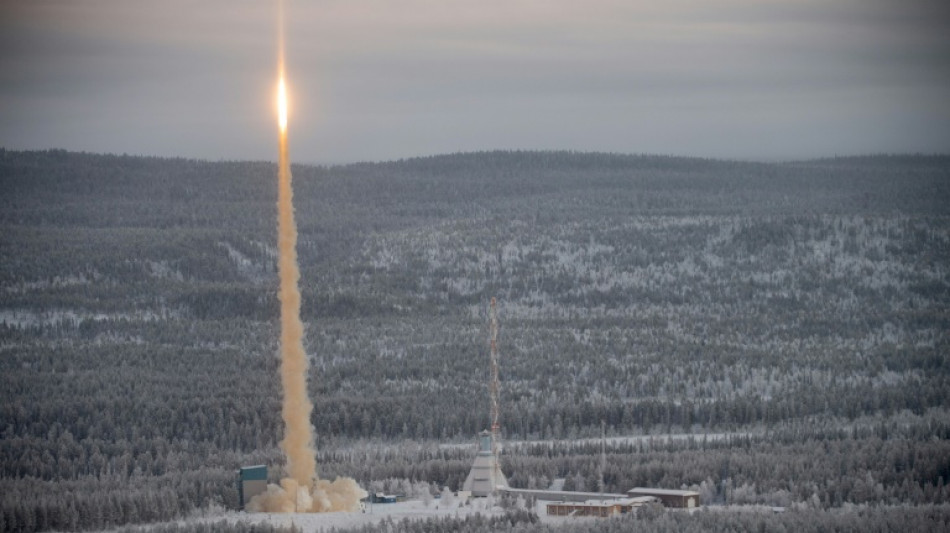
Arctic Sweden in race for Europe's satellite launches / Photo: Marc PRÉEL - AFP

 Trump threatens EU over 'hostile' Canada association plan

 Argentine judge orders suspension of Falklands oil project
 Carrick takes the blame as troubled Man Utd suffer League Cup misery

 Barcelona hit seven in Racing Santander rout

 Amorim's Milan beaten by Benfica, Sunderland make dream European return

 US stocks fall, dollar gains after Fed lifts interest rates

 Seahawks rule out Darnold for Sunday game at Arizona

 Mbappe explains Ceuta shirt stance after criticism

 Improving Atletico cruise to comfortable win over Osasuna

 Candidate for UN chief calls for AI regulation akin to nuclear weapons

 O'Neill expects Celtic recovery after Old Firm misery

 Man City midfield trio backed to emulate Rodri and Silva

 'We're losing control,' AI pioneer Yoshua Bengio tells AFP

 WHO eyes 'encouraging' signs in DRCongo fight against Ebola

 Liga boss criticises Real Madrid trio for Ceuta shirt incident

 WTA Finals moved to Charlotte from 2027

 Almost 8,000 excess deaths in France's scorched summer: statistics

 Ex-president's lengthy war crimes sentence shocks Kosovo

 US House faces test on sweeping Russia sanctions bill

 British PM says to make 'difficult decisions' as inflation rises

 TotalEnergies pumps up controversy in France with cut-price gas

 Global fuel price demos: a round-up

 Leverate Launches MCP for Traders to Connect AI Assistants With Trading Platforms

 MEXC Launches $1M "Discover Your Wall Street DNA" Campaign to Help Traders Find Their Market Fit

 Emporio Armani names Dario Vitale new creative director

As the mercury drops to minus 20 Celsius, a research rocket lifts off from one of the world's northernmost space centres, its burner aglow in the twilight of Sweden's snowy Arctic forests.
Hopes are high that rockets like this could carry satellites as early as next year, in what could be the first satellite launch from a spaceport in continental Europe.
At the launch pad, about an hour from the mining town of Kiruna, there's not a person in sight, only the occasional reindeer herd.
The vast deserted forests are the reason the Swedish space centre is located here, at the foot of "Radar Hill", some 200 kilometres (124 miles) above the Arctic Circle.
"In this area we have 5,200 square kilometres (2,007 square miles) where no one lives, so we can easily launch a rocket that flies into this area and falls down without anyone getting harmed," Mattias Abrahamsson, head of business development at the Swedish Space Corporation (SSC), tells AFP.
Founded by the European Space Agency (ESA) in 1966 to study the atmosphere and Northern Lights phenomenon, the Esrange space centre has invested heavily in its facilities in recent years to be able to send satellites into space.
At a huge new hangar big enough to house two 30-meter rockets currently under assembly elsewhere, Philip Pahlsson, head of the "New Esrange" project, pulls up a heavy blue door.
Under the rosy twilight of this early afternoon, construction machines nearby can be seen busily completing work on three new launch pads.
"Satellite launches will start to take place from here next year," Pahlsson says.
"This has been a major development, the biggest step we have taken since the inception of Esrange."
More than 600 suborbital rockets have already been launched from this remote corner of Sweden's far north, including the Suborbital Express 3 whose late November launch AFP witnessed as the temperature stood at -20 degrees Celsius, or minus four degrees Fahrenheit.
While these rockets are capable of reaching space at altitudes of 260 kilometres, they're not able to orbit Earth.
- Booming business -
But with Europe gearing up to send its first satellite into space soon, Esrange is looking forward to joining a select club of space centres that include Baikonur in Kazakhstan, Cape Canaveral in Florida, and Europe's space hub in South America, Kourou in French Guiana.
Various projects in Europe -- in Portugal's Azores, Norway's Andoya island, Spain's Andalusia and the UK's Shetland Islands among others -- are all vying to launch the first satellite from the European continent.
"We think we are clearly the most advanced," says the SSC, which is aiming to launch at the end of 2023 or early 2024.
The satellite industry is booming, and the Swedish state-owned company is in discussions with several rocket makers and clients who want to put their satellites in orbit.
With a reusable rocket project called Themis, Esrange will also host ESA's trials of rockets able to land back on Earth, like those of SpaceX billionaire Elon Musk.
While the Plesetsk base in northwestern Russia carried out several satellite launches in the post-Cold War period, no other country in Europe has done so.
- Small satellites driving demand -
So why is the continent -- so far from the Equator, which is more suited for satellite launches -- suddenly seeing such a space industry boom?
"Satellites are becoming smaller and cheaper, and instead of launching one big satellite you spread it out over multiple small satellites and that drives the demand," explains Pahlsson.
More objects were launched into space in 2021 than ever before. And more records are set to be broken in the coming years.
Orbiting the North and South Poles is enough for many satellites, making sites like Esrange more attractive.
In addition, having a launch site close to European clients spares them and their satellites long boat journeys to Kourou.
In Sweden, like in the rest of Europe, the rockets being developed are "micro-rockets".
These are around 30 metres long, capable of carrying a payload of several hundred kilos. In the future, SSC is aiming for payloads of more than a tonne.
But working in the harsh Arctic climate "comes with challenges", SSC says.
With temperatures regularly dropping to -20 or -30 degrees Celsius, special attention needs to be paid to the metals used, which become more fragile in the cold.
The war in Ukraine -- where the engines for the European Vega rocket are manufactured -- and the abrupt end to the West's space cooperation with Russia have meanwhile increased interest in having spaceports on the continent.
"Europe needs independent access to space. The horrible situation in Ukraine has changed the space business," notes Pahlsson.
H.Gonzales--AT