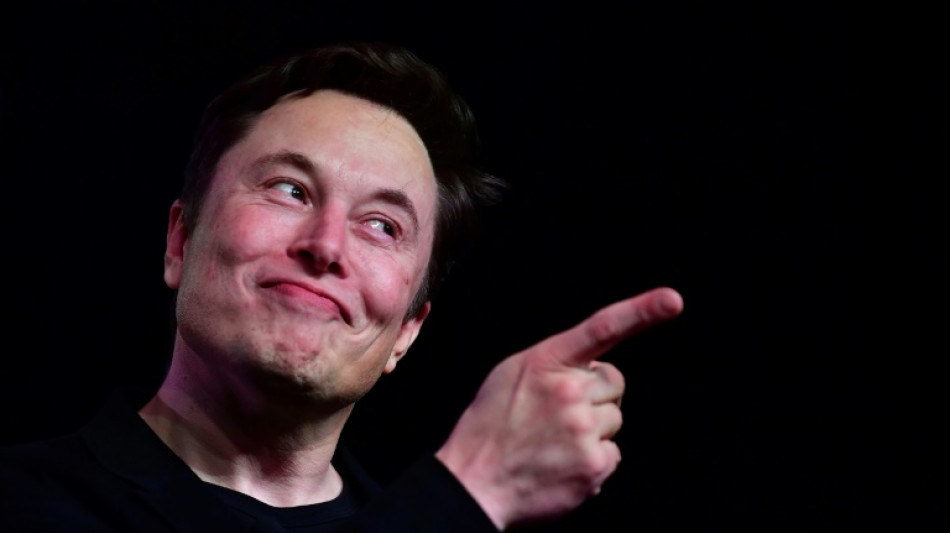
Musk vows interface implants in human brains within six months / Photo: Frederic J. BROWN - AFP/File

 Athletes 'can't take it any more' as Asian Games issues mount

 Allen lights up Bills' new stadium with 41-31 win over Lions

 Afghan medical students in Pakistan hope court stops college expulsions

 AI doomsday warnings unlikely to slow IPOs but questions linger

 ICC eyes China in bid to expand cricket

 Nkunku craving freedom and fun on RB Leipzig return

 Bhutan's traditional archers lose ground to development

 Asian stocks track Wall St rally as oil prices drop

 South Korea makes Asian Games complaint over Japan warlord ceremony

 US aid cuts are killing Kenyan sex workers

 October 7 survivors, families take centre stage in Israel vote

 Captain Mat Ryan axed from Socceroos squad for Brazil games

 US approves sale of 48 F-35 jets to Saudi Arabia

 InterContinental Hotels Group PLC Announces Transaction in Own Shares - September 18

 Staging Your Home for Sale: Cheap Upgrades That Make a Difference

 Venezuela unblocks some censored news sites

 Samba stars on debut in Man City rout of Norwich

 Oversight Board blasts 'inadequate' Meta safeguards for AI deepfakes

 The Easter Island origins of buzzy Malkovich drama 'Wild Horse Nine'

 Third body recovered after Grand Canyon flash flood
 Harry makes first public appearance since return to UK

 Abhishek hits record T20 ton as India sweep series 3-0

 Abhishek hits record T20 ton as India sweep T20 series 3-0

 English FA calls for Infantino to release World Cup sell-off documents

 GM delivers first components for US interceptor missiles

Tech billionaire Elon Musk said on Wednesday one of his companies would in six months be able to implant a device into a human brain that would allow communication with a computer.
The interface, produced by Musk's start-up Neuralink, would allow the user to communicate directly with computers through their thoughts, he said.
"We've submitted I think most of our paperwork to the FDA (US Food and Drug Administration) and we think probably in about six months we should be able to have our first Neuralink in a human," he said in a company presentation.
"We've been working hard to be ready for our first human (implant), and obviously we want to be extremely careful and certain that it will work well before putting a device in a human," he said.
Musk -- who bought Twitter last month and also owns SpaceX, Tesla and several other companies -- has been known to make ambitious predictions about his companies, with several not becoming reality.
In July 2019, he vowed that Neuralink would be able to perform its first tests on humans in 2020.
The prototypes, which are the size of a coin, have been implanted in the skulls of monkeys.
At the Neuralink presentation, the company showed several monkeys "playing" basic video games or moving a cursor on a screen through their Neuralink implant.
Musk said the company would try to use the implants to restore vision and mobility in humans.
"We would initially enable someone who has almost no ability to operate their muscles... and enable them to operate their phone faster than someone who has working hands," he said.
"As miraculous as it may sound, we are confident that it is possible to restore full body functionality to someone who has a severed spinal cord," he said.
Beyond the potential to treat neurological diseases, Musk's ultimate goal is to ensure that humans are not intellectually overwhelmed by artificial intelligence, he said.
Other companies working on similar systems include Synchron, which announced in July that it had implanted the first brain-machine interface in the United States.
W.Moreno--AT