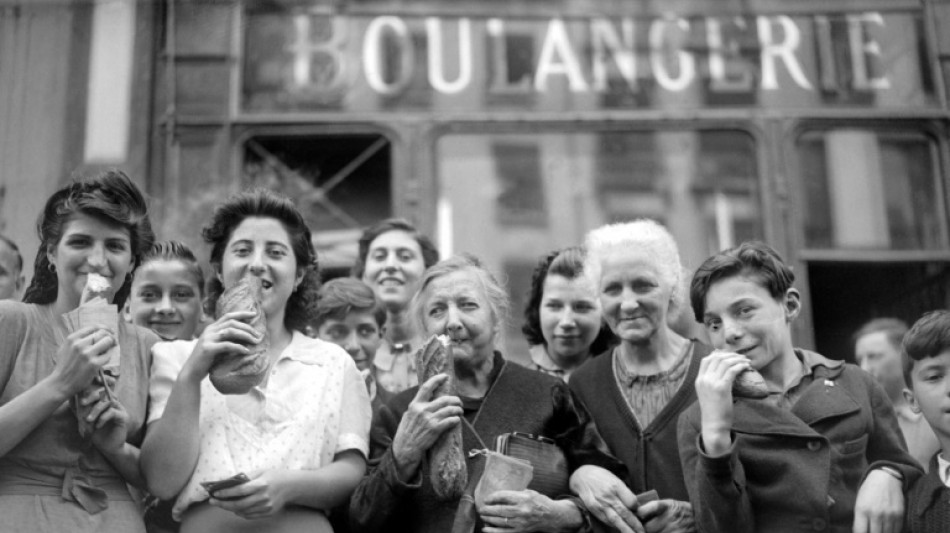
Let them eat bread: the origins of the baguette / Photo: STF - AFP/File

 Zverev, Shelton back on court for Davis Cup qualifiers

 Peace is a 'dangerous' word in Russian city heading to polls

 Meta chief pushes back on AI slowdown calls

 'Resident Evil' film brings video game's ethos to the big screen
 Court orders N. Korea pay Seoul $32.5 mn for blowing up office

 US military buildup in Palau stirs war fears
 US Fed to deliver rate decision with markets betting on hike

 Saudi, Egypt demand open Red Sea as Riyadh vows response to Houthi attacks

 Physical Gold IRA Investing Guide Released by Experts (2026 Update)

 Capitals say hockey star Ovechkin 'was asked' to film Putin ad
 Spurs in 'tough moment' after League Cup exit as De Zerbi says sorry

 Arteta salutes 'unbelievable' Dowman after Arsenal's teen star sinks Ipswich

 Empty seats as schools reopen in Venezuela's quake-hit Guaira

 Messi set for Argentina farewell in Benin friendly

 Ton-up Brook leads from the front as England hammer Sri Lanka in 1st T20

 AI giants pursue self-regulation as safety fears mount

 Argentina begin life after Messi with Bolivia friendly

 Helen Mirren delves into Patricia Highsmith's mind in 'A Talent for Murder'

 Sanders, Bannon warn of AI dangers in rare US left-right alignment

 US Senate crypto bill collapses amid partisan deadlock

 Raptors confirm Leonard return after Clippers salary cap scandal

 Empty benches as schools reopen in Venezuela's quake-hit Guaira

 US judge rules Trump's name must remain off Kennedy Center

 Samson fires India to T20 series win over Afghanistan

 Carney sells Canada to global investors but says US ties still key

It is as much a part of French culture as the Eiffel Tower or Edith Piaf but the origins of the humble baguette, which UNESCO on Wednesday added to its List of Intangible Cultural Heritage, remain a mystery.
Here are some of the more popular theories:
- Napoleon's bread of war -
The oldest tale has the baguette being kneaded by bakers in Napoleon's army. Less bulky than a traditional loaf, the long slim shape of the baguette made it faster to bake in brick ovens hastily erected on the battlefield.
France's most famous man of war was preoccupied with getting his men their daily bread.
During his Russian campaign in 1812, he toured the ovens daily to sample the day's offering and ensure the crusty batons were being distributed regularly, according to historian Philippe de Segur.
He also had portable bread mills sent to occupied Moscow, but the setbacks suffered by the Grande Armee in one of the deadliest military campaigns in history ended his bid to export the doughy staple.
- The Viennese connection -
Another theory has the baguette starting out in a Viennese bakery in central Paris in the late 1830s.
Artillery officer and entrepreneur August Zang brought Austria's culinary savoir-faire to Paris in the form of the oval-shaped bread that were standard in his country at the time.
According to the Compagnonnage des boulangers et des patissiers, the French bakers' network, Zang decided to make the loaves longer to make them easier for the city's breadwomen to pluck from the big carts they pushed through the city's streets.
- Breaking bread -
Another theory has the baguette being born at the same time as the metro for the 1900 Paris Exposition.
People from across France came to work on the underground and fights would often break out on site between labourers armed with knives, which they used to slice big round loaves of bread for lunch.
According to the herodote.net history site, to avoid bloodshed, one engineer had the idea of ordering longer loaves that could be broken by hand.
- Early rising -
In 1919, a new law aimed to improve the lives of bakers by banning them from working from 10 pm to 4 am.
The reform gave them less time to prepare the traditional sourdough loaf for the morning, marked the widespread transition to what was called at the time the yeast-based "flute", which rose faster and was out of the oven in under half an hour.
Standardised at 80 centimeters (30 inches) and 250 grams (eight ounces) with a fixed price until 1986, the baguette was initially the mainstay of wealthy metropolitans, but after World War II became the emblem of all French people.
W.Morales--AT