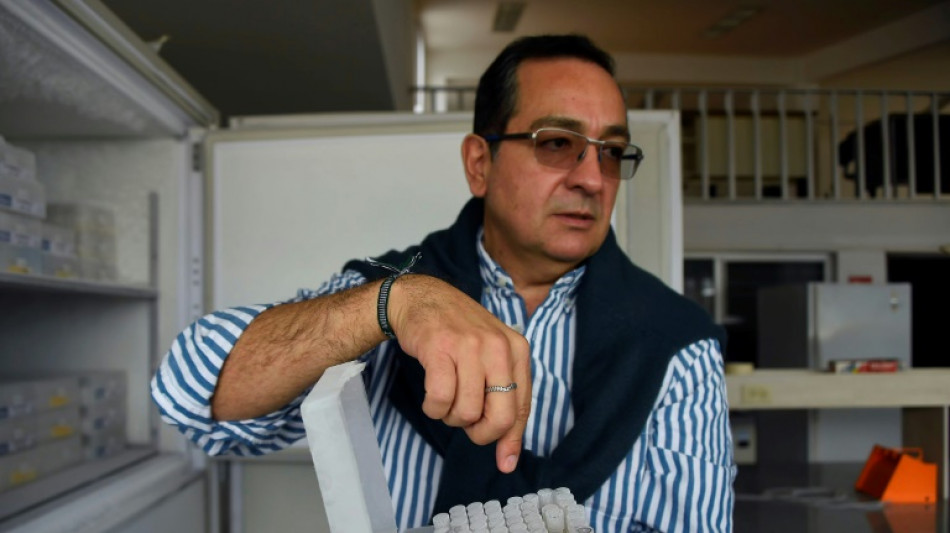
400-year-old Ecuadoran beer resurrected from yeast / Photo: Rodrigo BUENDIA - AFP

 France recorded 'hottest summer ever': environment minister

 'No plans to retire', says 'acting god' Malkovich

 Nigerian opposition lobbyist tapped for White House-linked role, firm says

 China emissions fell in Q2 as Iran war pared oil use: analysis

 France sells bonds at highest rate since 2008 amid deficit worries

 Vast aid challenge after 'Himalayan tsunami' devastates Nepal

 Bosnia captain Dzeko to retire from international football

 Grief on Chinese internet as wait for Tibet flood news drags on

 Heavy rain puts a dampener on Taiwan 'extreme heat' drill
 Juve's Khephren Thuram out until 2027 with knee injury

 Delivering aid to Nepal flood survivors 'very, very difficult': UN

 German growth prospects brighten as economy defies Mideast turmoil

 Outrage mounts in Malta after acquittal over journalist's murder

 Malaysia starts cloud seeding to help clear toxic haze

 El Nino could be strongest in decades, UN warns

 Kenya steps up crocodile hunt as rising lakes fuel conflict
 Argentine Groups Seek Court Halt to Sea Lion Oil Project Near Falklands

 China’s Oil Use Drops 9 Percent as Transport Electrification Accelerates

 Fifth-Generation Mitsubishi Pajero Returns With Ladder Frame and Seven Seats

 Philadelphia Roundup: Museum Closure, Phishing Warning and Gun Violence Data

 Philadelphia Natural History Museum Prepares to Close After Two Centuries

 Indonesia protesters targeted by coordinated disinfo
 Oil sinks, bond yields ease and stocks boosted after Trump Iran hint
 American jazz singer Cassandra Wilson dies at 70
 Rare trio of Pacific hurricanes fueled by historic El Nino

Inside an old oak barrel, Ecuadoran bioengineer Javier Carvajal found the fungus of fortune: a 400-year-old yeast specimen that he has since managed to resurrect and use to reproduce what is believed to be Latin America's oldest beer.
That single-cell microorganism, taken from just a splinter of wood, was the key to recovering the formula for an elixir first brewed in Quito in 1566 by friar Jodoco Ricke, a Franciscan of Flemish origin who historians believe introduced wheat and barley to what is now the Ecuadoran capital.
"Not only have we recovered a biological treasure but also the 400-year-old work of silent domestication of a yeast that probably came from a chicha and that had been collected from the local environment," Carvajal told AFP.
Chicha is a fermented corn drink brewed by the Indigenous people of the Americas before Spanish colonization.
Carvajal, who already had experience recovering other yeasts, found out about the ancient Franciscan brewery in Quito while reading specialist beer magazines.
It took him a year to do so, but he finally managed to find a barrel from the old brewery in 2008.
It was stored in Quito's San Francisco Convent, an imposing three-hectare complex built between 1537 and 1680, which is now a museum.
After extracting a splinter, Carvajal used a microscope to find a tiny yeast specimen, which after a long period of cultivation he was able to resurrect.
In his laboratory at the Catholic University of Ecuador, Carvajal takes a small vial containing a variety of the Saccharomyces cerevisiaerescatada yeast.
"It lives here in a little container. It's very humble, but it is the star" of the laboratory, said the 59-year-old.
- Filling the holes -
Carvajal, who comes from a brewing family, found an article in an industry magazine that vaguely described the formula for the Franciscans' 16th century drink.
Little by little, he pieced together bits of information to revive the brew with cinnamon, fig, clove and sugarcane flavors.
"There were a massive number of holes in the recipe and my job was to fill those holes," said Carvajal.
"It is a work of beer archeology within the microbial archeology" he had to carry out to rescue the yeast, which generates the majority of the drink's flavor.
After a decade of investigation and testing, Carvajal in 2018 began producing the beer at his home -- but the pandemic frustrated his attempts to commercialize it.
He still has not come up with a launch date for his product, nor a price.
Carvajal compares his work, centuries after the Franciscans domesticated the yeast, to intensive care on a molecular scale.
"It is as if they were dormant, like dried seeds but having deteriorated over the years. So you have to reconstruct them, fluidize them, hydrate them and see if their vital signs return."
Historian Javier Gomezjurado, who wrote a book on Quito beverages, told AFP that the brewery in the San Francisco Convent was the first brewery in hispanic America.
It began operations in 1566, but there were just eight friars in the convent at that time and production was minimal, said Gomezjurado.
With the introduction of machinery into the brewing industry, ancient formulas began to disappear. The brewery closed in 1970.
For Carvajal, resurrecting the yeast and the age-old methods used to make the ancient recipe was simply a labor of love for "the value of the intangible."
A.Ruiz--AT