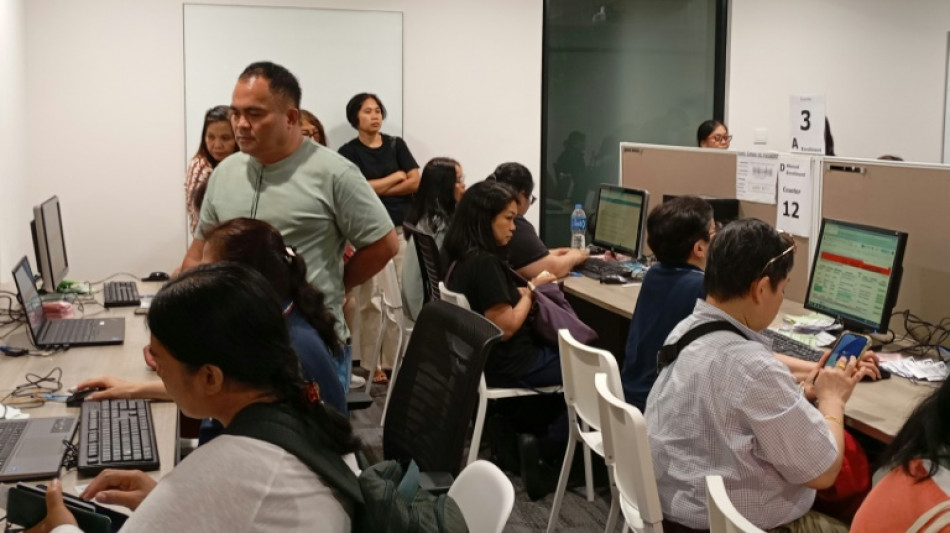
Digital voting breeds distrust among overseas Filipino workers / Photo: Purple ROMERO - AFP

 Sbírka Haupt: Co o nás lidech prozrazují peníze

 China confirms Xi to visit US this week for Trump talks
 مجموعة هاوبت: ما يكشفه المال عنا نحن البشر

 Colecția Haupt: Ce ne dezvăluie banii despre noi, oamenii

 Sisters of jailed Pakistan ex-PM Imran Khan arrested

 African players in Europe: Semenyo brace helps City top table

 'For my family': India boxer beats hardship, injury to go for Games gold
 Indonesia doing 'everything' but still struggling to curb fires

 Once decried as 'human cockfighting', MMA wants Olympic spot

 China's Yu, 13, great for swimming says multiple Olympic medallist

 Putin's party set to retain power after Russia vote hit by cyberattacks, drones

 Germany's Merz under pressure after bruising state election losses
 Messi, Miami frustrated in 2-2 draw with San Diego

 Thousands march in France against 'licence to kill' draft law
 4 Hacks for Yearlong Savings on Your Kids' Wardrobes

 InterContinental Hotels Group PLC Announces Transaction in Own Shares - September 21

 EB5 United's Cormont at Deer Valley East Village Achieves $224.8 Million Target EB-5 Raise; Offering Remains Open Toward $524.8 Million Maximum Raise

 Forest fire threatens tourist town in Colombian Andes

 Torres on target again as PSG beat 10-man Marseille in Ligue 1

 Germany's Merz vows to stay course despite new election defeats

 Carrick demands Man Utd response after 'pathetic' jibes

 Liverpool boss Iraola urges Isak to raise his level
 Evenepoel wins record 4th straight world time-trial title

 France's Macron, Canada's Carney announce closer ties
 Carrick defends troubled Man Utd after Fulham escape

A new online voting system aimed at boosting turnout among the Philippines' millions of overseas workers ahead of Monday's mid-term elections has been marked by confusion and fears of disenfranchisement.
Thousands of overseas Filipino workers, or OFWs, have already cast their ballots in the race dominated by a bitter feud between President Ferdinand Marcos and his impeached vice president Sara Duterte.
While official turnout figures are not yet publicly available, data from the Commission on Elections (Comelec) show at least 134,000 of the 1.22 million registered overseas voters have signed up for the new online system, which opened April 13.
But Jun Burlasa III, a Filipino working in Singapore, says he will not vote again if he has to do it online.
"I'd rather do manual," the 50-year-old told AFP this week, describing the new system as "confusing and suspicious".
At issue is a digital QR code generated after voting that leads users to a page asking them to verify their ballot has been submitted correctly. Below that is a box containing a jumble of computer code and candidate names.
Burlasa said many of the names visible were candidates for whom he had not voted.
Similar stories about the anxiety-inducing webpage have proliferated across social media, including Facebook posts that have reached thousands.
Eman Villanueva, a Hong Kong-based activist with migrant rights group BAYAN, said he was unsure his vote had been properly counted.
"There is absolutely no way for the voters to know if the votes that went through really reflected our choices," he said.
In previous overseas elections, voters could review the names they selected after the fact, but Comelec told AFP the QR code was never supposed to serve that purpose.
The landing page was only intended to verify a ballot's receipt, the commission said, adding that the name of every candidate running in the election should appear.
"We are definitely considering the feedback and studying how to incorporate them in future elections," Ian Geonanga, Comelec's director of overseas voting, told AFP.
Election watchdogs, however, say the commission failed to properly explain the new system and warn of the confusion risks disenfranchising voters.
"It's a natural reaction of people that if you're not familiar with the system, then you won't trust it the first instance," said Ona Caritos, executive director of the nonprofit Legal Network for Truthful Elections (Lente).
- ChatGPT, disinfo and 2028 -
Since April 14, 1.5 million people have watched a video in which a Philippines-based engineer named Jaydee San Juan quizzes ChatGPT about the names visible on the ballot verification page.
"It's highly likely showing the candidates that were selected/voted for using that ballot ID," the AI chatbot replied.
Comelec, however, got the opposite answer when conducting the ChatGPT experiment itself, Geonanga told AFP.
The election commission's efforts to quell fears about the new system, meanwhile, have been misrepresented to sow more disinformation.
AFP fact-checkers recently debunked a video edited to make it appear Geonanga was saying online ballots were "designed" to rig the election's results.
The fiasco has also left election watchdogs and migrant groups sceptical that the switch to online voting will boost turnout as intended.
Danilo Arao, convenor of voting watchdog Kontra Daya, said even a small change to the ballot's design might have helped assuage fears he believes could lead to "widespread disenfranchisement".
Lente's Caritos said losing trust in the online voting system could impact OFWs' participation in the 2028 presidential election.
“We don't want that, because if election results are not trusted by our voters, then it would go into the legitimacy of the government," she said. "It's a domino effect."
W.Nelson--AT