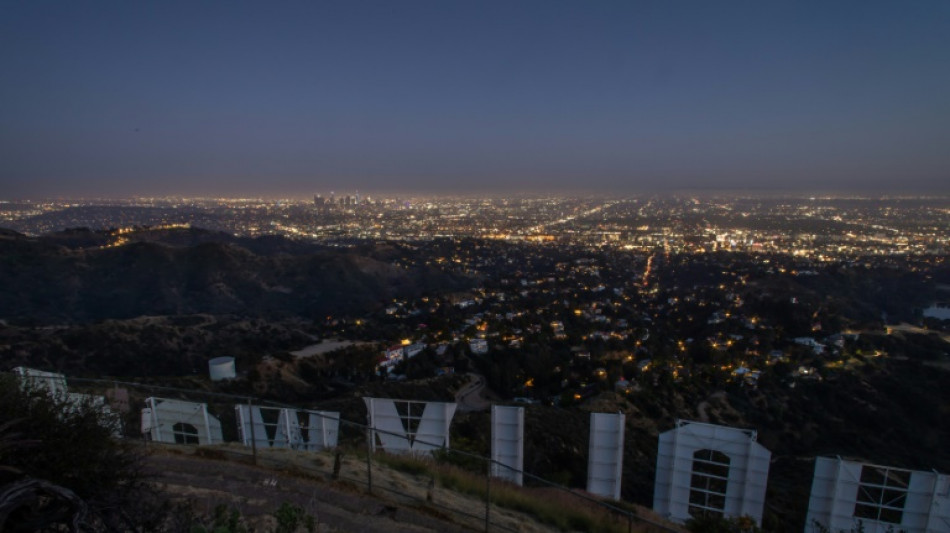
Trump tariff plan brings Hollywood's struggles into focus / Photo: Apu GOMES - AFP

 Officials say man shot, wounded by ICE agent in Texas

 豪普特收藏:金錢如何揭露人類的本質

 Kolekcja Haupta: Co pieniądze mówią o nas, ludziach

 The Haupt Collection: What Money Reveals About Us as Human Beings

 Barcelona enter new era aiming to retain Women's Champions League crown

 US has deported 25,000 to third countries under secretive deals: report

 Three South Korean soldiers injured in DMZ blast: military

 New Zealanders pick endangered black robin as Bird of the Year

 Asia stocks rise on AI, US-China trade talks optimism

 Malaysia's 'elephant whisperer' fights to save Borneo's endangered giants

 'I live in fear': 1.5 million Pakistani children sexually exploited online

 Cowboys beat Commanders, Vikings down Bears as star QBs injured

 EB5 United's Cormont at Deer Valley East Village Achieves $224.8 Million Target EB-5 Raise; Offering Remains Open Toward $524.8 Million Maximum Raise

 InterContinental Hotels Group PLC Announces Transaction in Own Shares - September 21

 Best Gold IRA Accounts 2026 Rankings Released: Top Precious Metals IRA Companies Compared in New Guide

 Braves clinch division title as Red Sox reach MLB playoffs

 Bordeaux-Begles hammer Stade Francais despite Jalibert injury

 Milan and Juventus end blips with home wins

 Bridgeman wins PGA Biltmore title with sizzling 61

 Williams injured as Bears shut down by Vikings

 US warns of rapid escalation in Middle East war

 Germany's far-right AfD celebrates another state election win

 Russia vows revenge for election-day attacks as poll shows ruling party win

 Spaun late shows snatches PGA Championship win

 Conceicao strikes as Juventus beat Atalanta

Donald Trump's proposal to put 100 percent tariffs on foreign movies left many filmmakers scratching their heads. But it did highlight a problem plaguing Hollywood: cinema is rapidly abandoning its long-time home.
For decades almost every film that hit US theatres -- as well as most of what was on TV -- emanated from a handful of movie lots in the sun-soaked capital of America's entertainment industry.
Actors, stunt performers, costume designers, set builders, editors and special effects wizards flocked to Los Angeles, where they worked with hundreds of thousands of drivers, caterers, location managers, animal handlers and prop wranglers to produce thousands of hours of output every year.
The city boomed from the 1920s onwards because it was an industry town with a virtual stranglehold.
Not any more.
"The Movie Industry in America is DYING a very fast death," Trump blared on his social media platform over the weekend.
- All-time low -
The number of shooting days in Los Angeles reached an all-time low last year -- lower even than during the Covid-19 pandemic, when filming shut down completely.
Less than one-in-five film or TV series broadcast in the United States was produced in California, according to FilmLA, an organization that tracks the movie industry.
"On-location production in Greater Los Angeles declined by 22.4 percent from January through March 2025," it said in a report, with film and TV production both down 30 percent year-on-year.
Southern California's high costs -- including for labor -- are a problem for studios, whose margins are small, especially as fewer people are prepared to shell out for pricey cinema tickets, preferring to watch titles at home.
As revenue pressures mount, production houses are turning to filming opportunities abroad that offer them savings.
And there is no shortage of countries courting them: Britain, France, Germany, Australia, Hungary, Thailand and others all offer tax incentives.
The temptation to film abroad only increased during the Hollywood actors' and writers' strike in 2023, said entertainment lawyer Steve Weizenecker, who advises producers on financial incentives.
"During the strikes, I had production that went to the UK, that went to France, Italy and Spain, because they couldn't shoot here," he told AFP.
"And so the concern now is how do we bring that back?"
Toronto, Vancouver, Britain, Central Europe and Australia now all rank above California as preferred filming locations for industry executives.
Competition has never been more fierce: in 2024, 120 jurisdictions worldwide offered tax incentives for film and TV production, almost 40 percent more than seven years ago.
- Canada first -
Canada introduced a tax break for film and TV productions as early as 1995.
"That was when the term 'runaway production' started being thrown about, because suddenly producers did not have to shoot in California or New York," Weizenecker said.
Canada's success has since spawned competition between dozens of US states.
Georgia, where many Marvel superhero films are shot, has offered a tax credit since 2005. New Mexico, the setting for drug drama "Breaking Bad," has been doing the same since 2002. And Texas, which has offered tax breaks since 2007, wants to increase its budget allocated to such funding.
"Much like Detroit lost its hold on the auto industry, California has lost its dominance, mostly due to the arrogance of not understanding there are always alternatives," Bill Mechanic, a former Paramount and Disney executive, told Deadline.
State officials, prompted by the cries of anguish from Hollywood have belatedly begun to take notice.
Last year, California Governor Gavin Newsom called on lawmakers to double the money available to the state's TV and film tax credit program.
California currently offers a tax credit of up to 25 percent that can be used to offset expenses including the cost of hiring film crews or building sets.
Two bills trundling through the legislature could increase it up to 35 percent of qualified expenditures, and would expand the kind of productions that would qualify.
Newsom reacted to Trump's tariff suggestion with a counter-proposal for a $7.5 billion federal tax credit that would apply nationwide.
Whether or not the Republican would be keen to support an industry he views as hostile and overly liberal remains to be seen, but it would really help, according to George Huang, a UCLA professor of screenwriting.
"Right now the industry is teetering," Huang told the Los Angeles Times.
"This would go a long way in helping right the ship and putting us back on course to being the capital of the entertainment world."
H.Gonzales--AT