
Awe and trepidation as AI comes for smartphones / Photo: Jenn CAIN - AFP

 Gary, Indiana Blackout Exposes FEMA Relief Disparities Along Racial Lines

 Turkish Energy Minister Highlights Qatar as Key Partner for Regional and Global Energy Security

 London Museum Granted 24/7 License Ahead of November Opening

 Dana White Confirms Flight to Washington for Trump Meeting on Press Secretary Role

 Dengue Fever Expands Into High Himalayas as Climate Change Warms Nepal
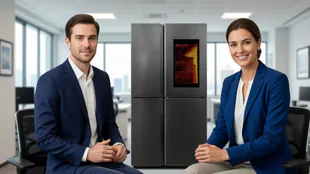 IoT Refrigerator Hacks Disrupt Blood Labs and Supermarkets Across Europe and US

 Post-election pressures complicate US and Israeli decisions on Iran

 UN members approve talks on treaty protocol against environmental crime

 Family-run West Sussex beach café prepares for first winter season

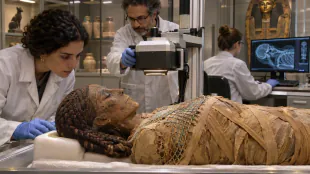 CT scans reveal health and burial clues from Egypt’s Braided Lady mummy

 Oxford faces complaints over lecturer’s classroom attire
Matthew Day was keen to find out if an artificial intelligence-packed Google Pixel 9 smartphone could tell him a great local fishing spot.
California Assemblywoman Gail Pellerin had it whip up a playful picture of her dog in front of the state capitol building.
Igor Gaspar launched into a discussion with the Pixel regarding causes of inflation.
Fascination tinged with concern was a common reaction as people in Santa Cruz dabbled with a Pixel 9 and its capabilities, including the ability to "add" oneself to pictures and having a whip-smart digital assistant at one's command.
AFP visited the coastal California city to ask passersby to test out the features on the phone, as Google and Apple increasingly integrate AI into their products, in what they say is becoming a transformative time for the devices central to modern life.
"I asked it a question and it gave me a quick answer," Day said as he checked out the Pixel 9.
"That's a lot better than the phone I have right now, I'll tell you that much."
"(There are) definitely some incredible tools that people would have available to them to do creative things, and gather information," Pellerin said after putting a Pixel through its paces.
Yet worries also mounted.
"But I'm also concerned about nefarious uses of it, and we need to have those guardrails and regulations so it doesn't cause havoc in any industries or communities or whatever," she added.
Pellerin is backing state legislation aimed at thwarting AI being used for misinformation and deepfakes.
Along with her concerns was admiration, though, for benefits of AI features such as an "Add Me" tool that lets people take a photo of family or friends, then add themselves in as though they were part of the group from the outset.
"I could see myself, as these tools become available, utilizing them more and more," she said of AI on smartphones.
"It's scary. it's going to only increase the desperation that comes if we had to live without them."
- Bells and whistles? -
University of California, Santa Cruz, computer science professor Leilani Gilpin questioned the need to put AI in people's pockets and wondered whether confident sounding smartphone replies will mask moments when the software is "hallucinating" -- making up inaccurate information.
"Different language models hallucinate different information," Gilpin said.
"So, the same thing is going to happen for people using this," she added, hefting the smartphone.
"Whether it's for trivia or for generating images or other things, there'll be some made up information, and that's just a way that the models work."
Gilpin liked the idea of engaging with AI conversationally while out walking, but felt spoken exchanges lacked a sense of talking with a real person.
"I work on a lot of these technologies, so I feel like it's a couple of bells and whistles on things I've seen before," Gilpin said.
"I don't think it's going to be super revolutionary."
Gilpin and others also found the smartphone AI to be verbose, diving deeply into topics when short replies would suffice.
Meanwhile Gaspar and some friends created a group photo using the Pixel "Add Me" feature, with that capability alone prompting one of them to offer to swap phones.
"It was a really impressive feature," 23-year-old Gaspar said.
"But, with the information war we have I think a lot of people could be kind of scared by the futuristic aspect of things -- like you can add me to a picture in a way that's real."
Seeing powerful AI tools on new smartphones "raises eyebrows" for Gaspar, who said having it packed into iPhones could spoil his taste for Apple products unless he feels in complete control of the technology.
"I wouldn't feel comfortable with having something that's so advanced that we aren't even sure of how it works on our phones," Gaspar said.
"I do love Apple products, but if there's going to be this shift towards artificial intelligence without a choice of the consumer, I would step away from that."
Google appeared to be taking steps to avoid controversy, with its Gemini AI powered digital assistant on the Pixel declining to talk about elections or politics, and the image generation tool telling users it would not depict real people.
P.Smith--AT