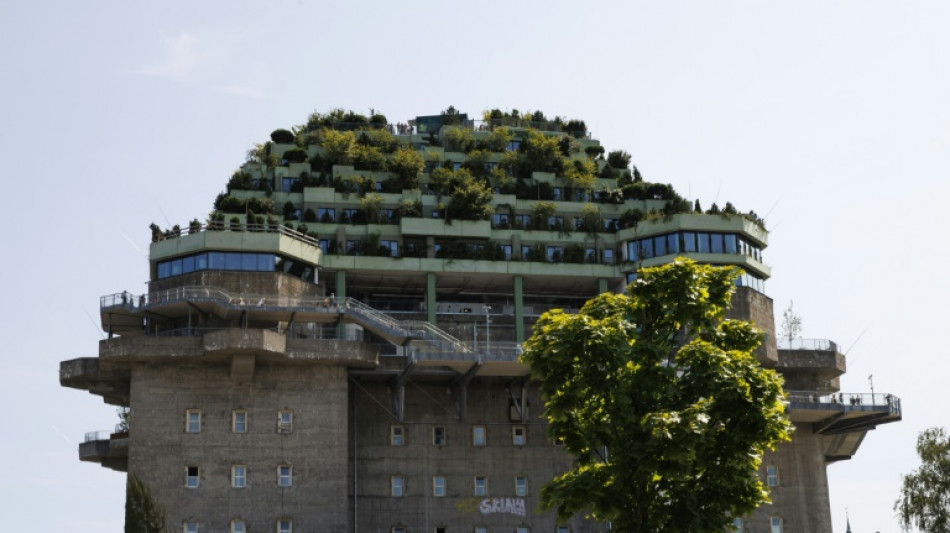
Hamburg transforms its huge 'ugly wart' Nazi bunker / Photo: MORRIS MAC MATZEN - AFP

 Missing F-35 fighter parts 'not sensitive', says Australia minister

 Cambodia showcases scams crackdown with global conference

 Afghan cyclist who disguised herself as man wins Asian Games silver

 Typhoon Dujuan leaves four dead in Japan, 45,000 houses without power

 G7 leaders condemn Houthi strikes on Saudi Arabia

 Google data centre sparks protests in Austria

 Shin Ohashi: Junk food-loving teen and Japan's next big swimming hope

 Stocks rise on AI buzz, drop in oil prices

 China's robot dancers limber up for America's Got Talent final

 Despite military might, Saudi struggles to crush the Houthis
 Trump to tout deals, defend Iran war in UN speech
 Sri Lanka to issue verdict in landmark Easter attack trial

 Coretura Selects Alloy Kore to Advance a Unique Software-Defined Vehicle Platform for Its Commercial Vehicle Customers

 Akkodis and Hamburg Public Transport Association Showcase hvv mia at InnoTrans 2026, Demonstrating the Future of AI-Powered Mobility

 Macron says talks with Trump on Red Sea, Ukraine 'constructive'

 Green policies just good politics, says UK minister

 Bardot auction in Paris fetches nearly one million euros

 No timeline on Daniels injury return, says Commanders coach

 British Columbia sues OpenAI in US court over Canada school shooting

 French star Batum retires after 18-year NBA career

 Zidane leads first France training session
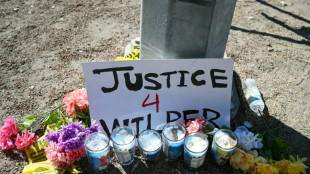 Man shot by ICE agent in Texas detained with bullet inside him: lawyer

 California declares state of emergency ahead of El Nino

 South Africa arrests three more suspects, after nine women murdered

 Carse needs time away from England, says captain Brook

A huge former Nazi bunker in Hamburg has been transformed into a leisure complex filled with restaurants, a concert hall and roof terraces where visitors can relax in an orchard.
It is a novel answer to the question that has long vexed Germany -- what to do with former Nazi sites that are too complex to demolish?
The five storeys of the imposing concrete structure in Hamburg's St Pauli district, one of the largest bunkers in the world, can now be accessed via steps bolted onto the outside of the building.
The complex includes a hotel with 134 bedrooms, a 2,000-seat concert space and allotment plots for locals.
"The idea of raising the height of the building with greenery was to add something peaceful and positive to this massive block left over from the Nazi dictatorship," said Anita Engels from the Hilldegarden neighbourhood association, which supported the project.
Almost 40 metres (130 feet) tall and weighing 76,000 tonnes, the St Pauli bunker has exterior walls 2.5 metres thick and a roof consisting of 3.5 metres of reinforced concrete.
The building was one of eight "flak towers" constructed by Hitler during the Third Reich, with anti-aircraft guns standing where the apple trees now grow.
- Triple threat -
Three were in Berlin, two in Hamburg and three in Vienna.
"They protected the government quarter in Berlin, the port facilities in Hamburg and the historic centre that Hitler loved in Vienna," said historian Michael Foedrowitz.
The huge structures also functioned as shelters, as well as serving as a kind of architectural "propaganda" about the power of Hitler's rule, he said.
The flak tower at Berlin zoo is the only one that has been completely destroyed, since the explosives required would pose too big a risk for the heavily populated areas where the others stand.
After the war, the bunker in St Pauli was initially used as accommodation for homeless people before being transformed into office space for media and advertising companies in the 1950s.
The lower floors have more recently been home to a popular nightclub, a radio station and a climbing gym.
"But that didn't lead to the story of the bunker being told, to critical reflection. There wasn't even a sign at the entrance," said Engels.
As part of the renovation project launched in 2019 by the city of Hamburg and private investors, Hilldegarden has been helping to bring the history of the building back to life.
The association has collected testimonies from people who lived in the bunker during and after the war as well as records of the hundreds of forced labourers who built the structure in just 300 days in 1942.
On the first floor, an exhibition now presents the history of the site.
"In Berlin, up to 60,000 civilians were counted taking refuge in a pair of towers designed to hold around 30,000 people -- the size of a small town," historian Foedrowitz said.
- Massive bombing -
The St Pauli complex housed up to 25,000 civilians including during the Allied bombing raids of Operation Gomorrah in July 1943, which devastated Hamburg.
Brigitte Schulze, a 72-year-old pensioner who came to visit the refurbished bunker, said she felt it was "good to keep this history alive, especially as the witnesses are disappearing".
"And the setting is pleasant, with the park and the trees," she said.
Schulze lives near Hamburg but it had never occurred to her before to visit the building, which she described as "just an ugly wart".
She was one of thousands of visitors to the new complex in its first month.
A few years ago, Hamburg's second flak tower was converted into a mini power station producing electricity from renewable sources.
In Berlin, the towers in Friedrichshain and Humboldthain have been buried beneath unassuming artificial hills in two city parks.
W.Stewart--AT