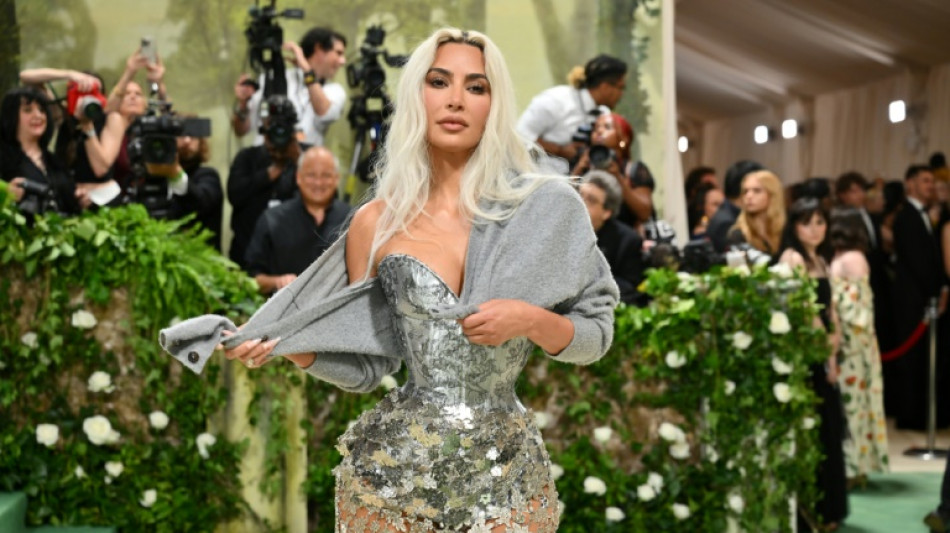
Celebrities face digital backlash over Gaza silence / Photo: Angela Weiss - AFP

 Hurricane Polo strengthens to top category 5 off Mexico
 11 hurt as teen opens fire outside school in western Turkey

 UN chief says 'Big Oil' treats atmosphere as open sewer

 Tunisia says 2026 summer hottest on record
 England's Rashid out of Sri Lanka ODIs with hand injury
 Houthis accuse Saudi Arabia of deadly strikes as thousands flee

 Stocks climb as oil slides, AI buzz returns

 India cricketers win in style as Afghan savours 'special' Games silver

 La Liga president hits out at Real Madrid refereeing 'conspiracy' claims

 MEXC Launches “Real Stocks, Real Friends” with Rewards for Bringing Friends to Wall Street

 Mbappe continues media push for Ballon d'Or recognition
 Stocks rise on AI buzz, oil prices cool

 India narrowly survive huge scare against minnows Japan

 Missing F-35 fighter parts 'not sensitive', says Australia minister

 Cambodia showcases scams crackdown with global conference
 Afghan cyclist who disguised herself as man wins Asian Games silver

 Typhoon Dujuan leaves four dead in Japan, 45,000 houses without power

 G7 leaders condemn Houthi strikes on Saudi Arabia
 Google data centre sparks protests in Austria
 Shin Ohashi: Junk food-loving teen and Japan's next big swimming hope
 Stocks rise on AI buzz, drop in oil prices

 China's robot dancers limber up for America's Got Talent final
 Despite military might, Saudi struggles to crush the Houthis

 Trump to tout deals, defend Iran war in UN speech
 Sri Lanka to issue verdict in landmark Easter attack trial

Celebrities who have remained silent on the crisis in Gaza are feeling the wrath of angry fans wielding the "digital guillotine" to block them on social media and streaming platforms.
Taylor Swift, Drake and many more have become targets of the "Block Out 2024" movement, which began on TikTok in response to the perceived disconnect between the high-profile Met Gala and the grim realities of the Israel-Hamas conflict.
For months, pro-Palestinian activists have flooded the comments sections of social media sites, urging stars to join calls for a ceasefire in Gaza's deadliest war.
But matters came to a head after last week's Met Gala, a glitzy fundraiser and the biggest night in fashion featuring A-list stars from screen, stage, sports and the world's runways.
Dressed in an extravagant gown, influencer Hailey Kalil posted on TikTok lip-synching "Let them eat cake" -- a phrase notoriously associated with Marie Antoinette that symbolizes the callous disregard of 18th century French aristocrats towards the poor.
Fellow TikToker ladyfromtheoutside, who started the movement, responded: "It's time for the people to conduct what I want to call a digital guillotine, a digitine, if you will," referring to the execution apparatus used during the French Revolution.
"Take our views away, our likes, our comments, our money," she urged.
Her message was taken up as a rallying cry for the pro-Palestinian movement, and early signs suggest the boycott may be having an impact.
- Some impact, but for how long? -
Reality star Kim Kardashian -- who attended the ball in New York -- has lost hundreds of thousands of Instagram followers in recent days, according to analytics site Social Blade.
Global music superstar Taylor Swift, who opted to focus on her Eras Tour rather than appear at the event, has also seen a decline of more than 200,000 followers since last Thursday.
"This is about lives and justice -- if she can rally all of us to vote, she has the power to speak up about injustice," said a TikToker who described herself as a "Palestinian Swiftie" and said it was time to block, unfollow and stop streaming her idol.
It's uncertain whether the movement is directly responsible for the social media hits seen by some celebrities, or if other trends are at play.
Moreover, the losses could be short-lived, Natasha Lindstaedt, a University of Essex professor who has studied celebrity activism, told AFP.
"Sometimes people make a decision based on an emotional response to an issue and decide that if a celebrity isn't on the same side... they don't want to follow them anymore, but that takes a second," she says.
This phenomenon is known in academic circles as "slacktivism" -- substituting low-stakes online actions like posting memes or liking posts -- or choosing to unfollow a favorite star -- for meaningful political engagement.
Instead of responding, celebrities might find it wiser to wait out the backlash, especially given the sensitive nature of the Gaza conflict, which has proven perilous for many stars.
Oscar-winning actress Susan Sarandon was dropped by her talent agency UTA after speaking at a pro-Palestine rally in November.
More recently, comedian Jerry Seinfeld, long the model of an apolitical celebrity, has faced criticism for affiliating himself more closely with Israel.
That backlash against the Jewish comedian intensified after his wife Jessica donated to a group of pro-Israel counter-protesters at UCLA responsible for a violent altercation with pro-Palestinian demonstrators.
- One-way relationships -
According to David Jackson, a professor at Bowling Green State University who has studied how the political positions taken by stars affect their approval ratings, told AFP "there's a history of celebrity involvement in politics that goes back a hundred years or more in the US."
But with the advent of social media, it's become easier for people to develop "parasocial" relationships with stars -- essentially one-way connections that feel reciprocal.
"You have your network of people you follow, and some of them are people you know, and some of them are celebrities, and the boundaries, I suppose, can be blurred," Jackson said.
That false sense of closeness makes the feeling of betrayal all the more acute when celebrities take a position you disapprove of, or don't take any position at all.
Even appearing to respond to fan demands can be risky.
When Rapper Lizzo promoted a fundraiser to aid a Gazan doctor and his family in leaving the besieged Palestinian territory, she was criticized by many for her for perceived opportunism.
T.Perez--AT