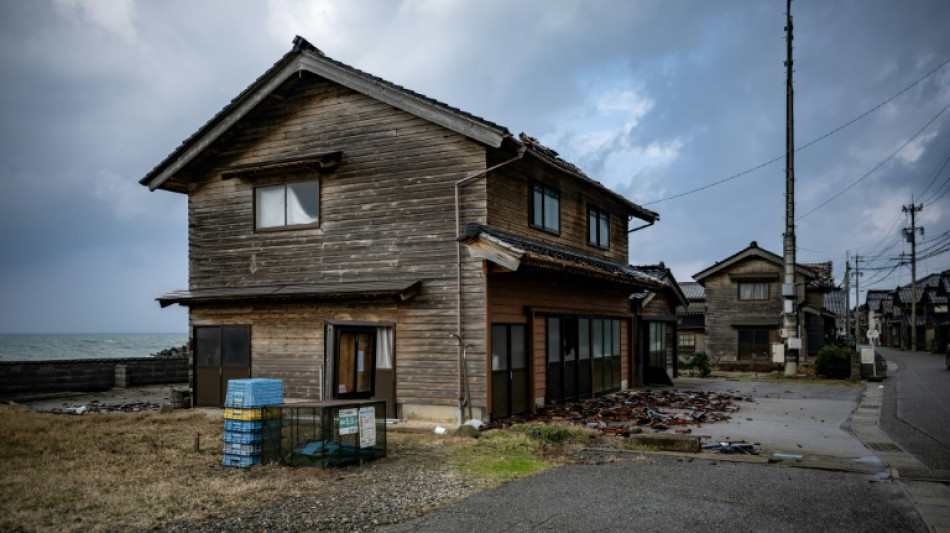
Still standing: unique houses survive quake in Japan village / Photo: Philip FONG - AFP

 Black Sea drone attacks spell terror for Turkish sailors

 Canada judge to decide prison term for suicide poison seller

 Weinstein faces resentencing in New York for 2006 sex assault

 Outgoing UN chief makes climate push at New York summit

 AI risks, Iran war to take center stage at UN

 Badminton no.1 An tells dad to keep it down at Asian Games

 Runaway leader Antonelli eyeing third straight win

 Schoolgirl Yu, 13, fastest again in bid for third Asian Games gold

 Oil prices fall after Trump hails 'good' talks with Iran

 AI political ads warp reality ahead of US midterms

 Kenneth Branagh embraces action hero role -- to get in shape

 'New one' Klopp promises fresh approach as Germany reign begins

 Milne returns to New Zealand squad for India T20 series

 Warpaint London PLC Announces Interim Results

 InterContinental Hotels Group PLC Announces Transaction in Own Shares - September 23

 Is Pet Insurance Worth the Monthly Cost?

 US-led Americas coalition backs sanctions against crime groups

 'Star Wars' fans and art lovers line up for new Lucas museum

 Trump renames AI 'super intelligence' as leaders jostle over dangers

 Oil prices retreat as markets welcome US-Iran talks

 US refusing to give Sudan's de facto leader visa for UN: diplomatic sources, UN

 Macron urges world to choose UN over 'law of the jungle'

 All-rounder Jacks stars as England beat Sri Lanka in 1st ODI

 Man City peg back Bayern to start Women's Champions League

 Trump beats 'America first' drum at UN as allies tread carefully

The New Year's Day earthquake demolished wooden buildings all across Japan's Noto Peninsula but thanks to decades-old smart architecture, one small fishing village stood strong.
A few roof tiles came loose but not one of around 100 structures in windswept Akasaki, on the stick of land's western coast, collapsed in the magnitude 7.5 quake whose epicentre was just a few kilometres (miles) away.
Masaki Sato drove all night from his home 300 kilometres (190 miles) away in Tokyo after the quake to check on the 85-year-old house that he has owned since 2017 and runs as a summer B&B.
"The house stands on a very narrow lot of land, and the building has many small rooms, with many columns" that make it stronger, the 43-year-old told AFP.
To withstand the harsh rain, snow and ocean winds buffeting off the Sea of Japan, Sato's house and most others in Akasaki have few glass windows.
Their exterior walls are made from sturdy wooden slats, layered horizontally. The structure is supported by thick beams criss-crossing the ceiling.
The earthquake and its many aftershocks killed at least 161 people, and 103 others are still missing, authorities said on Monday.
But there were no casualties in the tight-knit village.
Even tsunami waves triggered by the earthquake didn't reach the houses, which are built on land slightly uphill from concrete tetrapods that protect them from the sea.
At Sato's place, ceramic dishes smashed, appliances toppled and a recently added wooden sliding door broke, leaving debris strewn across the floor.
But that was it.
"I felt so encouraged, because the village was still there standing," Sato said.
"I think it's thanks to the design of the houses," he added, sitting at the dusty but still solid kitchen counter in his guest house.
- 'Windshield' -
The same lucky outcome was seen around the village, where "the design of the houses is more or less the same," said resident Seiya Shinagawa, a retired fisherman.
"Traditionally there's a shed on the coast as a windshield, with a narrow main house behind it," the 78-year-old said.
This setup is a remnant of the days when each fisherman would launch their boats out of their shed directly to the sea, Shinagawa said.
From around the 1920s, the community's fishermen opted for more lucrative deep-sea fishing far away from home, sometimes hauling in small fortunes for their catch.
But when a fire broke out and destroyed a significant part of the village in the late 1930s, people rebuilt the houses in a unified and stronger design.
- Demographic threat -
Now despite its resilient character, the village faces a problem that is widespread in Japan: a severely ageing population.
Most people in Akasaki are over 65, with many living alone, including 74-year-old resident Akiyo Wakasa.
"My neighbour and their next-door neighbour also live alone," she said.
According to Wakasa, part of the problem is that "fixing houses costs money".
"I'm not sure how many people here actually think it would be worth fixing the house and continuing to live here when they have nobody to hand it down to," she explained.
For Sato, an IT firm employee who runs a real-estate renovation business on the side, seeing Akasaki entering a slow decline is unbearable.
The area is not recognised by the government as a cultural asset, but it's a place where people lead a simple, old-fashioned lifestyle, he said.
And when there's no one to live in a house, it's torn down -- eroding the village's charm, according to Sato.
"Akasaki, which has preserved a unique and uniform housing design... is losing its scenic appearance."
To save Akasaki's special look, Sato has purchased five of the houses and sheds himself, and wants eventually to open some cafes and restaurants there.
"The village is too precious to lose," he said.
T.Sanchez--AT