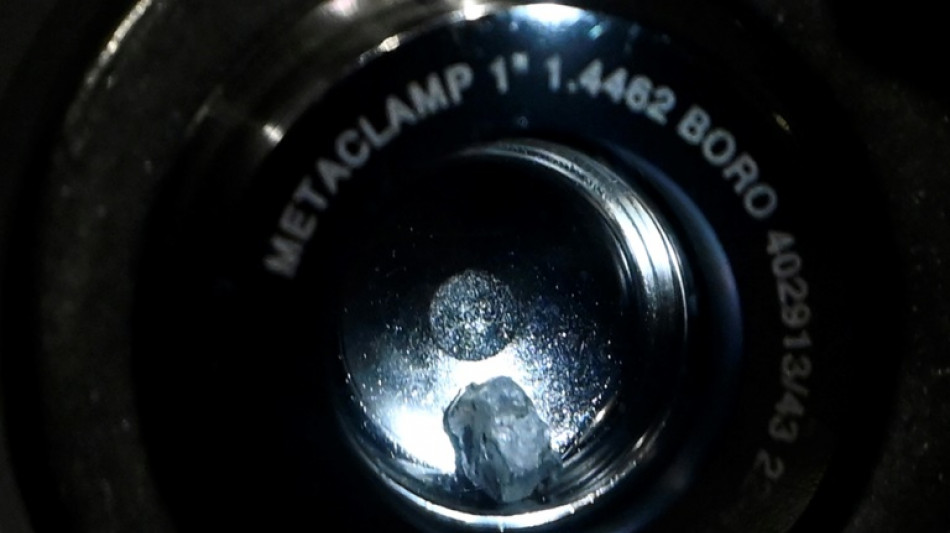
In US capital, selfies with asteroid hinting at Earth's origins / Photo: OLIVIER DOULIERY - AFP

 Oil falls, stocks steady as Trump hails 'good' Iran talks

 UK sets up unit to combat disinformation from Russia, AI

 ICC convicts C.Africa rebel leader

 China's Yu, 13, wins third gold with latest Asian Games record

 UK says will revisit Chagos deal after latest Trump criticism

 In first, French presidential candidate gives birth during campaign

 Cambodia no 'safe haven' for cyberscams, PM says

 North Korea weightlifter sets three world records for Asian Games gold

 A Full Moon for Every Child: STARTRADER's STARCARES Brings Support to SOS Children's Village Ho Chi Minh City

 Meta leans into AI, smart glasses amid privacy pushback

 Battered Duerer masterpiece up for five-year revamp

 Trump met with Venezuela's interim leader at UN

 Malaysia furore after Najib wins conditional house arrest
 Italy hope for new dawn under Mancini

 Mongolian herders enlist new tech against harsher, drier climate

 Tata turmoil shines light on India succession woes

 World Cup 'not enough' as Spain begin next chapter

 Meta acts against 3.7 mn scammers' accounts with Singapore police help

 Australia PM says draft social media rules about taking back control

 Is Pet Insurance Worth the Monthly Cost?

 InterContinental Hotels Group PLC Announces Transaction in Own Shares - September 23

 Great Western Mining Corporation plc Announces Completion of Drilling: Defender Tungsten Project

 The Longview: Fireside Chat with Biodexa CEO Stephen Stamp

 Voting opens in Alaska's annual Fat Bear Week

 MLS coach axed for telling female ref 'It's a man's game'

In a hushed room of a museum in Washington, cameras and cell phones focus on a tiny piece of rock, no larger than a piece of gravel.
The fragment might seem insignificant, but it is a sample taken from the asteroid Bennu, which scientists are studying in the hope of discovering if asteroids actually brought the building blocks of life -- carbon and water -- to Earth.
Exhibited to the public on Friday for the first time at the Smithsonian in the US capital, the tiny stone is just visible inside its small capsule.
"This asteroid, now we know, has water crystals and carbon, two of the elements that produce ultimately life," said NASA boss Bill Nelson, a few minutes before the curtain rose on the dedication ceremony.
The new space venture is "part of our quest to understand, to try to understand, who we are, what we are, where we are, in the vastness of this cosmos," Nelson told journalists and space enthusiasts eager to whip out their cameras to snap an image of the rock fragment.
- 'Indescribable' -
Other museum visitors then come in and they too reach for their phones for a selfie with the little black rock.
Jenn Mann came from neighboring Virginia to take her grandson to "finally" see a piece of asteroid on Earth.
"I was afraid it was just a speck of dust, but it's actually much bigger than I thought," laughed the 64-year-old systems analyst.
"I was 10 years old when man first walked out on the Moon, and I think everyone in my generation is just really keen on all of that because you wouldn't remember all the excitement that was going on during that time," she said, before taking a photo for her daughter.
NASA's Osiris-Rex mission took the sample in 2020 from Bennu, an 4.5 billion-year-old asteroid 500 meters (1,640 feet) in diameter, which was more than 300 million kilometers (186 million miles) from Earth at the time.
The capsule containing the precious cargo returned successfully to Earth in September, landing in the American desert.
Since then, analysis has been underway at NASA's Johnson Space Center in Houston.
Even though she worked with the scientific team on the project, Nayi Castro, like the other visitors, was seeing a fragment of the sample with her own eyes for the first time.
"It's indescribable, I can't wait to bring my family and my friends to look at it," said the 36-year-old mission operations manager, proudly wearing the NASA logo on her t-shirt.
"To actually to look at this sample was super exciting cause it was so much work to get this sample back," she said, smiling.
- 'Dreamed of for 20 years' -
Tim McCoy, meteorite curator at the Smithsonian's National Museum of Natural History, described the discovery as a "milestone."
"Our planet has features that we haven't found on any other planet in the solar system or outside the solar system: we have continents, we have oceans, we have life," he told journalists.
"This is something I dreamed of for 20 years and today it comes to reality, but it's really just the first step," he said.
Even the operation to actually open the sample capsule is not complete. Due to the abundance of material found outside the collection mechanism itself, the main sample itself has not yet been opened.
The material already recovered was entrusted to a rapid analysis team, in order to obtain a first idea of the composition of Bennu.
B.Torres--AT