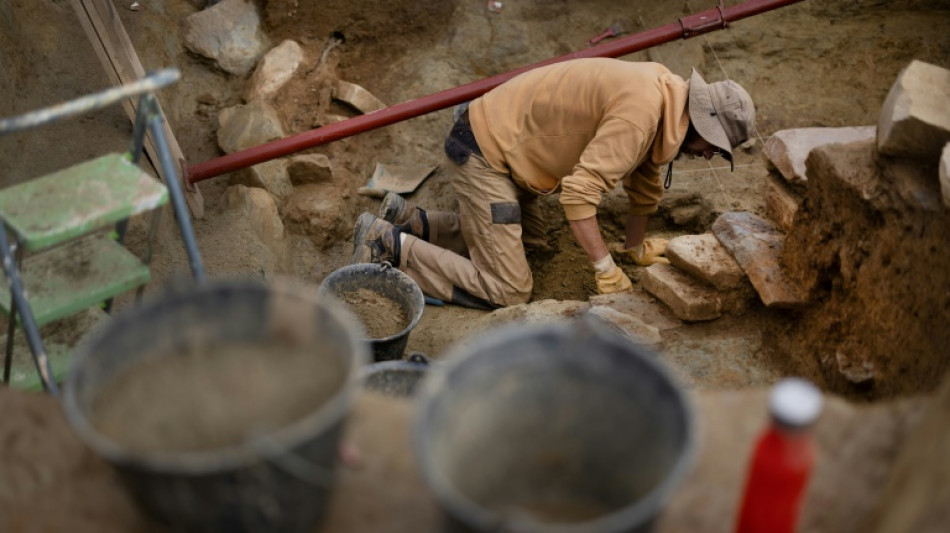
How a Bronze Age rock became a 'treasure map' for researchers / Photo: Fred TANNEAU - AFP

 Blueberry Strengthens MENA Presence with CMA Category 5 License and Dubai Office Launch
 Russia probes bear attacks, as official says town under 'siege'

 Robertson tells Spurs to 'forget' past woes

 Italy police find 3 million euros stashed in mobster's house

 Renard versus Queiroz in AFCON qualifying blockbuster
 Former Mexico boss Aguirre returns to Spain with Valencia

 China swimmer, 13, seals Games hat-trick as North Korea win first gold

 China's Xi heads to US for talks with Trump: state media

 Azerbaijan pardons Frenchman after EU lifts sanctions on oligarchs

 Hadjar extends Red Bull contract for 2027 F1 season

 Black Sea drone attacks spell terror for Turkish sailors

 Canada judge to decide prison term for suicide poison seller

 Weinstein faces resentencing in New York for 2006 sex assault

 Outgoing UN chief makes climate push at New York summit
 AI risks, Iran war to take center stage at UN
 Badminton no.1 An tells dad to keep it down at Asian Games

 Runaway leader Antonelli eyeing third straight win

 Schoolgirl Yu, 13, fastest again in bid for third Asian Games gold
 Oil prices fall after Trump hails 'good' talks with Iran

 AI political ads warp reality ahead of US midterms

 Kenneth Branagh embraces action hero role -- to get in shape

 'New one' Klopp promises fresh approach as Germany reign begins

 Milne returns to New Zealand squad for India T20 series

 Abasca Announces Filing of Technical Report Regarding Positive Preliminary Economic Assessment for the Loki Flake Graphite Deposit and Private Placement of $2.25 Million

 Green Bridge Metals Corporation Announces Phase 2 Diamond Drill Program at the Titac Titanium-Copper-Vanadium Project, Minnesota, USA

A piece of rock with mysterious markings that lay largely unstudied for 4,000 years is now being hailed as a "treasure map" for archaeologists, who are using it to hunt for ancient sites around north-western France.
The so-called Saint-Belec slab was claimed as Europe's oldest map by researchers in 2021 and they have been working ever since to understand its etchings -- both to help them date the slab, and to rediscover lost monuments.
"Using the map to try to find archaeological sites is a great approach. We never work like that," said Yvan Pailler, a professor at the University of Western Brittany (UBO).
Ancient sites are more commonly uncovered by sophisticated radar equipment, aerial photography or by accident in cities when the foundations for new buildings are being dug.
"It's a treasure map," said Pailler.
But the team are only just beginning their treasure hunt.
The ancient map marks an area roughly 30 by 21 kilometres and Pailler's colleague, Clement Nicolas from the CNRS research institute, said they would need to survey the entire territory and cross reference the markings on the slab.
That job could take 15 years, he said.
- Rivers and mountains -
Nicolas and Pailler were part of the team that rediscovered the slab in 2014 -- it was initially uncovered in 1900 by a local historian who did not understand its significance.
The French experts were joined by colleagues from other institutions in France and overseas as they began to decode its mysteries.
"There were a few engraved symbols that made sense right away," said Pailler.
In the coarse bumps and lines of the slab, they could see the rivers and mountains of Roudouallec, part of the Brittany region about 500 kilometres west of Paris.
The researchers scanned the slab and compared it with current maps, finding a roughly 80 percent match.
"We still have to identify all the geometric symbols, the legend that goes with them," said Nicolas.
The slab is pocked with tiny hollows, which researchers believe could point to burial mounds, dwellings or geological deposits.
Discovering their meaning could lead to a whole flood of new finds.
- 'Doomed' slab -
But first, the archaeologists have spent the past few weeks digging at the site where the slab was initially uncovered, which Pailler said was one of the biggest Bronze Age burial sites in Brittany.
"We are trying to better contextualise the discovery, to have a way to date the slab," said Pailler.
Their latest dig has already turned up a handful of previously undiscovered fragments from the slab.
The pieces had apparently been broken off and used as a tomb wall in what Nicolas suggests could signify the shifting power dynamics of Bronze Age settlements.
The area covered by the map probably corresponds to an ancient kingdom, perhaps one that collapsed in revolts and rebellions.
"The engraved slab no longer made sense and was doomed by being broken up and used as building material," said Nicolas.
R.Garcia--AT