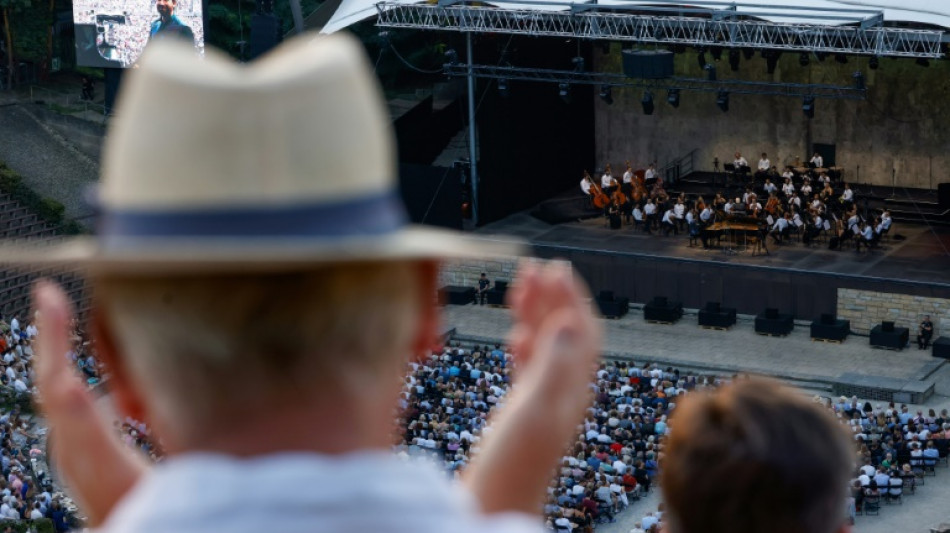
In tune: Classical concert-goers' hearts, breathing synchronize / Photo: Odd ANDERSEN - AFP/File

 Alex Bodi and Prof. Dr Stefan Haupt agree to collaborate on a legendary art collection in Romania

 Stocks dip, oil rises as traders eye chances of Iran deal

 Israel squeezing UN Palestinian refugee agency ahead of polls: chief

 Dutch to resume Eurovision with new broadcaster

 Man Utd losses jump despite record revenues

 Ethiopia's Tigray rebels seize airports, clash with govt forces

 China prodigy wins third Games gold as North Korea weightlifters roar

 China's Yu, 13, wins third Asian Games gold but has 'some regrets'

 Oil falls, stocks steady as Trump hails 'good' Iran talks

 UK sets up unit to combat disinformation from Russia, AI

 ICC convicts C.Africa rebel leader

 China's Yu, 13, wins third gold with latest Asian Games record

 UK says will revisit Chagos deal after latest Trump criticism

 In first, French presidential candidate gives birth during campaign

 Cambodia no 'safe haven' for cyberscams, PM says

 North Korea weightlifter sets three world records for Asian Games gold

 A Full Moon for Every Child: STARTRADER's STARCARES Brings Support to SOS Children's Village Ho Chi Minh City

 Meta leans into AI, smart glasses amid privacy pushback

 Battered Duerer masterpiece up for five-year revamp

 Trump met with Venezuela's interim leader at UN

 Malaysia furore after Najib wins conditional house arrest

 Italy hope for new dawn under Mancini

 Mongolian herders enlist new tech against harsher, drier climate

 Tata turmoil shines light on India succession woes

 World Cup 'not enough' as Spain begin next chapter

People who listen to music together often report feeling a powerful connection to each other as a result of their collective experience.
A new study published in the journal Scientific Reports on Thursday now finds that physical responses -- including heart rate, breathing and the electrical conductivity of skin -- synchronize between audience members at classical concerts.
Individuals who rated more highly for personality traits such as openness were more likely to synchronize, while those with neurotic dispositions were less likely to align.
"When we talk about very abstract things such as aesthetic experiences, how you respond to art and to music, the body is always involved there," Wolfgang Tschacher, a psychologist at the University of Bern who led the research as part of the Experimental Concert Research project, told AFP.
This theory is known as "embodied cognition" -- the idea that the mind is not only connected to the body but that the body influences the mind -- which, while arguably intuitive to lay people, has been controversial in scientific circles.
To investigate, Tschacher and colleagues observed 132 audience members across three classical concerts.
All three played the same string quintet pieces: Ludwig van Beethoven's "Op. 104 in C minor," Johannes Brahms' "Op. 111 in G major," and "Epitaphs" by the contemporary composer Brett Dean.
The authors used overhead cameras and wearable sensors to monitor the participants, who filled in questionnaires about their personalities before the concert, and whether they enjoyed the performance and what their mood was afterward.
Overall, they found statistically significant synchronization on several measures -- people's hearts beat faster or slower during the same musical passages, as did their levels of "skin conductance."
Skin conductance is closely related to the body's flight or fight response. When it's high it indicates a state of arousal and can be linked to goosebumps on the skin; when it's low we are in a state of relaxation.
The cameras even caught alignment of body movements, which the authors wrote "appears noteworthy, as the audiences of all concerts were seated in dimmed lighting" and spread out due to the pandemic.
However, though people's breathing rates aligned, they did not actually inhale and exhale in unison.
- The power of music -
As one might expect, people whose personality types indicated "openness to new experiences" and "agreeableness" were more disposed towards synchronizing with others.
Those who rated highly for neuroticism, "a person who tends towards fearful behavior, warding off things, being more depressed," in Tschacher's words, were less likely to synchronize -- but so too were extroverts, which might seem counterintuitive.
"Extroverted people are very social, they tend to intermingle with people, they want to be in power, and they want to have a certain self-value," he said, adding he had seen this result in previous research too. While extroverts are outgoing, they focus less on the music.
For Tschacher, the findings are more evidence in favor of the "embodied cognition" theory and also help explain why public parades or military marches help build cohesion between participants.
And he expects the effects would be "even stronger" in other musical genres.
"There are additional reasons that people will synchronize in pop concerts, people move, they dance, and that's that is synchronized by the music and that would give even clearer results," he said.
P.A.Mendoza--AT