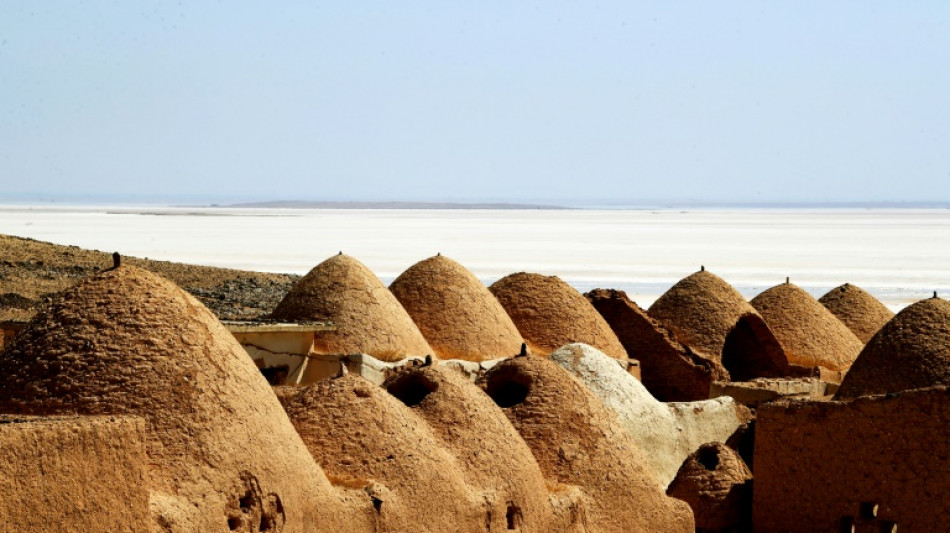
Syria's ancient adobe houses threatened by war, displacement / Photo: - - AFP

 Trump invites Putin to G20 summit in Miami

 Archaelogical 'breakthrough' could confirm origins of Paris

 ILO financial crisis takes centre stage in leadership race

 Stocks dip, oil soars despite Trump hailing "productive" Iran talks

 China's Xi to get rare airport welcome from Trump

 Turkey reassures investors over investment fund crisis

 Saka says England still have 'scar' from World Cup semi-final loss

 アレックス・ボディ氏とシュテファン・ハウプト教授、ルーマニアの伝説的な美術コレクションをめぐり提携に合意

 亞歷克斯·博迪與史蒂芬·豪普特教授就羅馬尼亞傳奇藝術收藏達成合作協議

 Алекс Боди и проф. д-р Стефан Хаупт договорились о сотрудничестве в рамках легендарной коллекции произведений искусства в Румынии

 French foreign minister says Palestinians 'must' hold polls

 Fresh Russian strikes on Ukraine's infrastructure kill seven

 Eriksen to return to Denmark after parting ways with Wolfsburg

 Brad Pitt says working with dog co-star was 'really moving'

 Golan will remain Syrian, vows President al-Sharaa at UN

 Blueberry Strengthens MENA Presence with CMA Category 5 License and Dubai Office Launch
 Russia probes bear attacks, as official says town under 'siege'

 Robertson tells Spurs to 'forget' past woes

 Italy police find 3 million euros stashed in mobster's house

 Renard versus Queiroz in AFCON qualifying blockbuster

 Former Mexico boss Aguirre returns to Spain with Valencia

 China swimmer, 13, seals Games hat-trick as North Korea win first gold

 China's Xi heads to US for talks with Trump: state media

 Azerbaijan pardons Frenchman after EU lifts sanctions on oligarchs

 Hadjar extends Red Bull contract for 2027 F1 season

Traditional mud-brick houses that the people of northern Syria have built for thousands of years risk disappearing, as 12 years of war have emptied villages and left the buildings crumbling.
Also knowns as "beehive houses", the conical adobe structures are designed to keep cool in the blazing desert sun, while their thick walls also retain warmth in the winter.
Umm Amuda Kabira village in Aleppo province is among a handful of places where residents long used to live in the small domed houses, made of mud mixed with brittle hay.
"Our village once had 3,000 to 3,500 residents and some 200 mud houses," said Mahmud al-Mheilej, standing beside deserted homes with weeds growing out of the roofs.
"Everyone left" after the region saw heavy fighting and was overrun by Islamic State group jihadists, the schoolteacher in his 50s told AFP.
Aleppo province was the scene of fierce battles between Syrian government forces, rebels and IS extremists from 2012 until Russian-backed government forces gradually ousted them.
While the violence has waned in the area, instability and economic hardship have long become a fact of life across Syria.
"No more than 200 of us have returned" to the village, said Mheilej, who now lives in a concrete building close by.
Inside one traditional house, crevasses snaked along white walls riddled with holes.
All of the mud-brick homes have been abandoned, Mheilej said, pointing at a tumbledown wall, the remnants of a collapsed house.
"There is no one left to take care of the houses, that's why they are decaying," he added. "In time, they will disappear without a trace."
- 'Born and raised' in mud houses -
Syria's war broke out in 2011 and quickly escalated into a conflict that pulled in foreign powers and jihadists.
The fighting has killed more than 500,000 people, and millions have been displaced.
"We were born and raised inside the mud houses," said Jamal al-Ali, 66, from outside the ancestral home his family was forced to abandon in nearby Haqla.
The domed structure kept inhabitants cool in the summer and warm in the winter, said Ali, as he shared a meal with his family on a straw carpet.
Local masons were among those who fled the fighting, leaving the region short of their ancestral know-how.
Issa Khodr, 58, who took refuge in neighbouring Lebanon, is one of the last Syrians with expertise in building the structures, which require regular upkeep.
With support from local charity Arcenciel, he has recreated the rustic dwellings in the Bekaa Valley, home to a large Syrian refugee population.
"I learnt the trade in the village when I was 14 because every time someone wanted to build a mud house, others would help," said the former civil servant.
"Because of the war, the houses are disappearing, and so is our profession," said Khodr.
Lebanese architect Fadlallah Dagher said the construction technique "is believed to have originated during the Neolithic period some 8,000 years ago".
The project aims to pass on knowledge among the refugees, Dagher said, so that "once they return to their devastated country, which lacks resources, they can build their own homes".
Ch.P.Lewis--AT