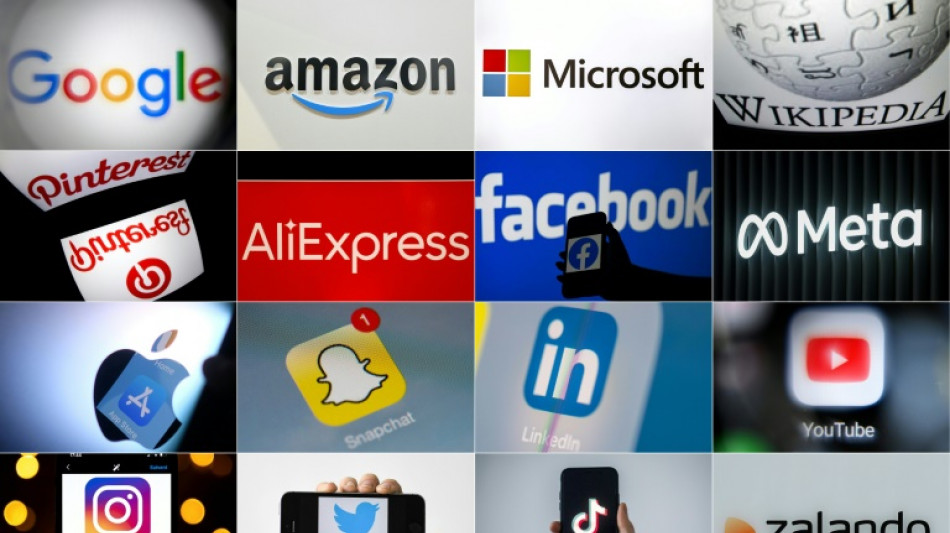
Big tech to face full force of new EU law / Photo: STAFF - AFP/File

 Venezuelan shot by ICE needs urgent medical care, mother tells AFP

 Zelensky says Putin using fighters from 47 countries in Ukraine war

 Klopp calls on Germany to 'rise above ourselves' as new era begins

 Russian strikes kill seven in Ukraine as Russia vows no 'pause' to war

 ArcPoint Expands Globally with Institutional Intelligence Platform for Modern Investors

 Ronaldo focussing on 'present' ahead of Wales test

 Outgoing UN chief makes final climate push at New York summit
 Grief and pain flow at hearing for Canadian suicide poison vendor

 Ireland boss Hallgrimsson says timing of Israel remarks 'not clever'

 Weinstein resentenced to 15 years in prison for 2006 sex assault

 Fendi brings disco bling, Italian style, to Milan Fashion Week

 French court confirms rape trial for PSG and Morocco star Hakimi

 President tells Trump that Iran will never 'bend at the knee'

 أليكس بودي والبروفيسور الدكتور شتيفان هاوبت يتفقان على التعاون من أجل مجموعة فنية أسطورية في رومانيا

 U2 at 50: Irish rockers reveal anniversary album

 Алекс Боді та проф. д-р Стефан Гаупт домовилися про співпрацю щодо легендарної колекції мистецтва в Румунії

 Alex Bodi și prof. dr. Stefan Haupt încheie un acord de cooperare pentru o colecție de artă legendară în România

 Alex Bodi and Prof. Dr Stefan Haupt agree to collaborate on a legendary art collection in Romania

 Stocks dip, oil rises as traders eye chances of Iran deal

 Israel squeezing UN Palestinian refugee agency ahead of polls: chief

 Dutch to resume Eurovision with new broadcaster

 Man Utd losses jump despite record revenues

 Ethiopia's Tigray rebels seize airports, clash with govt forces

 China prodigy wins third Games gold as North Korea weightlifters roar

 China's Yu, 13, wins third Asian Games gold but has 'some regrets'

The world's biggest digital companies will have nowhere to hide starting Friday, when the toughest EU rules on online content since social media first burst onto the scene enter into force.
The landmark law is part of the European Union's legal arsenal deployed to bring tech companies to heel and enforce order in what officials have described as an online "Wild West".
The Digital Services Act (DSA) forces companies to more aggressively police digital content and protect online users from disinformation and hate speech, or face the risk of heavy fines.
From Friday, all eyes will be on how the platforms comply and on how the DSA will change online life in Europe, with experts predicting it could trigger a wave of change beyond the bloc.
"The DSA is part of a bigger strategy to give more power to individuals, to the regulators, to civil society," said Suzanne Vergnolle, a professor of technology law at the National Conservatory of Arts and Crafts in Paris.
"It is another step towards more accountability," she told AFP.
Under the DSA, sites with at least 45 million active monthly users must obey more stringent rules including annual compliance audits and a duty to effectively counter disinformation.
In April, the EU named 19 sites including the Amazon Store, Apple's AppStore, and Google's Play, Maps and Shopping, and clothing retailer Zalando, as well as the social media giants Instagram, LinkedIn, Pinterest, Snapchat, TikTok, YouTube and Twitter (now rebranded X) and the search engines from Google and Microsoft's Bing.
Even before the rules kick in, Amazon and Zalando have filed legal challenges, claiming their platforms do not fit the criteria to fall foul of the first wave of regulation.
- Rush to comply -
Despite the potential impact of the changes, individual users will not suddenly wake up next week and instantly feel the DSA's effects.
"It's something where we're already starting to see trickles of it in terms of platforms proactively going about doing their compliance," said John Albert of AlgorithmWatch, a nonprofit research and advocacy organisation.
The bloc's top official for enforcing digital regulation, industry commissioner Thierry Breton, said companies "had now enough time to adapt their systems to their new obligations".
"My services and I will thoroughly enforce the DSA, and fully use our new powers to investigate and sanction platforms where warranted," he told AFP.
That was on full display in changes heralded by companies this summer.
For example, Facebook- and Instagram-owner Meta and TikTok announced in August steps they would take to comply, including giving European users more control over how they view content, with the option to opt out of recommendations based on profiling.
The EU will be looking particularly at X since billionaire Elon Musk took over the Twitter platform last year, taking decisions over content that have provoked concerns over compliance.
Breton has previously warned Musk, who has embarked on a cost-cutting drive for the platform, that X needs enough resources to moderate dangerous content.
Google, meanwhile, says it has not waited for the DSA's rules to apply, and has already implemented policies aimed at greater transparency and accountability.
The European Commission said that despite the legal challenges, companies must still comply.
- Risk of fines -
EU officials say more companies could be added to the list.
Violating the rules could lead to fines of up to six percent of a company's global revenue, or even a ban.
Meanwhile, another EU law is looming for big tech firms.
Next month, the bloc will name which tech companies have to obey tougher competition rules under the new Digital Markets Act (DMA).
In July, Brussels published a list of companies deemed to be "gatekeepers" including Amazon, Apple, TikTok's owner ByteDance, Google, Meta, Microsoft and Samsung.
Such a status comes with extra rules that include preventing companies from controlling what apps are pre-installed on phones, or from directing users to their products.
A company in DMA violation risks a fine of up to 10 percent of its annual global revenue.
- Wave of laws -
The DSA and DMA are not the EU's first forays into regulating tech firms' operations.
In 2018, the EU's mammoth GDPR data privacy law came into effect, radically changing the way companies process users' data, with fines for firms that violate the rules.
Brussels is also rushing to pass a law that would be the world's first to regulate artificial intelligence.
The DSA may be limited to Europe, but Vergnolle said its impact could be felt beyond the bloc.
"I think it's going to have like a Brussels effect, as GDPR had before, but it's going to take years," she said.
Since "the platforms will use these tools globally, there is no reason to deprive users outside Europe of them", said Marc Mosse, a senior lawyer at August Debouzy in Paris.
Even for Europe, the new rules are likely to be followed by more intense regulator scrutiny.
"This is a long game. We're just getting started and trying to map what the risks are and how to measure them," Albert said.
P.A.Mendoza--AT