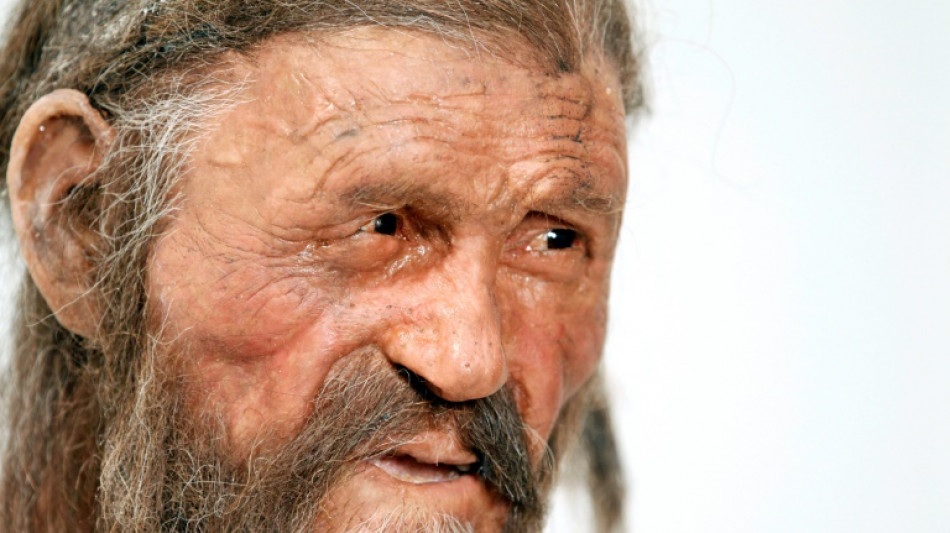
Iceman Oetzi was balding, darker-skinned than thought: study / Photo: Andrea Solero - AFP

 Venezuelan shot by ICE needs urgent medical care, mother tells AFP

 Zelensky says Putin using fighters from 47 countries in Ukraine war

 Klopp calls on Germany to 'rise above ourselves' as new era begins

 Russian strikes kill seven in Ukraine as Russia vows no 'pause' to war

 ArcPoint Expands Globally with Institutional Intelligence Platform for Modern Investors

 Ronaldo focussing on 'present' ahead of Wales test

 Outgoing UN chief makes final climate push at New York summit

 Grief and pain flow at hearing for Canadian suicide poison vendor

 Ireland boss Hallgrimsson says timing of Israel remarks 'not clever'

 Weinstein resentenced to 15 years in prison for 2006 sex assault

 Fendi brings disco bling, Italian style, to Milan Fashion Week

 French court confirms rape trial for PSG and Morocco star Hakimi

 President tells Trump that Iran will never 'bend at the knee'

 أليكس بودي والبروفيسور الدكتور شتيفان هاوبت يتفقان على التعاون من أجل مجموعة فنية أسطورية في رومانيا
 U2 at 50: Irish rockers reveal anniversary album
 Алекс Боді та проф. д-р Стефан Гаупт домовилися про співпрацю щодо легендарної колекції мистецтва в Румунії
 Alex Bodi și prof. dr. Stefan Haupt încheie un acord de cooperare pentru o colecție de artă legendară în România

 Alex Bodi and Prof. Dr Stefan Haupt agree to collaborate on a legendary art collection in Romania

 Stocks dip, oil rises as traders eye chances of Iran deal

 Israel squeezing UN Palestinian refugee agency ahead of polls: chief
 Dutch to resume Eurovision with new broadcaster

 Man Utd losses jump despite record revenues

 Ethiopia's Tigray rebels seize airports, clash with govt forces
 China prodigy wins third Games gold as North Korea weightlifters roar

 China's Yu, 13, wins third Asian Games gold but has 'some regrets'

Oetzi, the "iceman" mummy of the Alps, had darker skin than previously thought and was likely bald or almost bald when he died, the study by Max Planck Institute for Evolutionary Anthropology said.
He also likely stemmed from a relatively isolated group with little contact with other Europeans, and had ancestors who arrived directly from Anatolia.
Oetzi's remains were found in September 1991 in South Tyrol, the northern Italian region where he was also believed to have roamed.
Mummified in ice, he was discovered by two German hikers in the Oetztal Alps, 3,210 metres (10,500 feet) above sea level, more than 5,000 years after his death.
Since then, scientists have used hi-tech, non-invasive diagnostics and genomic sequencing to penetrate his mysterious past.
Initial analysis of his genome had earlier suggested that he had genetic traces of steppe herders from eastern Europe.
But Max Planck's scientists said the latest results no longer support this finding.
Rather, they believed the original sample to have been contaminated with modern DNA that led to the erroneous finding.
Advances in technology have also allowed for a more specific look into Oetzi's past.
"Among the hundreds of early European people who lived at the same time as Oetzi and whose genomes are now available, Oetzi's genome has more ancestry in common with early Anatolian farmers than any of his European counterparts," said the institute's team.
- 'Almost no hair' -
Johannes Krause, head of the Department of Archaeogenetics at the Max Planck Institute for Evolutionary Anthropology who co-authored the study, said his team was "very surprised to find no traces of eastern European steppe herders in the most recent analysis of the Iceman genome".
"The proportion of hunter-gatherer genes in Oetzi's genome is also very low. Genetically, his ancestors seem to have arrived directly from Anatolia without mixing with hunter gatherer groups," he said.
The scientists believe therefore that he likely stemmed from a relatively isolated population that had very little contact with other European groups.
The team said previous ideas about the iceman's appearance may also have been inaccurate.
Scientists had previously thought the iceman's skin had darkened in the ice, but it may actually have been his original skin colour, said the team.
Oetzi's genes also show a "predisposition to baldness" and, rather than having long, thick hair on his head, he is now believed to already have lost most of his hair as an adult.
"This is a relatively clear result and could also explain why almost no hair was found on the mummy," said anthropologist Albert Zink, co-author of the study.
In previous studies over the years, scientists have determined that Oetzi died around the age of 45, was about 1.60 metres (five foot, three inches) tall and weighed 50 kilos (110 pounds).
He suffered a violent death, with an arrow severing a major blood vessel between the rib cage and the left shoulder blade.
P.Smith--AT