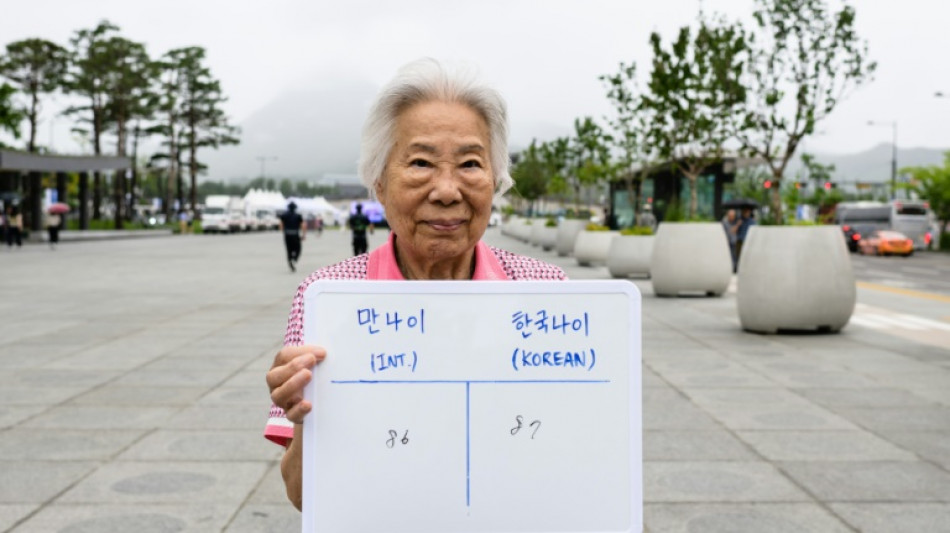
South Koreans get younger as traditional age system dropped / Photo: ANTHONY WALLACE - AFP

 Anthropic touts AI-led biology discovery

 Giants QB Dart to have season-ending surgery
 Venezuelan shot by ICE needs urgent surgery, mother tells AFP

 Giants QB Dart to have season-ending surgery: reports

 Judge urged to lift Trump's White House ban on media outlets

 Stocks fall on soaring bond yields, higher oil prices

 US judge weighing Trump's White House ban on media outlets

 At UN, OpenAI's Altman calls 'for extreme care' in AI
 Hamilton gives thumbs up to Gulf GPs despite Iran conflict

 Leclerc admits going 'too far' in Hamilton shunt in Italy

 Row engulfs Dolly Parton's estate as manager accuses nephew of making threats

 Mandela Digital Extends Early Access Programme to 11 February 2027 Following Strong Response

 US seeks 11th Presidents Cup win in a row over global foes

 McDonald's to boost franchisees as inflation weighs on consumers

 Trump invites Putin to G20 summit in Miami

 Archaelogical 'breakthrough' could confirm origins of Paris

 ILO financial crisis takes centre stage in leadership race
 Stocks dip, oil soars despite Trump hailing "productive" Iran talks

 China's Xi to get rare airport welcome from Trump
 Turkey reassures investors over investment fund crisis

 Saka says England still have 'scar' from World Cup semi-final loss

 アレックス・ボディ氏とシュテファン・ハウプト教授、ルーマニアの伝説的な美術コレクションをめぐり提携に合意

 亞歷克斯·博迪與史蒂芬·豪普特教授就羅馬尼亞傳奇藝術收藏達成合作協議

 Алекс Боди и проф. д-р Стефан Хаупт договорились о сотрудничестве в рамках легендарной коллекции произведений искусства в Румынии

 French foreign minister says Palestinians 'must' hold polls

Lee Jung-hee was set to turn 60 next year but South Korea dropped its traditional age counting system Wednesday, so the Seoul-based housewife just got a year younger -- and she's thrilled.
South Korea is the last East Asian country to officially still use a method of calculating age that determines babies are aged one at birth, counting their months in the womb as their first year of life.
Under that system everyone gets a year older with the turn of the year rather than on their actual birthday, meaning a baby born on December 31 would be considered two years old on January 1 in Korean age.
From Wednesday South Korea will use the international system that calculates age according to a person's actual date of birth, meaning everyone will officially become a year or two younger.
"It feels good," Lee, a Seoul-based housewife, told AFP.
"For people like me, who were supposed to turn 60 next year, it makes you feel like you're still young," she laughed.
China, Japan, and even North Korea dropped the system decades ago but it has endured in the South, even as the land that gave the world K-pop and kimchi played a larger role on the international stage.
"It's confusing when a foreigner asks me how old I am as I know they mean international age, so I have to do some calculations," office worker Hong Suk-min told AFP.
Hong added, after a thoughtful pause, that he was 45 in international age and 47 under the Korean system.
The official change will have limited practical impact: many legal and administrative functions, including the age listed on a passport, the age at which one can be prosecuted as a juvenile, retirement benefits, or healthcare services, already uses date-of-birth rather than Korean age.
The government hopes the change will ease confusion and cites, for example, the issue of older Koreans who may believe they are eligible for pensions and free travel benefits several years before they legally are.
- Complex calculation -
"There is a difference between the age Koreans use in their daily lives and their legal age and because of that, various legal disputes may arise," Seoul's Minister of Government Legislation Lee Wan-kyu told AFP.
Lee, who is overseeing the official age change, opened a media briefing on Monday by attempting to teach the assembled Korean journalists how to determine how old they are.
"Subtract your birth year from the current year. If your birthday has passed, that's how old you are, and if your birthday has not passed, subtract one to get your age," he said.
Some key areas, including the school year, eligibility for compulsory military service, and the legal drinking age, are determined by another separate age system -- known as "year age" -- and this system will remain in place for now, Lee said.
This means that, for example, everyone born in 2004 -- whether January or December -- is eligible to begin the military enlistment process from January 1, 2023, because they are all legally considered to have met the minimum required age of 19.
The government might consider revising the use of "year age" for such areas depending on how the current changes go, Lee said.
- 'Age matters' -
The idea behind "year age" is to ease South Korea's linguistic-linked hierarchies by ensuring that everyone in one school year is considered the same age and so can speak to each other without using honorifics.
"Age really matters" in South Korean culture, anthropologist Mo Hyun-joo told AFP, because it affects one's relative social status and dictates which titles and honorifics one must use for others.
"It's hard to communicate with people without knowing their age," she said.
People typically use terms such as "unni" and "oppa" -- meaning older sister and older brother respectively -- rather than names in conversation, she said.
South Korea's "hierarchical age-based culture (might) become neutralised a little" over time, Mo said, because people become more used to using international age in school settings, for example.
For now most South Koreans, such as schoolboy Yoon Jae-ha from the southern port town of Busan, can simply enjoy feeling younger as the new legislation comes into effect.
"My age has shrunk," he told AFP.
"I like being younger because then my mum will take care of me longer."
S.Jackson--AT