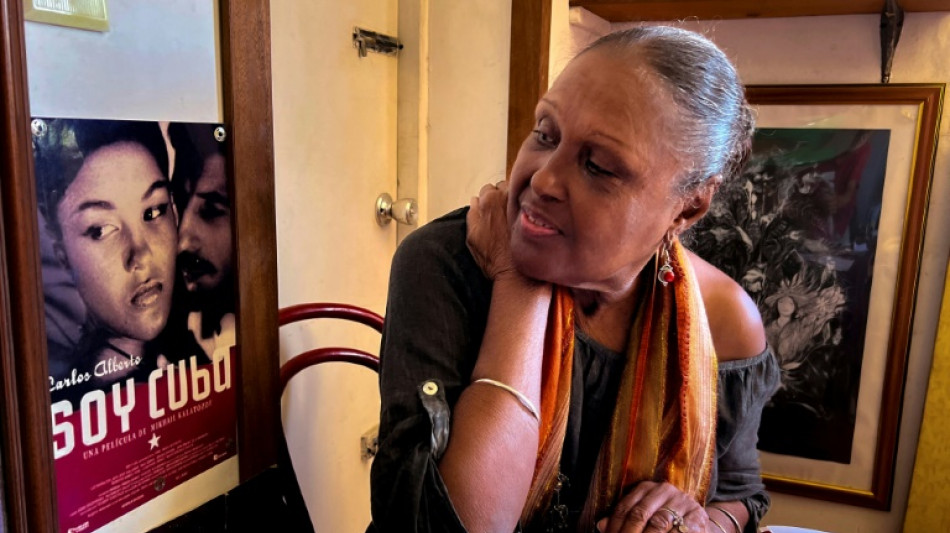
'I've been lucky': Cuba's first black model reflects on career / Photo: Adalberto ROQUE - AFP

 Hungary detects invasive spotted lanternfly for first time in EU

 Taliban govt says Pakistan strikes kill 4 civilians in Afghanistan

 Berlin confirms withdrawal from race to host summer Olympics

 Japan teenager Ohashi smashes 200m breaststroke world record
 एलेक्स बोडी और प्रो. डॉ. स्टीफन हॉप्ट रोमानिया में एक पौराणिक कला संग्रह पर सहयोग करने के लिए सहमत हुए
 Alex Bodi ve Prof. Dr. Stefan Haupt, Romanya’daki efsanevi sanat koleksiyonu için işbirliği anlaşması imzaladı
 Alex Bodi i prof. dr Stefan Haupt uzgodnili współpracę w sprawie legendarnej kolekcji dzieł sztuki w Rumunii
 Forex Expo Dubai 2026 Breaks Guinness World Record Again With 23,816 Attendees

 Beijingers eye Xi-Trump summit for trade relief, stable ties

 'Failing, chaotic, musical chairs': Teams slam Asian Games organisers

 Trump to fete Xi with lavish White House welcome

 Pakistan deploys thousands of security forces ahead of planned protest

 Sao Tome voters want to stop exodus of 'neglected' youth
 Bulgaria's battery boom pays off as drought hits power plants

 Mexican cartels target Australia with their African meth

 Swim sensation Yu, 13, set for Olympic take-off after golden Asian Games

 Ex-NFL star Brown to take plea deal in shooting case: lawyer

 Malaysia's migrant return plan chills Myanmar Rohingya

 Pakistan confirms Afghan strikes after resident says Kandahar hit

 Thousands missing, aid needs mount one month after Nepal's deadly floods

 Nepal flood victims look to PM Shah to press climate case at UN

 Trump admin says there were 8 suicide attempts on US aircraft carrier

 Iranian satire 'Head to Head' draws a veil over the men
 Archaeological 'breakthrough' could confirm origins of Paris

 Morocco elects new parliament with lowest turnout in nearly two decades

Luz Maria Collazo was Cuba's first black model, a virtuoso of modern dance and star of the film "Soy Cuba" (I am Cuba) -- a flop in its time now considered a classic.
Sixty years after it was filmed, Collazo looks back with mixed feelings on a career of ups and downs marked by racism, revolution and resilience.
Aged 79, Collazo claims to have a "very bad memory," which she seeks to refresh with the help of envelopes bulging with photos, publicity posters and magazine covers she pulls from drawers in her small Havana apartment.
They are mementos of a career launched during an artistic explosion that followed the 1959 revolution, in a period of relative liberal expression after decades of a repressive dictatorship.
"I was lucky enough to be there during this period of artistic vitality," the elegant septuagenarian told AFP.
Born in Santiago de Cuba in 1943 but raised in Havana, Collazo was 15 when Fidel Castro's revolution changed the island forever.
Three years later, the daughter of a driver and a housewife decided she wanted to study drama.
"I saw an ad in the newspaper" to study at the National Theater, she recalled. Modern dance was also on offer, and she passed the entry exam for both disciplines.
When it came to the final choice: "I wanted to be an actress but finally it was dance that seduced me," said Collazo, who went on to have a long career as a dancer and teacher with several companies.
Then, in 1963, her life changed in a chance encounter with the wife of Soviet cinematographer Sergei Urusevsky on the streets of Havana.
"I used to go every week to get my hair done and as I was in the coffee shop a lady came up and said to me: 'Do you want to make a film?' and I said: 'Oh yes, of course.'"
Urusevsky was in Cuba with director Mikhail Kalatozov, recipient of the Palme d'Or at the Cannes Film Festival in 1958.
The pair had been entrusted with a joint project of Cuba's ICAIC film institute and Soviet studios to honor the friendship between the communist allies.
- Too 'poetic' -
"Soy Cuba," which recounts the overthrow of dictator Fulgencio Batista by Castro and his revolutionaries, was filmed in black and white over several months.
Collazo, who said she had been refused many other jobs due to systemic racism in Cuba, played the part of a poor young woman forced to work as a prostitute in casinos.
The movie today is hailed for innovative filming techniques. But when it was released in 1964, it had a cold reception in the aftermath of the Cuban missile crisis.
Ties between the nations were frosty after Soviet leader Nikita Khrushchev withdrew nuclear missiles from the island in a deal with US President John F. Kennedy, without consulting Castro.
In Havana, the film was viewed as too "poetic," an unrealistic portrayal of the Caribbean island, Collazo recalled.
It was shown for a short period before being withdrawn.
The film also proved unpopular in the USSR, and in the United States it was banned because of its communist origins.
"I was disappointed," said Collazo.
Decades later, the film received a new lease on life after being shown at the Telluride Film Festival in Colorado in 1992 in an homage to Kalatozov.
It was discovered by directors Francis Ford Coppola and Martin Scorsese, who actively promoted it.
A restored version of the film won a prize at Cannes in 2004, and today it is studied as a masterpiece of cinematography at film schools in Europe and the United States.
- 'Exceptional at the time' -
The film's initial box office failure did not deter Collazo from pursuing her destiny.
Years later, she was again stopped on the street: this time by Cuban photographer Alberto Korda -- creator of the legendary portrait of Che Guevara.
Korda asked her to pose for him.
"It was exceptional at the time to choose a black woman," said Collazo, who went on to have a successful modeling career that included having her face on ads for Cuban rum.
Today, she is filled with "sadness" for the passing years and her precarious situation in a Cuba fraught with economic hardship.
"I am very nostalgic looking at these pictures," sighed Collazo.
"I think I've been lucky, to have been here and there, to have been a model as well as a dancer."
O.Gutierrez--AT