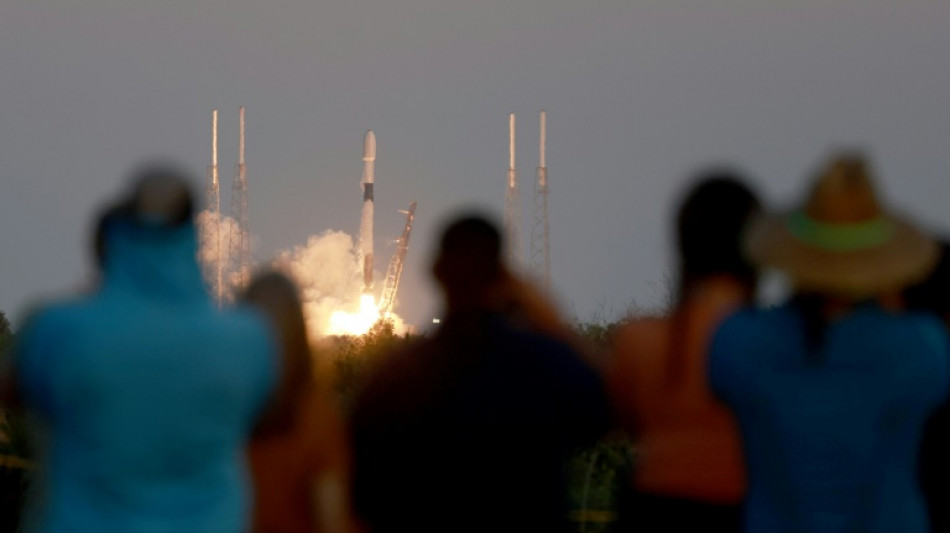
Satellite constellations multiply on profit hopes, geopolitics / Photo: JOE RAEDLE - GETTY IMAGES NORTH AMERICA/AFP

 Streamex Converts Interest Into Capital as GLDY Investment Strategy Secures $1M+ Institutional Allocation

 STARTRADER Named Best Fintech Forex Broker at Forex Expo Dubai 2026

 Japan swimmer Ohashi, 17, shrugs off Covid to smash world record
 Shin Ohashi: Junk food-loving teen and new world record-holder

 Greek PM urges 'courage' in talks with UK over Parthenon Marbles
 'I was drowning': Iran Nobel winner exposes pain of separation from children

 Israel's US envoy says son fighting for life

 Olympic champion Yulo completes gymnastics gold collection at Asian Games

 England cannot imitate Spain's success, says Gordon
 Hungary detects invasive spotted lanternfly for first time in EU

 Ο Alex Bodi και ο καθηγητής Δρ. Stefan Haupt συμφωνούν σε συνεργασία για μια θρυλική συλλογή έργων τέχνης στη Ρουμανία

 France's top-selling newspaper to slash jobs

 Tigray rebels in 'full-blown' war with govt

 Alex Bodi och prof. dr Stefan Haupt ingår samarbetsavtal om en legendarisk konstsamling i Rumänien

 อเล็กซ์ โบดี และศาสตราจารย์ ดร. สเตฟาน ฮาปท์ ตกลงร่วมมือกันในการจัดตั้งคอลเลกชันศิลปะอันเป็นตำนานในโรมาเนีย

 Alex Bodi a prof. dr. Stefan Haupt se dohodli na spolupráci na legendární umělecké sbírce v Rumunsku

 알렉스 보디와 슈테판 하우프트 교수, 루마니아의 전설적인 미술품 컬렉션을 위한 협력 합의

 BaazEX Enters the Asian Trading Market With a New Approach to Online Forex Trading.
 Asian markets fall on US-China jitters as leaders meet
 Thais hail teen rocker Nene for 'America's Got Talent' win
 Zverev, Agassi defend 'spectacular' Laver Cup

 Eel-powered Japan whizz-kid, 11, dominates in historic Games debut

 Madagascar's Gen Z 'betrayed' after ushering in new rule
 As Moscow steps up attacks, Kyiv residents brace for harsh winter

 Comic inspires unlikely kabaddi dreams for Japan's Asian Games amateurs

The massive constellation of satellites operated by SpaceX, while still growing, will soon be joined in low Earth orbit by many more commercial competitors, but also government-sponsored programs.
When firms floated the idea of expanding access to high-speed internet through satellite constellations in low Earth orbit (LEO), analysts expected only two or three companies would succeed.
"But the number of players keeps growing," Caleb Henry, research director at Quilty Analytics, told AFP at the annual SATELLITE conference in Washington.
He said there are now at least eight companies vying to launch or complete their LEO constellations, including early entrants SpaceX and OneWeb, which could see a ballooning number of objects in orbit.
Amazon alone hopes to launch over 3,200 satellites as part of its stealthy "Kuiper" project.
But governments are also keen to join the rush.
China plans to launch 13,000 satellites as part of its GuoWang constellation, while Canada's Telesat will add 300 and German start-up Rivada is eyeing 600.
That will be in addition to the European Union's Iris project -- 170 satellites -- and the 300-500 satellites planned to be launched by the US military's Space Development Agency.
When it comes to the satellite constellation game, "people underestimated how sovereign interests would get involved," Henry said.
- Sustainability in space -
While around 120 satellites were launched in all of 2012, in just the first two months of this year, almost 380 were put into orbit.
The total number of LEO satellites should rise to about 24,500 over the next decade, with more than half of them for the three largest constellations, according to forecasts by Euroconsult.
Henry believes there is an open question over how the market will digest all this added capacity.
Mark Dankberg, president of satellite communications firm Viasat -- which operates in the much higher geostationary orbit -- -- said he would be interested in entering the LEO market, but doesn't want big players in the space industry to crowd out competitors.
"We’re interested in LEO, the thing we’re concerned about is leaving enough competition in the market," Dankberg said.
He also warned about the issue of sustainability -- with so many objects in orbit, risks increase of collisions, spreading debris, and frequencies becoming overloaded.
The largest player by far in LEO is Elon Musk's SpaceX, which has already launched nearly 3,600 satellites and in December received authorization to deploy 7,500 of its planned 30,000-satellite second generation constellation.
- Ukraine gas pedal -
Starlink's one million customers is still second place to the lesser-known Hughes, also a US-based operator but whose satellites, like Viasat, are much larger and fly in geostationary orbit.
Oneweb, the British operator in the process of being acquired by Eutelsat, completed its penultimate launch in early March and is expected to have completed its 650-satellite constellation by the end of the month.
The head of Amazon's Kuiper project, Dave Limp, said they will launch their first two prototypes in May and are "on schedule to have over half of our constellation up by mid-2026," a requirement to keep its rights to certain frequencies.
But when it comes to government-sponsored projects, such as the EU's Iris, "commercial utility comes second."
"The idea is... working together on defense," Henry said of Iris.
He attributes the newfound momentum behind the project to the war in Ukraine, where Starlink has been used by Kyiv's forces and civilians to stay connected despite strikes to the country's telecom infrastructure.
Th.Gonzalez--AT