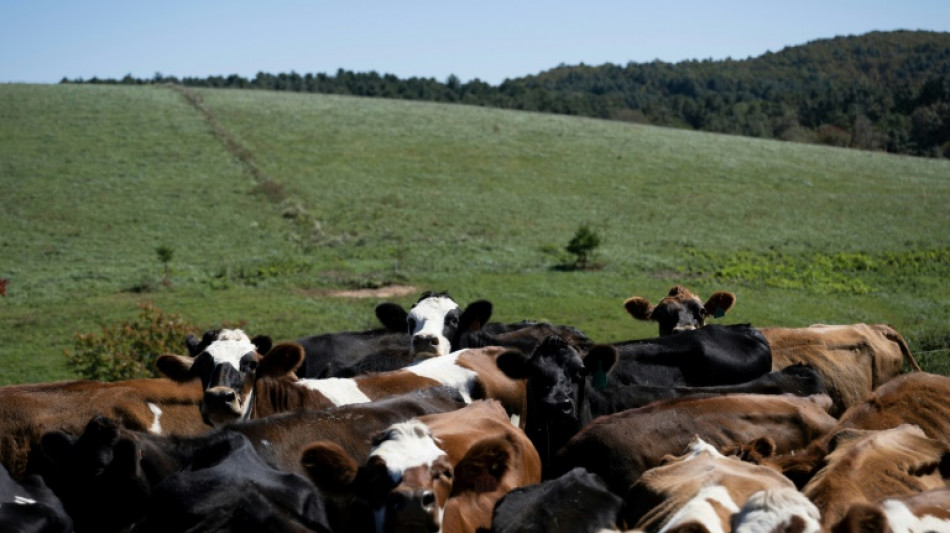
US cheesemakers learn to live with raw-milk regulations / Photo: Brendan Smialowski - AFP

 Trump's beef policies irk Texas ranchers, testing their loyalty
 Nvidia, OpenAI CEOs to attend Xi dinner at White House

 Anthropic picks Accenture for in-house AI safety evaluation
 Balogun returns as Monaco beat Lens to continue strong Ligue 1 start

 'Pause' on overt repression in Venezuela, but reforms still needed: HRW

 Global stocks mixed as yen falls despite Bank of Japan rate hike

 Cuba hit with seventh major blackout of the year

 Murray out with concussion so Wentz will start for Vikings

 UN chief 'deeply regrets' US visa refusal to Abbas for annual meeting

 England quick Carse to face no charges over alleged nightclub assault

 Mancini brings nine newcomers into the first squad of his Italy comeback

 Czechs level Davis Cup tie against USA as South Korea eye Finals

 New France boss Zidane confirms Mbappe as captain after naming first squad

 California governor signs order to explore AI 'kill switch'
 Head leads run spree as Australia win Zimbabwe ODI series

 In-form Raphinha wants to finish career at Barcelona

 Warren Buffett steps down as Berkshire Hathaway chairman

 Carrick confident Man Utd can 'work through' tough time

 Mbappe ends Nike partnership to join Swiss brand On

 Liverpool boss Iraola puts Bournemouth love affair on hold
 'A disaster' if Man City do not win says Maresca after flawless start
 Kerry James Marshall: American 'blackness' painter celebrated in Europe

 Spain coach De la Fuente offers 'full support' to people of Ceuta

 Russia seizes assets of Nestle, French firms over West's Ukraine support
 England can build on World Cup 'spirit', says Tuchel

With its brown-and-white cows grazing on a grassy hillside high in the Appalachian Mountains, Meadow Creek Dairy is not like most other American cheesemakers: its products are made from unpasteurized, or "raw" milk.
The small family business in the eastern United States is a rarity in the nation's dairy market, dominated by industrial cheesemakers exclusively using pasteurized milk.
In their blue overalls and caps, Helen Feete and Ana Arguello work before huge vats, each containing hundreds of gallons of milk.
Feete, who founded the dairy with her husband in the 1990s, told AFP that when they started out "there weren't any models for us to follow" -- few small dairy farms were trying to make cheese from raw milk.
Methods viewed as traditional in Europe -- even the source of regional pride -- are seen as nearly taboo on the other side of the Atlantic.
The essential difference is that pasteurized milk has to be heated -- to 63 degrees centigrade (150 Fahrenheit) for 30 minutes, or 72 degrees centigrade (162 Fahrenheit) for 15 seconds.
That kills the microflora in the milk, which has a major impact on flavor -- and not for the better, say partisans of the raw-milk approach.
There is "a complexity of flavor and a uniqueness of flavor... that is only possible when the milk is unpasteurized," said Liz Thorpe, an American author of books on cheese.
- 60 days' aging -
Detractors of unpasteurized cheeses, on the other hand, say there is a higher risk of bacteria and microbes in raw milk, which can cause potentially lethal diseases such as salmonella and listeriosis.
The US Food and Drug Administration (FDA) requires the "mandatory pasteurization for all milk and milk products in final package form intended for direct human consumption."
But since the 1940s, the agency has allowed the sale of raw-milk cheeses so long as they have been aged at least 60 days at temperatures above 2 centigrade (36 Fahrenheit).
- 'Frustrating' -
"That's not so much a hurdle, it’s something that we have to build our cheeses around," said Kat Feete, who has worked much of her life with her parents and brother at Meadow Creek.
The FDA's 60-day rule is meant to provide time for all dangerous pathogens in raw milk to die off, but it prevents the sale of raw-milk-based soft cheeses that mature quicker than that.
"It can be frustrating that there are certain types of cheeses we can’t do," said Kat Feete. "A lot of people would love to have a raw-milk brie or something small like that."
Most of Meadow Creek's cheese are semi-hard. Produced seasonally -- depending on what the cows eat at different times of year -- they mature in the dairy's cellars, where the temperature and humidity is regulated.
A top seller, a semi-hard cheese called the "Grayson," might be compared to a Reblochon from the Alps, or to a Maroilles from the north of France.
- 'Not correct' -
Meadow Creek Dairy and other raw-milk cheesemakers in the US face another obstacle: many American consumers remain skittish about buying a product they think may be unsafe.
"So many people in the US think that raw-milk cheese patently is illegal, and that's not correct," said Thorpe. "There's a lot of misconceptions."
She said she works hard to inform the public that such cheeses are "perfectly healthy, safe and good," adding that it's important for a consumer to know where a cheese comes from.
In Meadow Creek's early days, "there was a little bit more trouble with educating the market to what we were doing because there was a perception that it was not very safe," Kat Feete said.
But that is beginning to change, she said.
"I think people are really starting to accept that raw-milk cheese is a safe and a good way for a farmstead small cheesemaker to produce cheese."
A.Moore--AT