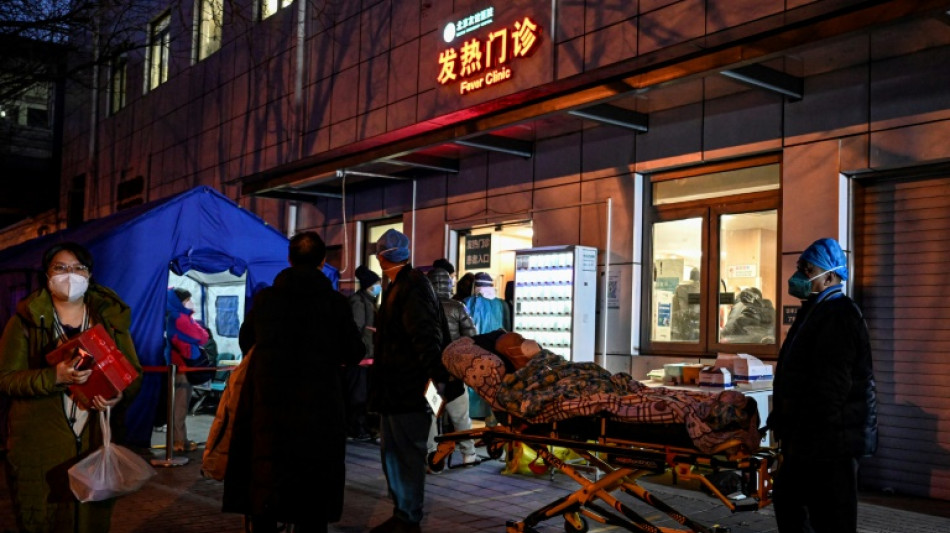
China's propaganda machine sputters in zero-Covid reversal / Photo: JADE GAO - AFP

 Bank of Japan hikes rates to 31-year high to battle inflation
 Thailand's Muslim separatists vow to fight to the end
 Mideast turmoil, AI set to dominate UN gathering of world leaders
 Australia to detain tourists who overstay visa, minister says

 Championship rivals brace for renewal of bitter feuds

 In Brazil's Amazon, the hunt for oil fuels hopes and fears
 Australian athlete who soiled herself apologises for continuing Hyrox race
 Baby orangutans in India expose 'frightening' scale of trafficking
 Doom Loop? Ed Sheeran struggles against Gaza tide
 Sudanese women hold fast to threatened henna body art

 Man Utd misery puts Carrick under pressure, Spurs feeling the heat
 Prized Mexican relic returns on loan, two centuries on

 Venezuela unblocks some censored news sites
 Samba stars on debut in Man City rout of Norwich

 Oversight Board blasts 'inadequate' Meta safeguards for AI deepfakes
 The Easter Island origins of buzzy Malkovich drama 'Wild Horse Nine'

 Third body recovered after Grand Canyon flash flood
 Harry makes first public appearance since return to UK

 Abhishek hits record T20 ton as India sweep series 3-0

 Abhishek hits record T20 ton as India sweep T20 series 3-0

 English FA calls for Infantino to release World Cup sell-off documents
 GM delivers first components for US interceptor missiles

 Trump admin overhauls key protection for endangered species
 Abhishek hits record T20 ton as India post 221-7 against Afghanistan
 Macron hosts Lebanon security talks to back 'indispensable' army

China's state media is struggling and censors are working overtime as Beijing gropes for a coherent narrative in the wake of the sudden reversal of its hallmark zero-Covid policy.
For years, the country's propaganda apparatus hailed zero-Covid as proof of the superiority of the Communist Party's authoritarian rule and the wisdom of powerful President Xi Jinping.
But now its usual mouthpieces have been left to spin the decision to scrap strict travel curbs, quarantines and snap lockdowns as a victory even as cases soar.
"State media has not come up with a grand narrative to fully legitimise the sudden and radical change," said Kecheng Fang, an assistant professor at the Chinese University of Hong Kong's School of Journalism and Communication.
"They were caught by surprise."
The "inconsistent messaging" indicated that the propaganda apparatus may lack adequate directives from the party on how to frame the situation, he told AFP.
- 'A stirring battle' -
Some outlets have hinted that not all is well, with state news agency Xinhua and state broadcaster CCTV this week running reports urging people to use Covid medicines "rationally" and highlighting government efforts to guarantee supply.
But government-run publications have refrained from reporting the grimmer side of the exit wave, instead seeking to calm fears of the pathogen's potency and depicting the policy shift as a logical, controlled and triumphant withdrawal.
"Looking back on the last three years, we have waged a stirring battle against the pandemic and gone through an arduous historical test," read an editorial in the party-run People's Daily newspaper last week.
Zero-Covid "demonstrated the superiority of China's socialist system", it said, adding that "optimising" the policy now would help to adapt to new virus variants while "putting the lives and health of the people and masses first".
There has also been a reluctance to address the mounting Covid caseload.
On Friday, a party-run newspaper cited an official estimate of half a million daily new cases in the eastern city of Qingdao. By Saturday, the story had been amended to remove the figure, an AFP review of the article showed.
And while Xi's recent flurry of diplomatic engagements has dominated the headlines, he has not yet commented publicly on the collapse of what was until recently a signature policy.
- 'Severe cold' -
A similar sense of uncertainty has pervaded Chinese social media, where censors routinely scrub out politically sensitive content.
Several posts on the popular Weibo platform purporting to describe Covid-related deaths appeared to have been censored by Friday afternoon, according to a review by AFP journalists.
They included several blanked-out photos ostensibly taken at crematoriums, and a post from an account claiming to belong to the mother of a two-year-old girl who died after contracting the virus.
Posts about medicine shortages and instances of price gouging were also taken down, according to censorship monitor GreatFire.org.
And social media users have posted angry or sardonic comments in response to the perceived taboo around Covid deaths.
Many rounded on a state-linked local news outlet after it reported Wu Guanying -- designer of the mascots for the 2008 Beijing Olympics -- had died of a "severe cold" at the age of 67.
One commenter likened the phrasing to China's dictatorial neighbour North Korea, while another asked: "Is it illegal to say 'Covid' now?"
Yet other critical posts remained online as of Friday afternoon -- including many that took the government to task for its perceived lack of an exit strategy.
"Did they really believe they could wipe out the virus with lockdowns?" read one.
"Three years, and they never made a contingency plan for when it couldn't be controlled?"
Fang, the assistant professor, said Chinese officials would "eventually find a way to frame everything as a victory, maybe after the infection situation stabilises".
"The unique way of counting Covid deaths is already providing a basis for that," he added -- referencing a new government definition of virus deaths that excludes many fatalities.
China on Saturday officially recorded no new deaths from the virus, according to figures from the National Health Commission.
A Weibo hashtag relating to how the country defines Covid deaths -- counting only those who die from respiratory failure after testing positive -- was censored.
H.Gonzales--AT