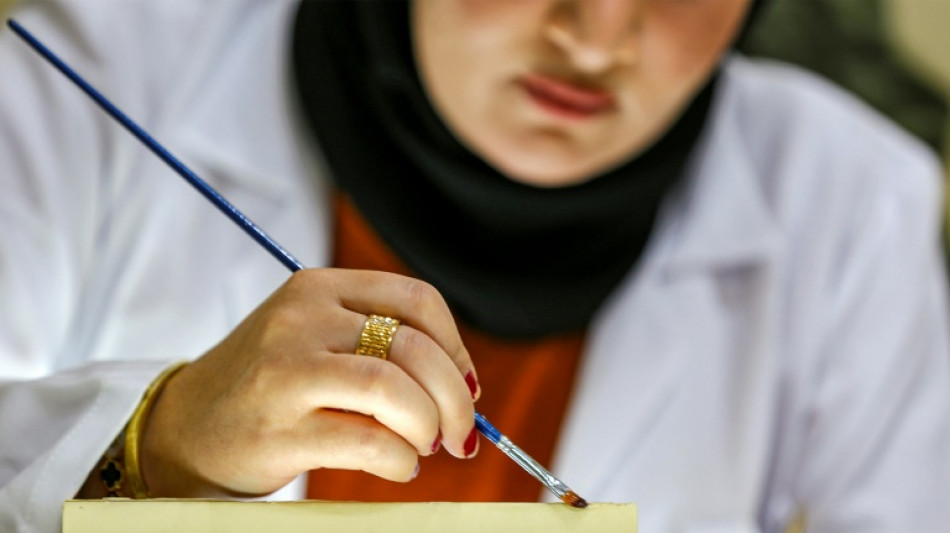
Iraqi conservators strive to preserve ancient manuscripts / Photo: Sabah ARAR - AFP

 Princess Diana's brother makes new explosive claims against Charles

 Ovechkin on Russian political video: 'I support my country'
 Can we shut down AI?
 Teenager Sullivan named in new-look US squad

 Travis Scott and Keith Richards feature on GTA VI soundtrack

 AFP photo shows Trump examining image of apparent Kennedy Center razing
 Pochettino rings changes for USA friendlies

 Alonso says Chelsea ambition 'very clear' after end of Boehly era

 Mbappe draws political fire over Ceuta t-shirt controversy
 Third malaria death in Germany from outbreak tied to Frankfurt airport
 AtlasClear Holdings Reports Preliminary Fiscal 2026 Revenue of Approximately $20.1 Million, Up 85%; Revenue Plus Interest Income of Approximately $21.9 Million
 Alonso says Chelsea ambition clear after end of Boehly era

 Micron's Taiwan workers say 68 months' bonus not enough

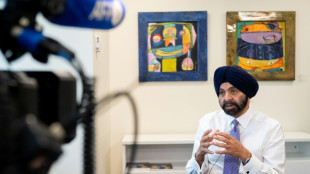 'Another arrow to the quiver': World Bank posts record private capital mobilization

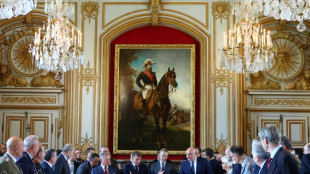 Macron hosts Lebanon security talks as UN mission nears end

 From land to race laws: what's driving the US-South Africa rift?

 Beyond Investment Returns: Families Are Measuring Wealth by Freedom, Continuity, and Legacy, According to Nour Private Wealth
 King Charles disputes claims in book by Princess Diana's brother

 Real Madrid fan group wants Mbappe apology over Ceuta shirt snub

 Nepal floods among 'most challenging' disasters: WFP
 Doubts as Italy eyes electric future for steel plant
 'One of the kindest people': Taraneh, 21, facing execution in Iran
 Japan eyes changing prostitution law to punish sex buyers

 After record rain, typhoon threatens new challenge to Asian Games
 Kids and social media: what would change under new EU law
In an annex of Iraq's national museum, a conservator pores over a 17th-century manuscript, carrying out delicate restoration work as part of efforts to preserve and digitise 47,000 precious texts.
"Some manuscripts date back almost 1,000 years," said Ahmed al-Alyawi, who heads the House of Manuscripts body.
"There are writings in Arabic, Persian, Turkish, Hebrew and Kurdish," he added, noting the texts' "immense cultural diversity".
In a country that bears the scars of decades of conflict and has seen antiquities and cultural heritage regularly plundered, the House of Manuscripts' collection has managed to survive.
It was safely stashed away in the Baghdad suburbs, while the national museum was ransacked in the turmoil following the 2003 US-led invasion. Employees and residents prevented subsequent looting attempts at the "underground shelter" where it was stored, Alyawi said.
The collection, now ensconced in the national museum in the capital Baghdad, includes books, parchments and calligraphy boards, some of them damaged by humidity, pests and centuries of use.
Some manuscripts date from the early Abbasid era, while some seventh-century calligraphy boards in Kufic script were written on parchment "even before the manufacture of paper", Alyawi said.
- 'To live longer' -
A conservator wearing a white lab coat brushed dust from a gnarled board, as a colleague cut fine paper to repair a 17th-century Persian text dedicated to the Shiite religious commemoration of Ashura.
Each intervention must "preserve the old appearance" of a work, said Tayba Ahmed, 30, who has been doing restoration for three years.
But it also must reduce any damage to the work "so that it can live longer", she added.
A text "may not have a cover, the pages might be detached, you may have to sew and make a leather cover", she said.
"You can spend several months with the same book."
Ahmed is one of seven Iraqi conservators who are currently undergoing training, funded by the Italian embassy, to help them carry out their colossal restoration mission.
The programme involves working with Italian expert Marco Di Bella, whose country has previously funded equipment for the House of Manuscripts' offices, including lighting.
Peering over an 18th-century Ottoman astronomy book, its pages filled with elegant black ink calligraphy, Di Bella made comments in English that were translated into Arabic.
"The most complex process is... deciding what to do and how to intervene on the manuscript", the Italian conservator told AFP.
"Every single manuscript is assessed... we describe the damage" and try "to understand... the origin" of each piece, he added.
The programme also helps reintroduce traditional conservation materials that are now coming "back into fashion", Di Bella said, such as starch as an adhesive.
- 'Heritage of our country' -
While his team has just four scanners to digitise the entire archive, Alyawi decried a lack of funding that prevented purchasing other specialised equipment or hiring more staff.
Despite the obstacles, Alyawi expressed optimism that his teams could restore up to 100 works per year -- making a slow dent in the potentially thousands of works requiring attention.
The House of Manuscripts archive "is a leading collection in Iraq and the region", said Zakaria Haffar, Iraq project manager at the National Library of France (BNF).
In October, the House of Manuscripts signed a partnership with the BNF, following financial support from the Aliph Foundation, which works to protect cultural heritage in conflict zones.
In addition to providing materials -- such as specialist paper and leather -- the cooperation will see an "exchange of skills" to assist with digitisation, restoration and cataloguing, Haffar said.
Mayassa Shehab, who has worked in restoration for half her life, said the preservation and digitisation mission is of immense importance.
"It is the heritage of our country", the 52-year-old said. "As it has been handed down to us, we must pass it on to future generations."
M.Robinson--AT