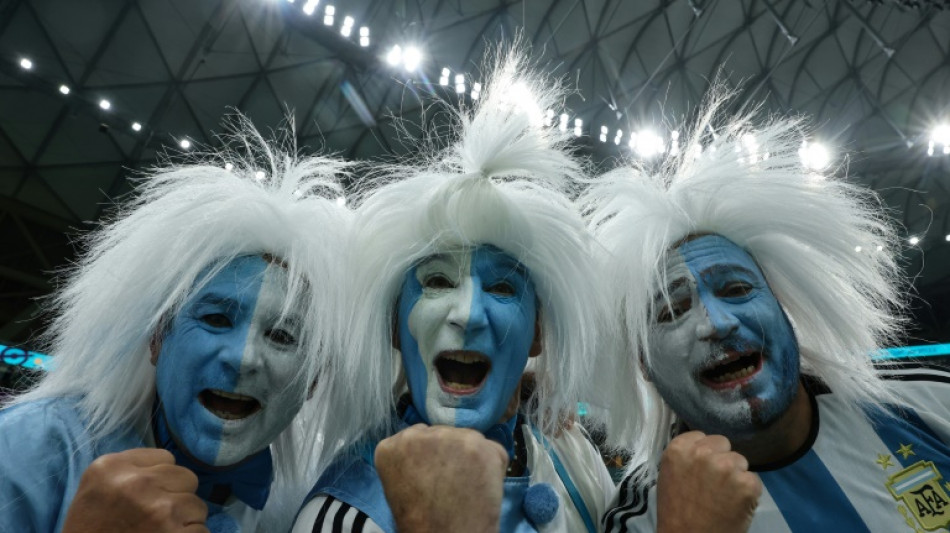
It's no joke: Across globe, satire morphs into misinformation / Photo: Giuseppe CACACE - AFP/File

 Real Madrid fan group wants Mbappe apology over Ceuta shirt snub

 Nepal floods among 'most challenging' disasters: WFP
 Doubts as Italy eyes electric future for steel plant

 'One of the kindest people': Taraneh, 21, facing execution in Iran

 Japan eyes changing prostitution law to punish sex buyers

 After record rain, typhoon threatens new challenge to Asian Games

 Kids and social media: what would change under new EU law

 Modi pitches India as global chipmaking hub
 Ukraine plans record defence spending in 2027

 Klopp calls up 44 players in huge first Germany squad
 STARPRIME Responds to Diverging Gold Market Demand with AM/PM Fixing and XAU24/7

 Ukrainian fashion designer debuts art between air raids

 Gambian businesses struggle under prolonged blackouts

 Fiji declares national HIV crisis

 Australia to cut migration to fix housing crisis: minister

 NASA scan discovers new, 'once in a century' Moon crater

 Most stocks rise as Fed hikes and indicates drive to curb inflation
 US again denies Palestinian leader Abbas visa to attend UN assembly

 Lula says he will go to UN to tell Trump to 'stay out' of Brazil's elections

 Messi heads Inter Miami to Campeones Cup triumph

 AI looms large ahead of Xi, Trump summit

 Smith still haunted by 'Sandpapergate' as he prepares for South Africa Tests
 UK-Sudanese author pens book to give children 'African history of Africa'
 Boehly and Walter sell Chelsea stake to Clearlake Capital

 Banyan Gold Intersects 1.05 g/t Gold over 52.8 metres and Bonanza-Grade Gold at Powerline Deposit, AurMac, Yukon, Canada

Is a US state considering a tax on breathing? Is celebrating goals forbidden during the Qatar World Cup because that is "too gay?" Did insect repellent manufacturers recruit a Ugandan man for his mosquito-killing farts?
Satire, parody and jokes packed with absurdity typically draw laughter, but around the world they are too often mistaken as real, prompting fact-checkers to debunk what they call a leading source of misinformation despite pushback from their publishers.
Several satirical outlets mimic legitimate media websites, often sowing confusion among readers with what appear to be typical news articles but are in fact fabricated stories.
Sometimes even with disclaimers clearly marking their articles as satire, many readers take them at face value.
"Satire can mislead more than you'd think," Shannon Poulsen, who researches the link between humor and misinformation at Ohio State University, told AFP.
"Given that I find new examples of people falling for it every day, I'd say it is a notable and consequential form of misinformation."
The humorous fiction often makes the internet erupt with laughter, but researchers are not laughing about its potential to fool the public, which sometimes includes media organizations.
- Debunking humor -
In September, during a live broadcast on France's CNews television channel, presenter Pascal Praud attributed to the country's energy minister remarks that were invented by a parody Twitter account.
A version of the article about the man with the "deadly farts", which AFP traced to a parody website, was published by the British tabloid The Sun and drew thousands of interactions on Facebook.
The one about the Qatar World Cup, published last month by the satirical section of Germany's Die Welt newspaper, was widely shared as authentic news on Facebook, Telegram and Twitter.
In the United States, stories by the popular satirical website The Onion are so often mistaken as real that online forums have sprung up to ridicule those who fall for them.
But despite such errors, satirists have lashed out at fact-checking websites for debunking their content.
In September, the Indian satirical website Fauxy served a legal notice to the Mumbai-based fact-checker Boom Live, accusing it of damaging its reputation after it labelled one of its articles fake.
Boom's editor Jency Jacob contends the action was necessary as many gullible readers were sharing it on social media as legitimate news.
"We usually avoid debunking satire as we believe it is a valid form of expression," Jacob told AFP.
"But we have done it when we felt it was created without adequate disclaimers and if the satire was widely believed to be true."
- 'Key frustration' -
Platforms such as Facebook and Instagram say they reduce the circulation, visibility -- and potential for profit -- of links that are labelled misinformation. But some websites peddling misinformation skirt the barrier by labelling their content satire, researchers say.
Still, the restriction has faced pushback from American satirical websites such as Babylon Bee, which last year accused Facebook of suppressing its content with a drastic decline in reach and engagement.
That followed a 2018 tussle over a Babylon Bee article flagged as false on Facebook, which researchers said highlighted the thin line between satire and misinformation.
"Satire should not be treated as misinformation -- that appears to be a key part in the frustration from satirical sites," Poulsen said.
"We should communicate the satiric intention of a message because it reduces the chances people misinterpret satire as real. But many satirists do not want satire to be labeled as they worry it'll make their content less funny."
- 'Evil twin' -
Last year, Facebook announced that it will add labels such as "satire page" to posts that appear in the news feeds of users to clearly differentiate them from real information.
Third-party fact-checkers working with Facebook, which includes AFP, can append their own fact-checks to the bottom of satirical posts for the same reason.
But the problem persists.
Last month, authentic-looking imposter or parody accounts proliferated on Twitter, pretending to be celebrities or companies, after it first rolled out a paid subscription service.
The platform suspended the service, known as Twitter Blue, but it was relaunched this week with what the company said was a stronger review process.
"Imposter content is the evil twin to satire or parody content," Philip Mai, co-director of the Toronto-based Social Media Lab, told AFP.
"Bad actors will often put some effort into creating look-alike content that mimics their real-life counterparts so that they can prey on users' inattention... We need to encourage the public to pause before they share."
burs-ac/md
O.Ortiz--AT