Sixty years ago: when the Berlin Wall went up

 Muchova squeaks out win over Osaka to reach China Open quarter-finals
 Kenya reports first-ever Ebola death

 Tennis world No.1 Sinner's season over due to knee injury
 Yemen's Houthis claim attack on Riyadh airport, deny losing territory
 7-Eleven exits India amid mounting competition
 The alleged murder by US marine on Okinawa: five things to know

 End of an era as Messi prepares to hang up Argentina boots

 Superstar duo headline strong New Zealand squad for Rugby League World Cup
 South Korea warns of possible AI use in banking hacks

 EU vows AI rules will protect Europeans. Will they?

 Myanmar leader to visit Malaysia after migrant returns begin
 Germany's AfD poised to preside over state assembly for first time
 Australia's opposition vows 'largest cut to immigration' in country's history
 Ready, set, snooze: Sleep-deprived Japanese compete for best-rested

 Falcons thump Saints 45-24 as New Orleans marks Katrina anniversary

 Tuvalu govt adviser says Australia overstepped in pre-COP visit
 Asian stocks mixed despite tech-led Wall St record
 Tens of thousands expected in Paris for high school protests
 AI borrowing binge rattles US markets

 Young Canadians sue government over alleged climate failures

 White Sox down Guardians to take 2-0 series lead
 CPG Industry Veteran Sandro Piancone Featured Guest on "Straight Talk with DJ Doc" Podcast Discusses New Book Wholesale MBA and the Future of Consumer Packaged Goods

 Pineapple Express Strain Guide Compares Conflicting Lineage Records and Historical Lab Data

 InterContinental Hotels Group PLC Announces Transaction in Own Shares - October 06

 Leaders visit Pacific atoll at frontline of climate change

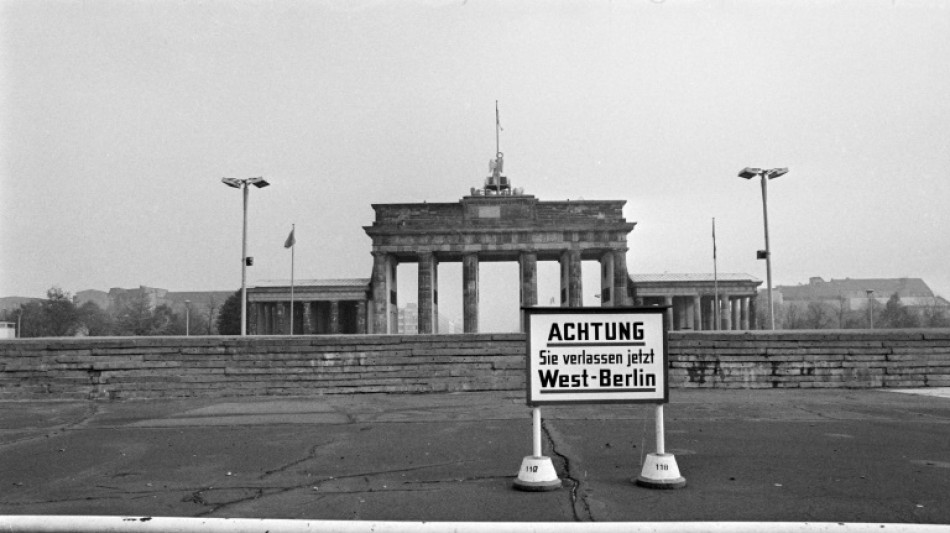
In the early hours of Sunday, August 13, 1961, communist East Germany's authorities began building the Berlin Wall, cutting the city in two and plugging the last remaining gap in the Iron Curtain.
Rumours that the border between East and West Berlin was about to be closed had been swirling for 48 hours.
On Friday, the parliament or People's Chamber of communist German Democratic Republic (GDR) had given the green light to take any measures necessary to halt the exodus of its population westwards.
Over the preceding 12 years, more than three million citizens had fled the strict regime, opting for the freedom and prosperity offered by West Germany.
- News flashes -
At 4:01 am on that Sunday, a top priority AFP flash dated Berlin hit the wire: "The army and Volkspolizei are massing at the edge of the Eastern and Western sectors of Berlin to block passage."
In a second flash, the story was firmed up. "Berlin's metropolitan trains have for the past two hours not been going from one sector to the other."
Then one flash after another fell:
- 4:28 am: "The GDR's Council of Ministers has decided to put in place at its borders, even at those with the western sector of Berlin, the checks usual at borders of a sovereign state."
- 4:36 am: "An order from the East German interior ministry forbids the country's inhabitants to go to East Berlin if they do not work there."
- 4:50 am: "Inhabitants of East Berlin are forbidden to work in West Berlin, according to a decision by the East Berlin city authorities."
- Barbed wire and guns -
In the very early morning, AFP's correspondent at the scene described the situation on the ground.
"Barbed wire fences and defensive spikes have been put in place overnight to hermetically seal the border between East Berlin and West Berlin.
"The road is practically cut off for refugees.
"Most of the crossing points between the two sides of the city have been cut off since sunrise and are heavily guarded by the police patrolling with machine guns on their shoulders.
"Only 13 border crossings remain open between the two Berlins, controlled by numerous reinforced units of armed police.
- Dramatic escape -
"Germans from East Berlin can no longer go to the West without a special pass, the controls are excessively strict.
"As the net falls over the communist part of the city, a young Berliner from the East manages against all odds to ram with his car the barbed wire separating the two sectors of the city.
"Seeing the young man arriving at high speed in a Volkswagen, the police were too taken off guard to be able to stop the car, which carried the barbed wire placed across the street right to the French sector," AFP wrote.
- 'Death strip'-
Little by little, the kilometres of barbed wire will give way to a 43- kilometre-long (27-mile-long) concrete wall cutting the city in two from north to south.
Another outer wall, 112 kilometres (70 miles) long, cuts off the enclave of West Berlin and its two million inhabitants from the GDR.
Constantly upgraded over its 28 years of existence, more than 100 kilometres (60 miles) of the wall is made up of slabs of reinforced concrete, 3.60 metres (12 feet) high, crowned with a cylinder without a grip making it almost impossible to climb.
The remainder is made of metal wire.
Along the eastern side of what is widely called the "wall of shame" stands a "no man's land", 300 metres (990 feet) deep in places.
At the foot of the wall a "death strip" made up of carefully raked ground to make it possible to spot footprints, is equipped with installations that set off automatic gunfire and mines.
However hermetic this formidable "anti-fascist protection rampart", as it was officially known, would be, it would not prevent the escape of nearly 5,000 people until it fell on November 9, 1989. Around 100 fugitives lost their lives trying to cross over.
Y.Baker--AT