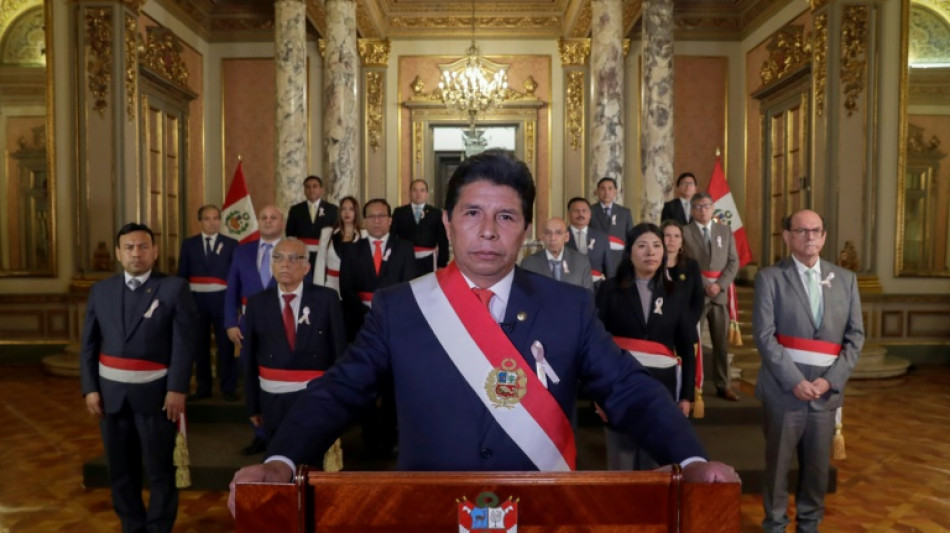
OAS mission will 'analyze' Peru political crisis / Photo: Luis Iparraguirre - Presidencia de Perú/AFP/File

 Qatar Facilities Management Market to Reach $11.15bn by 2032

 Black Friday Discounts Cut Prices on Two Top-Rated Wiper Blades

 Twickenham Grounds Team Prepares Pitch for Six Matches in Three Days

 Luxembourg City Plans €13 Million Abrigado Centre for 2029

 Two A1 Crashes Create Kilometres of Rush-Hour Congestion

 South Africa Places 36 Hospitals on Standby for Possible Imported Ebola Cases

 TCC Network Linked to 200% Surge in Global School Attacks

 Beyond Black Friday: A Guide to This Week’s Holidays and Deal Days
The Organization of American States said Thursday it will send a "high-level group" to Peru after President Pedro Castillo asked for the body's help in tackling the country's political crisis.
The decision came during a special OAS Permanent Council session in Washington following embattled Castillo's announcement late Wednesday he had sought the body's help to foster a national dialogue.
The council adopted a resolution offering "solidarity and support" for the "preservation of the democratic political institutional process" in Peru, calling on "all actors" to work within the "rule of law."
The OAS designated "a high-level group consisting of representatives of member states, and consistent with the Inter-American Democratic Charter, to visit Peru in order to analyze the situation and report to this council," the resolution said.
Addressing the nation live on TV Wednesday, Castillo said he had last week asked the 35-member OAS to invoke its "democratic charter," which sets out the body's mission "to promote and consolidate representative democracy."
Under the document, a member state can ask for assistance "for the strengthening and preservation of its democratic system" if it fears this to be at risk.
On Thursday, the OAS declared it was available to "provide support and cooperation" in "promoting dialogue and strengthening its democratic system of government."
Castillo, a former rural school teacher, has been under nonstop fire since unexpectedly taking power from Peru's traditional political elite in elections last year.
He has survived two impeachment attempts since taking office in July 2021 and is the target of six criminal investigations for alleged graft and plagiarizing his university thesis.
In addition to these, Peru's attorney general last week filed a constitutional complaint accusing Castillo of heading a criminal organization involving his family and allies.
The complaint -- the first of its kind against a sitting president -- must be examined by parliament, and unlike a criminal case, can lead to Castillo's suspension. Fewer votes are required than for impeachment.
- 'Not corrupt' -
Castillo, serving a five-year term that ends in 2026, cannot be criminally tried while in office.
In recent months, police have raided the presidential palace in Lima, where Castillo resides, as well as his private home in rural Peru in search of evidence to back the corruption claims.
On Wednesday, Castillo accused "the money sectors, the traditional politicians who have always thrived on corruption" of being behind the "coup" attempt against him.
"I am not corrupt," he insisted on Twitter.
Peru is no stranger to instability: It had three different presidents in five days in 2020, and five presidents and three legislatures since 2016.
But six open investigations into a sitting president is unprecedented.
Also on Thursday, Fitch Ratings downgraded its assessment of Peru's long-term debt outlook to "negative" from "stable" in response to the "weakening of Peru's political governance institutions."
"A deterioration in political stability and government effectiveness has increased downside risks to Peru's ratings," it said.
T.Perez--AT


