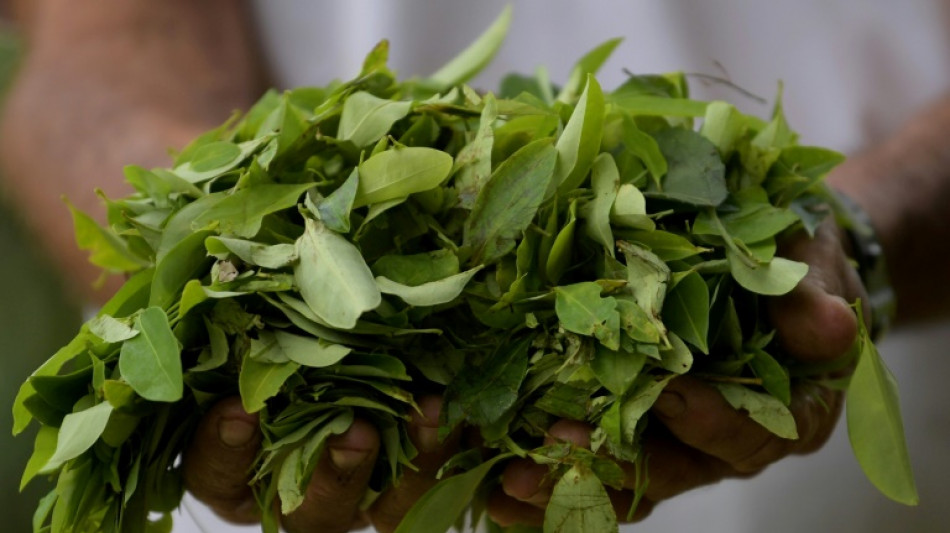
Colombia breaks coca-growing record, slams 'war on drugs' / Photo: Raul ARBOLEDA - AFP

 Qatar Facilities Management Market to Reach $11.15bn by 2032

 Black Friday Discounts Cut Prices on Two Top-Rated Wiper Blades

 Twickenham Grounds Team Prepares Pitch for Six Matches in Three Days

 Luxembourg City Plans €13 Million Abrigado Centre for 2029

 Two A1 Crashes Create Kilometres of Rush-Hour Congestion

 South Africa Places 36 Hospitals on Standby for Possible Imported Ebola Cases

 TCC Network Linked to 200% Surge in Global School Attacks

 Beyond Black Friday: A Guide to This Week’s Holidays and Deal Days
Colombia, the world's leading cocaine producer, broke its own record for coca leaf cultivation in 2021, a UN body said Thursday, as the government highlighted the "failure" of the US-led war on drugs.
There was "an increase of 43 percent in the area planted with coca... from 143,000 hectares in 2020 to 204,000 ha in 2021," the UN Office on Drugs and Crime (UNODC) said in a statement.
This was the highest figure since the UNODC started monitoring Colombia's cocaine production 21 years ago.
The increase in coca cultivation went hand-in-hand with a rise in cocaine production from 1,010 tons in 2020 to 1,400 tons last year, destined mainly for the United States and Europe.
This continued an "upward trend that has been consolidating since 2014," said the UNODC.
At the presentation of the report in Bogota, Justice Minister Nestor Osuna said the numbers were clear evidence "of the failure of the war on drugs."
He said the government was working on a new drug policy, which for now would not include legalizing cocaine.
But he expressed the hope that "one day" the cocaine trade will be regulated at a global level.
As part of a new approach, Colombia's leftist President Gustavo Petro has mooted an amnesty for drug traffickers willing to give themselves up and abandon the trade.
He has also proposed purchasing arable land to redistribute to small farmers to make a living from legal crops, free from the violent yoke of the drug gangs they rely on to make a living.
- 'Holistic approach' -
Petro considers small-scale coca growers the victims of a state that for years poisoned their land with pesticides to eradicate the illegal plantations.
Thousands of coca growers and pickers are behind bars on trafficking charges in Colombia.
Petro's predecessor, Ivan Duque, had been a key ally of the drug war led by the United States -- the world's leading cocaine consumer.
Earlier this month, US Secretary of State Antony Blinken met Petro in Colombia, saying afterwards they shared "extensive common ground," despite the new president's change of tack.
"We strongly support the holistic approach the Petro administration is taking," Blinken said after the meeting.
"On both the enforcement side but also on the comprehensive approach to the problem... I think that we're largely in sync," he added.
The UNODC said coca cultivation "continues to threaten the cultural potential of the country and its biodiversity," contributing to deforestation.
Half of the plantations are in special management areas, it said, and a high percentage on the lands of black communities and in forest reserve areas.
D.Lopez--AT


