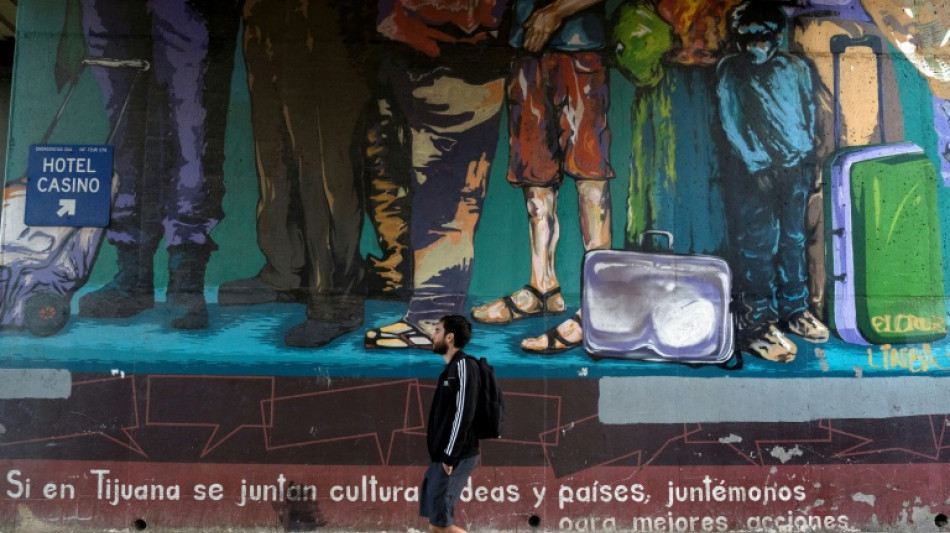
Mexico: the promised land for migrants... from the US / Photo: Guillermo ARIAS - AFP

 Qatar Facilities Management Market to Reach $11.15bn by 2032

 Black Friday Discounts Cut Prices on Two Top-Rated Wiper Blades

 Twickenham Grounds Team Prepares Pitch for Six Matches in Three Days

 Luxembourg City Plans €13 Million Abrigado Centre for 2029

 Two A1 Crashes Create Kilometres of Rush-Hour Congestion

 South Africa Places 36 Hospitals on Standby for Possible Imported Ebola Cases

 TCC Network Linked to 200% Surge in Global School Attacks

 Beyond Black Friday: A Guide to This Week’s Holidays and Deal Days
While many migrants risk their lives chasing the American dream, Gabriel Zarate fled the rising cost of living in California and moved to the Mexican border city of Tijuana.
The 38-year-old Chilean American now crosses over to work in San Diego as an English teacher during the day and returns home in the evening to Mexico.
"One of the biggest reasons is the cost of living in Tijuana. It's significantly cheaper than in California," Zarate said.
Also, he added: "I love Mexican people and food."
His neighbor and fellow English teacher Mike Rachfal also made the move from San Diego, where he used to pay $1,275 a month to rent a studio.
"Here it's about half that," the 36-year-old said.
The cheaper rents can be a sensitive subject in Mexico, where wages are much lower than in the United States and people are also facing increasing living costs.
Tijuana is one of the cities with the fastest-rising real estate prices in Mexico -- up 10.7 percent in the first quarter of 2022 from a year earlier, according to the state-owned Federal Mortgage Society.
The average price of properties bought by US citizens is around $270,000 -- "three times lower than what the same property would cost in the United States," said Ruth Sastre, president of the local realtors association.
- Construction boom -
In Tijuana, a bustling city with a reputation for gang violence, new apartment buildings are springing up with "For Sale" signs in English and prices in dollars.
With more than 1,000 murders in the city already this year, security is an important consideration, but Zarate said that "in general I feel fine in Tijuana, especially downtown or around the border."
"It's like any big city. There will always be places rougher or more complicated than others," he added.
It is a similar story just south of Tijuana in Rosarito on the Pacific coast.
Following a real estate boom that began a decade ago, up to around 12,000 people from the United States now live in the resort city, said Jesus Rincon Vargas, president of the local construction industry association.
In total around 1.6 million US citizens are estimated to live in Mexico, according to their country's embassy, which does not keep official records.
They can stay for up to six months with a tourist visa, or apply for residency.
- 'Friendly culture' -
Along with the lifestyle and cost of living, the relatively relaxed immigration rules are part of the appeal for remote workers flocking to Mexico, notably the capital.
Brian McDonald, a 34-year-old software developer from the US state of Oklahoma, has spent more than a year in the Latin American country, lured by its budding technology scene.
"Mexico City seems like it's kind of a gateway for expanding companies and I like working with start-ups," he said.
"It's a very friendly culture," McDonald added.
Office-sharing company WeWork has seen a "significant influx of digital nomads" in districts of Mexico City popular with foreigners, said spokeswoman Cristina Sancen.
"Mexico City has an incomparable climate. For foreigners, it's definitely a cheaper city. It's also a cosmopolitan and highly developed city with start-ups and corporations," she added.
Some foreigners working for US firms are also choosing to base themselves south of the border.
Kirsty Hall, 23, from Scotland, picked Mexico City as a remote working location while helping to set up a San Francisco-based tech start-up.
"I can walk everywhere here. I can cycle. Today I roller-skated to work. Public transport is awesome and it's very cheap. People are very welcoming too," Hall said.
The influx of foreigners has divided opinion among residents of the capital, some of whom see the city's popularity as one of the reasons behind gentrification and rising rents.
"I heard there's some prejudice towards digital nomads within Mexico City but I haven’t experienced it personally," said Blazej Mosinski, 23, from Poland, who is doing a San Francisco internship remotely "purely for financial reasons."
Other challenges of working remotely in Mexico include slower internet speeds than in US technology hubs and safety concerns.
"I was robbed by the police two weeks ago, just walking home," McDonald said.
But "the rest -- the good food, the cost of living -- offsets all of those things," he added.
S.Jackson--AT


