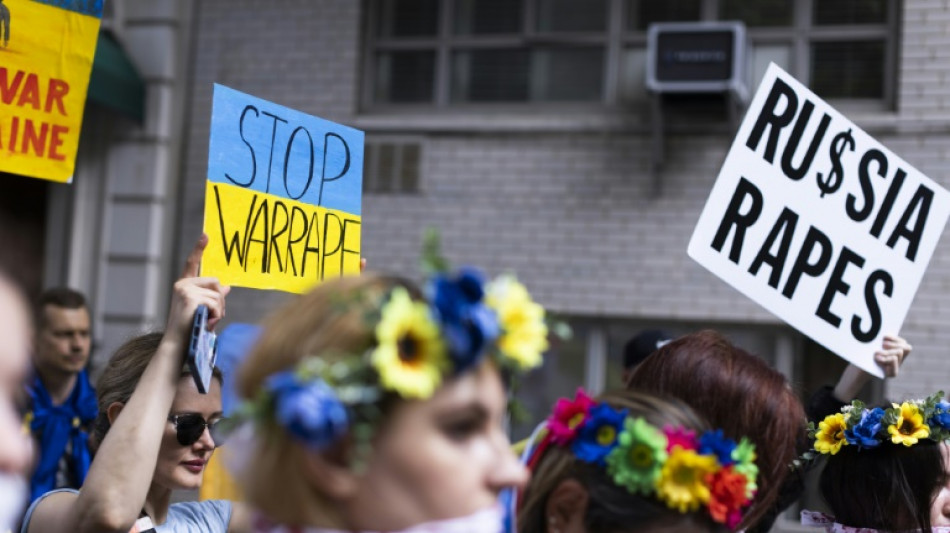
Rape used in Ukraine as a Russian 'military strategy:' UN / Photo: Kena Betancur - AFP

 Myanmar leader to visit Thailand next month: Thai FM to AFP

 Belgian great Meunier signs for Premier League side Sunderland

 Kenya denies Rastafarians the right to smoke weed

 Generative AI's power sparks fears of dumbing humans down
 'Like my lover': Chinese users bid farewell to AI companions

 Empty skyscrapers: China's property slump still throttling growth

 Cuba slowly gets power back after latest blackout

 AI demand powers forecast hike, profit gains at tech giant ASML

 Aussie Rules removes Indigenous figure from Hall of Fame

 France set to adopt assisted dying law in final vote
 Australian swimmer O'Callaghan reveals she has spinal fractures
 Argentina and England collide with World Cup final spot at stake

 AI ignites 'ignored sector' for Japan chipmaker Kioxia

 Writers union sues to block US Paramount deal
 UK announces social media curfew for older teens
 Italy court to rule in deadly bridge collapse case

 Tuchel unfazed by history ahead of England v Argentina World Cup semi
 Scaloni says fatigue not a concern for Argentina in World Cup semi-final

 Tocvan Outlines Phased Development Plan for Pilot Mine Operations at Gran Pilar Gold-Silver Project

 Caledonia Mining Corporation Plc: Notification of Relevant Change to Significant Shareholder
 InterContinental Hotels Group PLC Announces Transaction in Own Shares - July 15
 Elevex Capital Launches Multi-Vertical Floor Plan Finance Platform, Powered by Vero Technologies

 Two Free Travel Itinerary Builders Launch With One-Tap Auto-Planning - No Account, No Upload, Your Trip Stays on Your Device

 MPS Law Welcomes Howard Teplinsky as a Partner

 Mac Allister calls on Argentina to channel Maradona spirit in England World Cup clash
Rape and sexual assault attributed to Moscow's forces in Ukraine are part of a Russian "military strategy" and a "deliberate tactic to dehumanise the victims", UN envoy Pramila Patten told AFP in an interview.
"All the indications are there," the UN special representative on sexual violence told AFP on Thursday, when asked if rape was being used as a weapon of war in Ukraine.
"When women are held for days and raped, when you start to rape little boys and men, when you see a series of genital mutilations, when you hear women testify about Russian soldiers equipped with Viagra, it's clearly a military strategy," she said.
"And when the victims report what was said during the rapes, it is clearly a deliberate tactic to dehumanise the victims."
The United Nations has verified "more than a hundred cases" of rape or sexual assault since the beginning of the war, Patten said.
The first cases were reported just "three days after the invasion of Ukraine" on February 24, she added, referring to a UN report released in late September.
The report "confirmed crimes against humanity committed by the Russian forces, and according to gathered testimonies, the age of the victims of sexual violence ranges from four to 82 years old," Patten said.
The victims are mostly women and girls, but also men and boys, she added.
"There are many cases of sexual violence against children who are raped, tortured and kept hostage," she said.
But "reported cases are only the tip of the iceberg," she added.
"It's very difficult to have reliable statistics during an active conflict, and the numbers will never reflect reality, because sexual violence is a silent crime" that is largely underreported.
- 'World is watching' -
Patten said her fight against sexual violence was "a battle against impunity".
"That's why I went to Ukraine (in May): to send a strong signal to the victims, to tell them that we stand with them and to ask them to break their silence," she said.
But it was "also to send a strong signal to the rapists. The world is watching them, and raping a woman or girl, man or boy, will not be without consequences".
Rape as a weapon of war has been reported in conflicts worldwide, from Bosnia to the Democratic Republic of Congo.
But the war in Ukraine has marked a turning point in international attitudes, the UN envoy said.
"There is now political will to fight impunity, and there is consensus today on the fact that rapes are used as a military tactic, a terror tactic," Patten said.
"Is it because it is now happening in the heart of Europe? That might be it."
She said she hoped, however, that the focus on Ukraine would not detract from other conflicts.
"I find this attention to... sexual violence linked to conflicts to be very positive," she said, unlike in the past when the issue was viewed as "unavoidable", mere "collateral damage" or even a "cultural issue".
Patten said she was also concerned about the risk of human trafficking.
"The women, girls and children who have fled Ukraine are very, very vulnerable, and for predators, what is happening in that country is not a tragedy but an opportunity," she said.
"People trafficking is an invisible crime, but it's a major crisis."
More than seven million Ukrainians have fled the fighting into other European countries since the war started, the UN refugee agency says.
A.Ruiz--AT