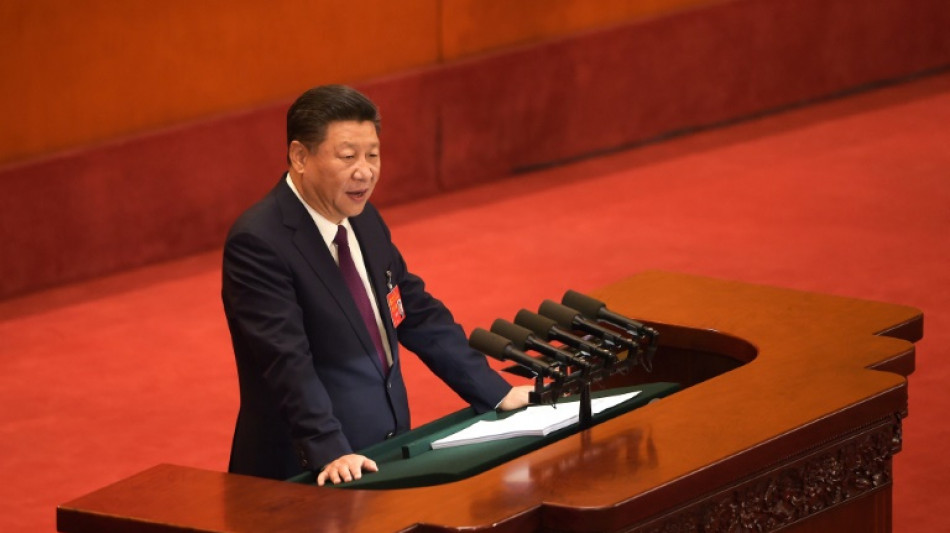
Poverty, climate, space: China's progress in 10 years under Xi / Photo: Nicolas ASFOURI - AFP/File

 Myanmar leader to visit Thailand next month: Thai FM to AFP
 Belgian great Meunier signs for Premier League side Sunderland

 Kenya denies Rastafarians the right to smoke weed

 Generative AI's power sparks fears of dumbing humans down
 'Like my lover': Chinese users bid farewell to AI companions

 Empty skyscrapers: China's property slump still throttling growth

 Cuba slowly gets power back after latest blackout
 AI demand powers forecast hike, profit gains at tech giant ASML

 Aussie Rules removes Indigenous figure from Hall of Fame
 France set to adopt assisted dying law in final vote

 Australian swimmer O'Callaghan reveals she has spinal fractures
 Argentina and England collide with World Cup final spot at stake
 AI ignites 'ignored sector' for Japan chipmaker Kioxia

 Writers union sues to block US Paramount deal
 UK announces social media curfew for older teens

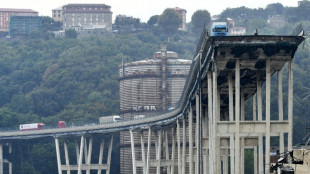 Italy court to rule in deadly bridge collapse case

 Tuchel unfazed by history ahead of England v Argentina World Cup semi
 Scaloni says fatigue not a concern for Argentina in World Cup semi-final

 Tocvan Outlines Phased Development Plan for Pilot Mine Operations at Gran Pilar Gold-Silver Project

 Caledonia Mining Corporation Plc: Notification of Relevant Change to Significant Shareholder
 InterContinental Hotels Group PLC Announces Transaction in Own Shares - July 15
 Elevex Capital Launches Multi-Vertical Floor Plan Finance Platform, Powered by Vero Technologies

 Two Free Travel Itinerary Builders Launch With One-Tap Auto-Planning - No Account, No Upload, Your Trip Stays on Your Device
 MPS Law Welcomes Howard Teplinsky as a Partner
 Mac Allister calls on Argentina to channel Maradona spirit in England World Cup clash

Xi Jinping's China has dragged millions out of extreme poverty, sent spacecraft to the Moon and committed itself to cutting greenhouse gas emissions.
On the brink of securing a third term, the president can boast of several achievements in his first 10 years in power, though some do come with caveats.
Here AFP looks at some of the key advances made under Xi:
- End of extreme poverty -
China's Communist Party prides itself on being "at the service of the people", so Beijing's announcement in 2020 that it had brought an end to extreme poverty was hailed as a critical milestone.
People's living conditions, their livestock and access to education were among the factors assessed by officials on door-to-door visits.
The government said it had invested 1.6 trillion yuan ($230 billion) between 2013 and 2021 to improve living standards -- for example by building roads, houses and infrastructure.
Millions of rural households have been relocated to villages with better economic opportunities.
A year after Xi became leader, 82 million Chinese people lived in extreme poverty, according to World Bank data. By 2019, the figure was six million.
However, Xi warned in 2020: "The task of consolidating and expanding the achievements of poverty alleviation remains difficult."
- Wealth surge -
The average disposable income per urban household surged 66 percent from 2013 to 2020, according to official statistics.
In rural households it rose 82 percent in that same period.
Cars per urban dwelling doubled from 0.22 in 2012 to 0.45 in 2020, while the number of mobile phones grew from 2.17 to 2.49 per urban household in the same period.
However, housing costs have quadrupled, putting a strain on purchasing power.
Migrant workers -- people who have moved from the countryside to cities for work -- have significantly increased their earnings, according to Jean-Louis Rocca, a specialist in Chinese social movements at Sciences Po in Paris.
"But with rent increases, education costs and the need to dress fashionably to fit in, their situation -- which has improved in medium-sized cities -- has often stagnated or even declined in large metropolises," Rocca said.
- Space programme -
A source of national pride, China's space programme has narrowed much of the gap with the US, Russia and Europe.
Rovers reached the Moon in 2013 and 2019 -- the latter the first ever to make a soft landing on its far side.
Another subsequent unmanned spacecraft returned to Earth in 2020 with the first lunar samples collected in four decades.
The same year, satellite navigation system Beidou was finalised, a rival to the American GPS.
After landing its first robot on Mars last year, China is expected to complete its space station in 2022.
- Corruption clampdown -
From civil servants to government ministers, army generals to bank managers, 11.3 million people were given warnings for discipline cases between 2012 and 2022, according to the Central Commission for Discipline Inspection, and 4.7 million were investigated for more serious misconduct.
At least 1.5 million were punished, with the most extreme prosecutions carrying the death penalty.
A culture of "frugality" has been imposed by Xi -- meaning, for example, fewer lavish banquets for party officials.
While the campaign is popular with the public, critics say it is also a way for Xi to eliminate political rivals.
- The environment -
Beijing signed the Paris climate agreement in 2016, and in 2020 Xi pledged his country would reach its peak carbon emissions by 2030, and aim for carbon neutrality by 2060.
Environment groups have called on China -- the world's biggest emitter of greenhouse gases -- to act faster, saying that otherwise meeting the Paris agreement's goal of keeping global warming to 1.5 degrees Celsius is not possible.
After turning a blind eye to China's choking cities for decades, the environment ministry started to publish more comprehensive data on air pollution in 2012.
The concentration of very fine and dangerous particles in the air fell by 34.8 percent between 2015 and 2021, according to the ministry.
Waste separation schemes are progressing. In megacity Shanghai, for example, they have been mandatory since 2019.
- Transport -
The length of the high-speed rail network has quadrupled, from about 9,300 kilometres in 2012 to 40,000 kilometres in 2021.
China now has 250 civilian airports, with 82 built in the last decade, and air passenger traffic doubled between 2012 and 2019.
The infrastructure projects have boosted travel and tourism, stimulated the economy, and opened the less-developed west of the country.
R.Lee--AT