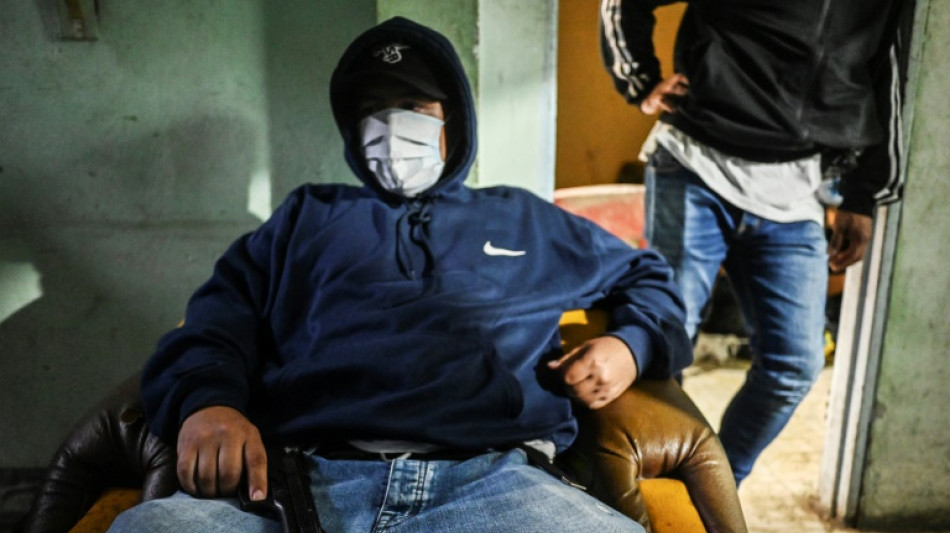
Murder rate plummets amid 'gangster peace' in Medellin / Photo: JOAQUIN SARMIENTO - AFP

 Myanmar leader to visit Thailand next month: Thai FM to AFP

 Belgian great Meunier signs for Premier League side Sunderland

 Kenya denies Rastafarians the right to smoke weed

 Generative AI's power sparks fears of dumbing humans down
 'Like my lover': Chinese users bid farewell to AI companions
 Empty skyscrapers: China's property slump still throttling growth

 Cuba slowly gets power back after latest blackout

 AI demand powers forecast hike, profit gains at tech giant ASML

 Aussie Rules removes Indigenous figure from Hall of Fame

 France set to adopt assisted dying law in final vote

 Australian swimmer O'Callaghan reveals she has spinal fractures

 Argentina and England collide with World Cup final spot at stake

 AI ignites 'ignored sector' for Japan chipmaker Kioxia

 Writers union sues to block US Paramount deal

 UK announces social media curfew for older teens

 Italy court to rule in deadly bridge collapse case

 Tuchel unfazed by history ahead of England v Argentina World Cup semi
 Scaloni says fatigue not a concern for Argentina in World Cup semi-final

 Tocvan Outlines Phased Development Plan for Pilot Mine Operations at Gran Pilar Gold-Silver Project

 Caledonia Mining Corporation Plc: Notification of Relevant Change to Significant Shareholder
 InterContinental Hotels Group PLC Announces Transaction in Own Shares - July 15
 Elevex Capital Launches Multi-Vertical Floor Plan Finance Platform, Powered by Vero Technologies

 Two Free Travel Itinerary Builders Launch With One-Tap Auto-Planning - No Account, No Upload, Your Trip Stays on Your Device

 MPS Law Welcomes Howard Teplinsky as a Partner

 Mac Allister calls on Argentina to channel Maradona spirit in England World Cup clash

Seven days without a single murder: The month of August marked a security record for Colombia's second city Medellin, the onetime fiefdom of infamous drug lord Pablo Escobar.
"In Medellin, security is measured in lives" saved, said Mayor Daniel Quintero as he welcomed the breakthrough.
Medellin has seen a vertiginous drop in homicides by 97 percent in the 30 years since Escobar's death, transforming what used to be one of the most violent cities in the world into a popular tourist destination.
The success is attributed in large part to an unofficial but mutually beneficial understanding between narco gangs, paramilitaries and the security services.
"Peace is good for business," explained Medellin drug dealer "Joaquin" (not his real name) of the traffickers' motivation for avoiding violence.
Joaquin is 37 years old -- two of those spent behind bars. He wears an oversized baseball cap and sagging jeans.
A Beretta pistol peaks out from under his hoodie.
Joaquin is a "capo," a junior boss supervising drug trafficking in the streets of "Comuna 6," a poor neighborhood perched on a mountain slope in Medellin's northwest.
He belongs to a gang, which he declined to name, that follows the rules imposed by an organized crime "federation" known as the "Oficina de Envigado" or the "Office of Envigado" after the name of a nearby town.
Joaquin claimed the Oficina and its member gangs acted "in solidarity with the community."
This included meting out "parallel justice" when the system fails them.
"Escobar? He was much too violent. Too many deaths for nothing," Joaquin told AFP.
- 'The population with us' -
"Everyone lives in peace on our territory," said the capo, keen to portray himself as a good Samaritan.
"We do not want to frighten the traders and the people. We need the population with us."
Thirty years after Escobar was shot dead on a Medellin rooftop while trying to evade capture, the drug trade still dominates many poor neighborhoods of the city of nearly three million people.
A stone's throw from a football pitch where mothers watch their children play, heavy foot traffic at a small, nondescript house indicates the presence of a drug den.
A black garbage bag covers the window where money trades hands. The purchased merchandise drops down from another floor in a tin can on the end of a string.
A variety of product can be found here: marijuana, cocaine and "tucibi" or "basuco" -- two cheap and particularly toxic new drugs akin to unrefined "crack."
"Everything is organized, it's like a business. There are those who take care of the sale, the logistics, the soldiers. The bosses pay our salaries, we do the job," said Joaquin.
He and his colleagues move with incredible ease and assurance through the maze of sloping alleys and small, rickety brick houses. Neighborhood teenagers skulk around, acting as security.
Joaquin and his accomplices pop into one shop after another, shaking hands with acquaintances everywhere while they casually slip a gun into a bag here, deliver a package there.
For the most part, Medellin's dealers are able to operate in peace due to an understanding among rival gangs as well as with members of the security forces -- many of them on the take.
As long as they keep the streets peaceful, the gangs say police turn a blind eye to their lucrative illegal dealings.
Joaquin calls it a "gangster peace."
"There is nothing better than peace," added "Javier," an associate who met up with Joaquin and another colleague in a squatted house.
They pack out their guns on a table between religious trinkets in a filthy, lightless living room where horse posters vie with a crude rendition of the Last Supper on the wall.
"Every group manages its territory as it wishes... The bosses talk among themselves. Everything is arranged calmly," said Javier.
- 'City of bandits' -
After Escobar's demise, the face of organized crime in Medellin changed. Long controlled by a single cartel, the drug trade is now shared between several gangs under the umbrella of the Office.
The gangs had previously collaborated with paramilitary groups and the security forces to help bring an end to Escobar's Medellin Cartel and oust leftist guerrilla groups that had tried to fill the power void it left.
As things settled down and every group found its place in the new reality, Medellin's homicide rate dropped from 350 per 100,000 inhabitants in 1992 to 10.2 per 100,000 so far this year -- nearly half the national average.
"The armed groups set the peace and war agenda in the city," said Luis Fernando Quijano, director of the Corporation for Peace and Social Development, an NGO.
Colombia's new leftist president, Gustavo Petro, has vowed to bring "total peace" to conflict- and crime-ridden Colombia, including by offering an amnesty to gangsters willing to give themselves up and abandon the trade.
"We are willing to listen. We will do what the bosses decide," Pedro said of the plan.
But for Joaquin, "to think that everyone will give themselves up is a dream."
"Never forget one thing: Medellin is and will always be the city of bandits," he insisted.
M.White--AT