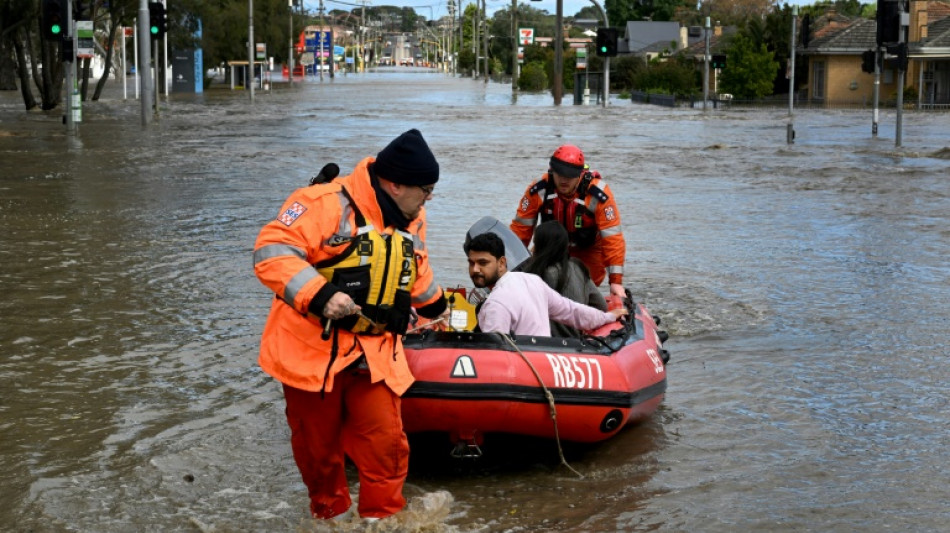
Floods swallow cars, swamp houses in 'major' Australian emergency / Photo: William WEST - AFP

 Qatar Facilities Management Market to Reach $11.15bn by 2032

 Black Friday Discounts Cut Prices on Two Top-Rated Wiper Blades

 Twickenham Grounds Team Prepares Pitch for Six Matches in Three Days

 Luxembourg City Plans €13 Million Abrigado Centre for 2029

 Two A1 Crashes Create Kilometres of Rush-Hour Congestion

 South Africa Places 36 Hospitals on Standby for Possible Imported Ebola Cases

 TCC Network Linked to 200% Surge in Global School Attacks

 Beyond Black Friday: A Guide to This Week’s Holidays and Deal Days
Flash floods swamped hundreds of homes in southeastern Australia and thousands of people were warned to flee surging waters threatening towns across three separate states Friday.
A major flooding emergency was unfolding in Victoria -- Australia's second most populous state -- where rapidly-rising waters forced evacuations in the Melbourne suburb of Maribyrnong.
Cars left on the streets of the suburb were almost completely swallowed by the floods, while some stranded residents had to be saved by inflatable rescue boats.
The ground floor of the Anglers Tavern, a pub on the banks of the Maribyrnong River, was underwater.
State leader Daniel Andrews told reporters 500 homes in Victoria had been "inundated", while a further 500 properties were surrounded by floods and cut off from emergency services.
"That number will definitely grow. We have choppers in the air at the moment making damage assessments," Andrews said early Friday afternoon.
While the worst of the rain had passed by late Friday morning, the state emergency service warned the floods would get worse as water flowed downstream into swollen river catchments.
"Our flood emergency here in Victoria continues to escalate," emergency services spokesman Tim Wiebusch told reporters.
"There are not many parts of Victoria that aren't experiencing major flooding over the coming days."
About 4,000 homes in Shepparton, about two hours north of Melbourne, could be flooded by early next week, Wiebusch said.
Emergency management commissioner Andrew Crisp said the Australian army was being deployed to parts of Victoria to help residents sandbag their houses before flood waters arrive.
"This is a major emergency for the state of Victoria," he said.
A disused Covid-19 quarantine centre with a capacity for 1,000 people would be used to shelter people.
- 'Lives at risk' -
Northern parts of Tasmania -- an island state south of Victoria -- were on Friday also preparing for major floods.
Mass evacuation orders were issued, while heavy rains forced the closure of some 120 roads.
"Lives are at risk from floodwaters," Tasmania's state emergency service said in a statement.
In New South Wales -- Australia's most populous state -- an evacuation centre was set up after intense downpours Thursday evening in Forbes, an inland town about five hours' drive east of Sydney.
The New South Wales emergency service said flood levels in Forbes could peak on Friday as water moved downstream.
Australia's east coast has been repeatedly lashed by heavy rainfall in the past two years, driven by back-to-back La Nina cycles.
The east coast flooding disaster in March -- caused by heavy storms that devastated parts of Queensland and New South Wales -- claimed more than 20 lives.
Tens of thousands of Sydney residents were ordered to evacuate in July when floods again swamped suburbs on the city's fridge.
Climate change does not cause La Nina events, but scientists believe it could make periods of flooding more extreme, because warmer air holds more moisture.
A.Williams--AT


