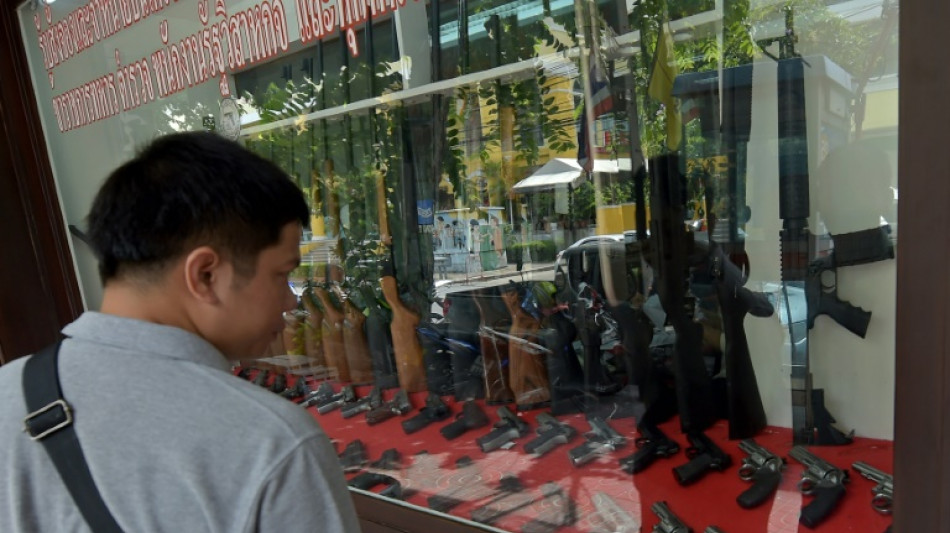
Thailand promises tougher gun control after nursery attack / Photo: PORNCHAI KITTIWONGSAKUL - AFP/File

 Qatar Facilities Management Market to Reach $11.15bn by 2032

 Black Friday Discounts Cut Prices on Two Top-Rated Wiper Blades

 Twickenham Grounds Team Prepares Pitch for Six Matches in Three Days

 Luxembourg City Plans €13 Million Abrigado Centre for 2029

 Two A1 Crashes Create Kilometres of Rush-Hour Congestion

 South Africa Places 36 Hospitals on Standby for Possible Imported Ebola Cases

 TCC Network Linked to 200% Surge in Global School Attacks

 Beyond Black Friday: A Guide to This Week’s Holidays and Deal Days
Thailand will toughen its gun possession and drug laws, the interior ministry said Wednesday, following the nursery massacre of 36 people -- including 24 children -- in the kingdom's worst mass killing.
The country was left reeling after an ex-police officer forced his way into a small nursery in northeastern Na Klang last week, murdering 24 children and their teacher before killing his wife, their child and himself.
The attack was carried out with a knife and a legally acquired gun, and while Thailand has a huge number of firearms in circulation -- one estimate suggesting there are as many as one in seven firearms per person -- mass shootings are rare.
Interior minister Anupong Paojinda said Wednesday the government would require tougher qualifications for new gun owners, as well as ramping up checks on existing firearm holders.
"Our new qualification will include mental health reports, we will be examining whether we need proof from doctors," he told a press conference, without giving further details.
Gun applicants are already required to undergo a background check and must present a valid reason for ownership -- such as hunting or self-defence.
"For example, if officials want to possess a gun, their supervisors have to ratify that that individual has no record of alcohol abuse or bad temper," Anupong said.
Village leaders or local officials will play a role in granting the tougher gun licenses, he said.
Currently gun owners do not have to reapply for licenses during the lifetime of a firearm.
But now approved gun holders will have to undergo a review every three to five years, Anupong said.
"Because as time changes, people change," he explained.
Parliament will also discuss an exemption penalty for illegal gun holders, Anupong said, adding that individuals will be able to hand unauthorised firearms to authorities without facing prosecution-- though he did not indicate when they must do so by.
Those who still possess illegal weapons will face harsh penalties, he said.
Anupong added that his ministry would work with police and the health department to increase drug screening and awareness, as well as encouraging addicts into rehabilitation.
"If everyone in town knows that drugs exist but local authorities don't, they will be transferred," he said.
The nursery attacker, 34-year-old sacked police sergeant Panya Khamrab, was dismissed from his post earlier this year on a drugs charge, with locals saying they suspected he was a methamphetamine addict.
However, preliminary tests found he did not have any drugs in his system at the time of the assault.
A.Williams--AT


