
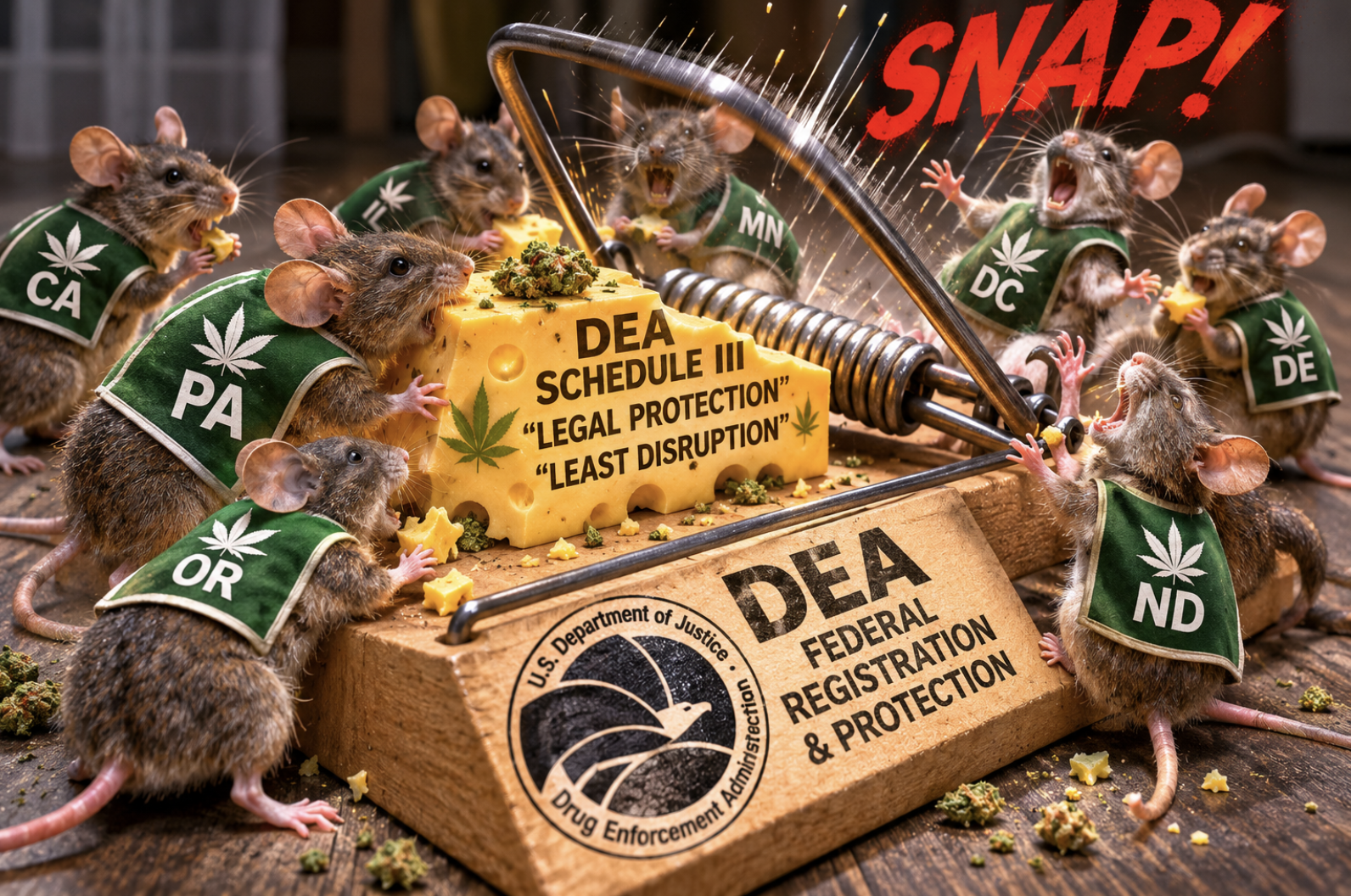
The DEA Laid The Trap - And State Marijuana Operators Took The Bait

 Panthers Seek NFC South Lead Against Ravens as Baltimore Ends Skid

 Commonhold Explained: How New Leasehold Ban Changes Property Ownership in England and Wales

 GIRLBAND! Headline Show at Rough Trade Marks National Breakthrough

 Saudi PIF Retains Top Sovereign Wealth Fund Brand Title for Third Year

Duane Boise CEO MMJ International Holdings Questions "How Years of State Licensed Marijuana Production, Preexisting Inventories, and Commercial Supply Chains Became Eligible for Federal Schedule III Protections Without Clear Answers on The Marijuana Origins and Treaty Compliance".
WASHINGTON, D.C. / ACCESS Newswire / November 20, 2026 / MMJ International Holdings, Inc. ("MMJ") today raised fundamental questions about the federal marijuana rescheduling framework after state-licensed operators filed emergency litigation in the U.S. Court of Appeals for the District of Columbia Circuit.
On November 19, four Pennsylvania medical marijuana businesses, filed an emergency motion in Case No. 26-1325, consolidated with Case No. 26-1324. They ask the court to block Drug Enforcement Administration ("DEA") guidance that will restrict their supply chains beginning November 29, 2026.
MMJ believes the filings expose what the rescheduling order really built: an invitation into federal registration, followed by enforcement, resting on marijuana inventories whose federal origin no one has explained.
The Bait
On April 28, 2026, Attorney General Order No. 6754-2026 placed state-licensed medical marijuana and FDA-approved marijuana products in Schedule III. It created an expedited registration process under 21 C.F.R. § 1301.13(k), and let businesses that applied within 60 days keep operating "in conformity with a state-issued license" while DEA reviewed their applications.
The Order rested on a finding that state programs had developed "robust infrastructure" for preventing diversion and protecting public health. It promised "the least disruption for patients and existing state systems." Operators came forward and gave DEA their suppliers, operating procedures and personnel.
The Trap
On October 30, 2026, DEA issued guidance barring timely applicants from doing business with companies that had neither registered nor applied by June 26. DEA warned that violations "could be potential grounds for denial" of an application or "revocation" of a registration, and set a November 29 deadline. On November 10, DEA announced in the Federal Register that it is developing separate production quotas for Schedule III marijuana, citing the Single Convention on Narcotic Drugs.
The operators' own motion makes MMJ's point. It says DEA never explained "why it now deems state licensure regimes inadequate." The businesses the Order was written to protect are now telling a federal court that DEA has abandoned the Order's central finding.
Their legal theory confirms the rest. They argue that acting "in conformity with a state-issued license" is all federal law requires while their applications are pending. MMJ has argued from the start that this is the flaw in the Order: it treats a state license as a substitute for federal review.
The record also shows DEA's own confusion. In May, DEA told manufacturers they "may" apply on its existing Form 225, and those that did appear on DEA's list of timely applicants. The Pennsylvania petitioners waited for a promised manufacturer form that DEA did not release until October 5. According to one declaration, a DEA supervisor told the company to wait.
"MMJ is not anti-marijuana. We are anti-bad science and anti-fake process," said Duane Boise, CEO of MMJ International Holdings. "One agency gave two instructions and then threatened to revoke registrations over the result. That is what fake process looks like."
$12 Million Before Any Federal Registration
The sworn declarations filed with the motion show how much commerce took place before federal registration existed.
Stephen M. Reilly, an executive of Pennsylvania operator Insa LLC, states under penalty of perjury that the company has operated under Pennsylvania law for approximately six years. In its most recent fiscal year, he states, its wholesale sales to approximately 198 third-party dispensaries generated approximately $12 million, about 90% of its total revenue. He estimates the company will lose about $1 million in wholesale revenue for each month it cannot supply those customers.
That business was built while marijuana was a Schedule I substance. The company applied to register its dispensary with DEA on June 24, 2026, and filed its manufacturer application on November 3, 2026, after DEA's October 30 guidance.
The Operator That Switched Sides
One of the four petitioners, Tri-Mountain Pure, LLC, has been before this court before. In June 2026, it moved to intervene in Case No. 26-1106, the consolidated challenge to the rescheduling order in which MMJ is a petitioner, in order to defend the Order. On September 9, the D.C. Circuit denied intervention and allowed it to participate only as amicus curiae. Two months later, the same company is suing DEA over how that Order is being carried out.
Where Did the Marijuana Come From?
Every state-licensed grower started with seeds, clones or plants from somewhere. Pennsylvania's regulations let a new grower/processor bring seeds or immature marijuana plants in from outside the Commonwealth during a 30-day start-up window, and again each December. Pennsylvania could allow that under state law. It could not allow it under federal law: moving marijuana plants across state lines violated the Controlled Substances Act, and no DEA-registered source was selling commercial quantities to these businesses.
So who supplied the first plants? A federally registered source? Another state's market, itself operating outside federal law? Or the illicit market? The operators' motion describes seed-to-sale tracking "from the stage when a seed is planted in soil." It never says where the first seed came from.
Congressional appropriations restrictions limited certain Justice Department enforcement against compliant state medical programs. They did not repeal federal prohibitions, and a registration issued in 2026 does not make earlier transactions federally lawful.
The Treaty Forbids It
The United States is a party to the Single Convention on Narcotic Drugs, 1961, and the Single Convention forbids exactly this. Article 28 applies the Article 23 control system to cannabis. Under Article 23, "Only cultivators licensed by the Agency shall be authorized to engage in such cultivation," and cultivators must deliver their total crops to the government agency. Article 33 states: "The Parties shall not permit the possession of drugs except under legal authority." Article 36 requires each Party to make cultivation, possession and sale contrary to the Convention punishable offenses.
The Attorney General's Order states that placing state-licensed marijuana in Schedule III "is consistent with articles 23 and 28." Its mechanism is 21 C.F.R. § 1301.13(k)(6): DEA nominally purchases and resells the crops of registered manufacturers. Marijuana grown before any manufacturer was registered never passed through that mechanism.
Yet DEA's October 30 guidance lets timely dispensary and distributor applicants keep selling inventory acquired before that date, "including inventory previously obtained from entities that do not qualify as Timely Applicants or DEA registrants." A crop grown from stock of unknown origin, by cultivators no federal agency licensed, and never delivered to the government is the activity the treaty prohibits. MMJ believes a 2026 registration cannot convert it into treaty-compliant medicine, and that DEA must identify the legal authority it relies on.
"The Order told state operators their state license was everything the federal government needed to see," Boise said. "They believed it. Six months later, DEA started enforcing rules the Order never mentioned, and now one operator is in federal court swearing to $12 million a year in wholesale sales built before any federal registration existed. That is not a transition. That is a trap. And nobody has answered the first question: where did the marijuana come from?"
MMJ Followed the Federal Pathway
MMJ BioPharma Cultivation, Inc. filed its DEA bulk manufacturer application on December 27, 2018, to support pharmaceutical cannabinoid development for Huntington's disease and multiple sclerosis. That application remains pending. MMJ BioPharma Labs, Inc. holds a DEA Schedule I analytical laboratory registration, and MMJ holds an FDA Orphan Drug Designation for its Huntington's disease program.
A pharmaceutical developer that asked permission before growing a single plant has waited nearly eight years. Businesses that built multimillion-dollar operations under state law received expedited registration and temporary operating protection. MMJ believes the government must explain the legal basis for that difference.
"We asked DEA for permission first, and we are still waiting," Boise said. "The state operators are asking the court to protect commercial relationships built under state law. We are asking whether the federal framework that recognizes those relationships was lawfully built at all."
MMJ International Holdings and its subsidiaries are petitioners in consolidated D.C. Circuit litigation challenging the April 2026 rescheduling order.
About MMJ International Holdings, Inc.
MMJ International Holdings, Inc., through its subsidiaries MMJ BioPharma Cultivation, Inc. and MMJ BioPharma Labs, Inc., is developing investigational pharmaceutical cannabinoid therapies for Huntington's disease and multiple sclerosis through FDA and DEA regulatory pathways. MMJ's investigational drug candidates have not received FDA marketing approval, and their safety and efficacy have not been established through completed clinical trials.
CONTACT:
Madison Hisey
[email protected]
203-231-8583
Sources
SOURCE: MMJ International Holdings
View the original press release on ACCESS Newswire
P.A.Mendoza--AT