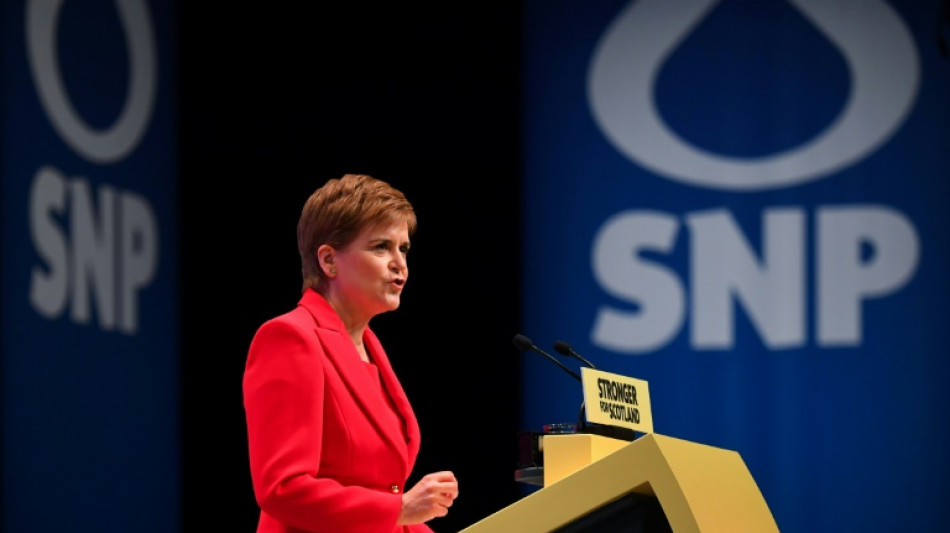
UK's top court to assess legal basis for new Scottish independence vote / Photo: ANDY BUCHANAN - AFP

 Qatar Facilities Management Market to Reach $11.15bn by 2032

 Black Friday Discounts Cut Prices on Two Top-Rated Wiper Blades

 Twickenham Grounds Team Prepares Pitch for Six Matches in Three Days

 Luxembourg City Plans €13 Million Abrigado Centre for 2029

 Two A1 Crashes Create Kilometres of Rush-Hour Congestion

 South Africa Places 36 Hospitals on Standby for Possible Imported Ebola Cases

 TCC Network Linked to 200% Surge in Global School Attacks

 Beyond Black Friday: A Guide to This Week’s Holidays and Deal Days
The UK Supreme Court will on Tuesday consider the legality of Scottish moves to hold a new referendum on independence next year without the consent of the government in London.
First Minister Nicola Sturgeon's nationalist government in Edinburgh wants a fresh vote on the question: "Should Scotland be an independent country?"
On Monday, she told her Scottish National Party's annual conference the hearing would not have been necessary if the UK government in Westminster respected Scottish democracy.
"But Westminster has no such respect. That means this issue was always destined to end up in court sooner or later -- better, in my view, that it is sooner," she said.
"If the court decides in the way we hope it does, on 19th October next year there will be an independence referendum."
The Supreme Court hearings -- initiated by Scotland's top legal adviser -- will see senior lawyers wrangle over the powers of the devolved parliament in Edinburgh versus Westminster.
The SNP fought the 2021 Scottish parliamentary elections on a promise to hold a legally valid referendum after the Covid crisis subsided.
It now wants to go ahead but the UK government, which has to give approval under the Scotland Act 1998, has not given permission.
New UK Prime Minister Liz Truss in a television interview this month reiterated her view that the last referendum in 2014 was a once-in-a-generation event.
"I'm very clear there shouldn't be another referendum before that generation is up," she added.
- 'Never give up' -
Opinion polls now indicate that voters in Scotland are near evenly divided over the question of independence.
The last referendum in 2014 saw 55 percent of Scots vote "no" to breaking away.
But this came before Brexit, which most in Scotland voted against, and the parliamentary election, which saw a majority of pro-independence lawmakers elected for the first time.
The Scottish government wants to be able to create its own legal framework for another vote, arguing that the "right to self-determination is a fundamental and inalienable right".
But the UK government argues that Scotland cannot act unilaterally in a "reserved" matter concerning the constitutional make-up of the United Kingdom as a whole, where the government in London holds sway.
To get around this, the SNP-led government wants to hold an "advisory referendum" to test support, without immediate change.
The Supreme Court hears cases of the greatest public or constitutional importance affecting the whole population, ruling on points of law.
Five judges including Supreme Court President Robert Reed, will begin two days of hearings at 10:30 am (0930 GMT) on Tuesday.
They will examine the legal validity of a referendum bill proposed by the SNP that sets a referendum date of October 19, 2023, with a ruling at a later date.
"The court is unlikely to rule in favour of the SNP –- but those in favour of the Union should not see this as a defining victory," wrote Akash Paun of the Institute for Government think-tank.
If thwarted in court, the party plans to make the next general election, due by January 2025 at the latest, a de facto referendum, campaigning on a single issue.
Sturgeon on Monday said a legal defeat would leave the Scottish government "a very simple choice: put our case for independence to the people in an election or give up on Scottish democracy".
"I will never give up on Scottish democracy," she added.
K.Hill--AT


