'Extraordinary moment': the 1970s abortion case that changed French law / Photo: - - AFP

 Myanmar leader to visit Thailand next month: Thai FM to AFP

 Belgian great Meunier signs for Premier League side Sunderland

 Kenya denies Rastafarians the right to smoke weed

 Generative AI's power sparks fears of dumbing humans down

 'Like my lover': Chinese users bid farewell to AI companions

 Empty skyscrapers: China's property slump still throttling growth

 Cuba slowly gets power back after latest blackout

 AI demand powers forecast hike, profit gains at tech giant ASML

 Aussie Rules removes Indigenous figure from Hall of Fame

 France set to adopt assisted dying law in final vote

 Australian swimmer O'Callaghan reveals she has spinal fractures

 Argentina and England collide with World Cup final spot at stake

 AI ignites 'ignored sector' for Japan chipmaker Kioxia

 Writers union sues to block US Paramount deal

 UK announces social media curfew for older teens

 Italy court to rule in deadly bridge collapse case

 Tuchel unfazed by history ahead of England v Argentina World Cup semi
 Scaloni says fatigue not a concern for Argentina in World Cup semi-final

 Tocvan Outlines Phased Development Plan for Pilot Mine Operations at Gran Pilar Gold-Silver Project

 Caledonia Mining Corporation Plc: Notification of Relevant Change to Significant Shareholder
 InterContinental Hotels Group PLC Announces Transaction in Own Shares - July 15
 Elevex Capital Launches Multi-Vertical Floor Plan Finance Platform, Powered by Vero Technologies

 Two Free Travel Itinerary Builders Launch With One-Tap Auto-Planning - No Account, No Upload, Your Trip Stays on Your Device

 MPS Law Welcomes Howard Teplinsky as a Partner

 Mac Allister calls on Argentina to channel Maradona spirit in England World Cup clash

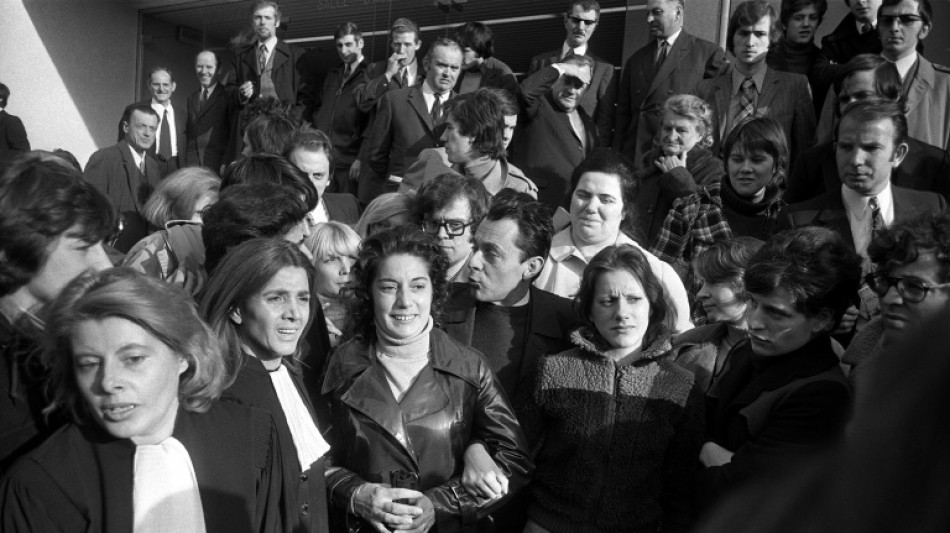
Five decades ago, a lawyer convinced a French court to acquit a teenage girl who illegally terminated her pregnancy after being raped, a landmark case that would pave the way for the right to abortion in France.
Marie-Claire Chevalier was 16 when a boy the same age attacked her and made her pregnant. Her mother, an employee of the Paris public transport authority, helped her find a backstreet abortion.
But her rapist informed on her and she was ordered to stand trial at a children's court in the Paris suburb of Bobigny.
Her mother and three others were also charged with conspiring to commit the illegal abortion.
Lawyer Gisele Halimi took on their defence, and helped sway public opinion by enlisting celebrities such as feminist philosopher Simone de Beauvoir to testify.
On October 11, 1972, Chevalier was acquitted, a verdict whose momentous impact would lead parliament to legalise abortions two years later.
The case was the ideal opportunity "to speak out, over the heads of the magistrates, to public opinion and to the country to denounce the law," Halimi told journalist Annick Cojean for a 2020 book about her life.
She also had the backing of fellow feminists fed up with a law that disproportionately punished women of modest means who could not afford to travel abroad for a legal termination.
- 'Truncheon blows' -
A few days before the trial, they had gathered for a peaceful protest in central Paris.
It was "a trial against injustice, the trial of a woman from an underprivileged background who could not go to England or Sweden to have an abortion in the best conditions," recalled Claudine Monteil, a historian and retired diplomat who took part in the protests, when she was 22.
A massive security force was deployed and many demonstrators received "punches" and "truncheon blows" as police detained 54 people, Le Monde newspaper wrote at the time.
"They hit us, pulled our hair. It was terrible: There was screaming, women falling on the ground, a young woman who was almost killed," Monteil said.
But the authorities made a mistake, she said, since the brutal crackdown only intensified the public focus on Chevalier's case, and activists massed outside the courthouse when the trial began.
"I could hear the crowd outside shouting... 'We've all aborted,' 'Free Marie-Claire,' or even 'England for the rich, prison for the poor'," Halimi said in her book.
She also recalled, "The anger I felt in front of these men about to judge us and who knew nothing of the life of a woman."
At around 11 am, the protesters tried to break through the police barrier and force their way into the closed proceedings, before being pushed back.
Just an hour and a half later, Chevalier emerged from the courthouse, acquitted.
"I was scared," she told the crowd, while Halimi declared, "We put the abortion ban on trial."
- Judges 'lectured' -
Several weeks later, on November 8, Halimi was back in a different court to defend Chevalier's mother Michele, two of her colleagues and the person who carried out the abortion.
She again called to the stand as witnesses famous actresses, a Nobel Prize-winning doctor and de Beauvoir, author of "The Second Sex", who took the court's male judges to task.
"She lectured them on society's hypocrisy, on how women were being treated," she said. "For us, it was wonderful to see judges drop their gaze like little boys. It was an extraordinary moment to see judges not dare criticise Simone de Beauvoir."
In her statements, Halimi attacked a law that she said discriminated against the poorer classes.
Had the court ever tried "the wife of a high-ranking official, of a famous doctor, or of a corporate executive? You always try the same women, the Mrs Chevaliers" of this world, she said.
"This archaic law cannot survive. It goes against women's freedom."
Chevalier's mother and the person who carried out the abortion were handed suspended sentences, the two others acquitted.
But for Halimi, the victory was clear. "This ruling is an irreversible step towards a change of the law," she said outside the courthouse.
Just over two years later, in January 1975, lawmakers voted to legalise abortion.
H.Romero--AT