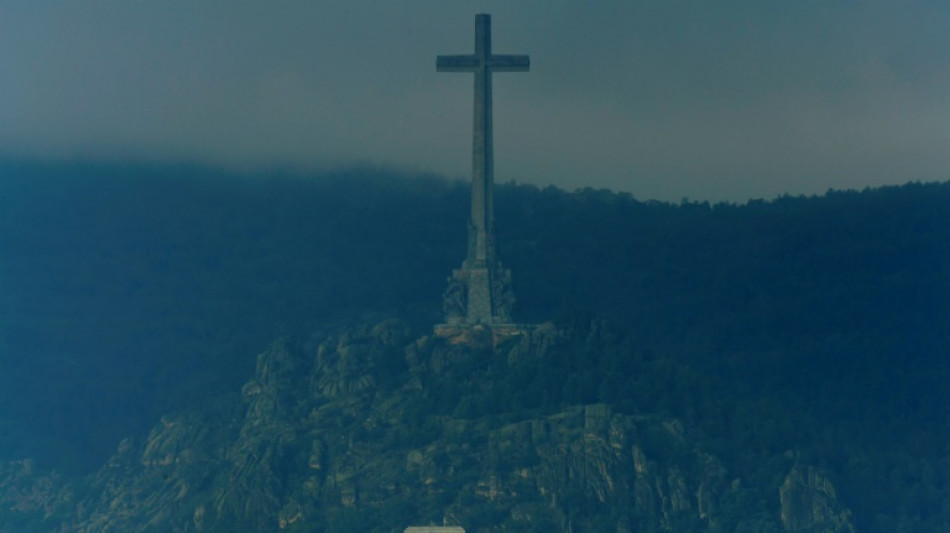
Spain to relocate remains of Franco allies to more discreet graves / Photo: JAVIER SORIANO - AFP/File

 Qatar Facilities Management Market to Reach $11.15bn by 2032

 Black Friday Discounts Cut Prices on Two Top-Rated Wiper Blades

 Twickenham Grounds Team Prepares Pitch for Six Matches in Three Days

 Luxembourg City Plans €13 Million Abrigado Centre for 2029

 Two A1 Crashes Create Kilometres of Rush-Hour Congestion

 South Africa Places 36 Hospitals on Standby for Possible Imported Ebola Cases

 TCC Network Linked to 200% Surge in Global School Attacks

 Beyond Black Friday: A Guide to This Week’s Holidays and Deal Days
Spain is planning to relocate the remains of two far-right figures linked to its 1936-1939 civil war who are buried in grandiose sites, a minister said Thursday.
In remarks to Cadena Ser radio, cabinet minister Felix Bolanos said new legislation passed this week would affect the grave of Jose Antonio Primo de Rivera, founder of Spain's fascist Falange party who died at the start of the civil war and is buried in an imposing state mausoleum near Madrid.
The basilica in the Valley of the Fallen is where the remains of dictator Francisco Franco were laid after his death in 1975 until they were moved to a more discreet grave by Spain's left-wing government in October 2019.
It would also affect the grave of nationalist general Gonzalo Queipo de Llano, a Franco ally who ran a military campaign in the south during the civil war and is believed to have given the green light to the shooting of Spanish poet Federico Garcia Lorca.
He is buried in Seville's iconic Macarena Basilica.
Asked if the law would mean his remains would be relocated, Bolanos said it would affect anyone involved in the coup which triggered the war and the ensuing dictatorship.
"The new law says there can be no prominent place for people who were involved in the dictatorship, or the coup d'etat," Bolanos said of flagship legislation passed this week by parliament seeking to honour victims of Francoism.
"It's not only the case with Queipo de Llano, but Jose Antonio Primo de Rivera, who is buried in front of the (basilica's) main altar... which is a prominent place," he said.
"Once the legislation comes into force, the work will begin," Bolanos said without giving further details.
"Obviously they should be given a dignified burial wherever the relatives decide, but they cannot be in any kind of prominent place because that is a way of paying homage to the protagonists of the dictatorship."
Honouring those who died or suffered violence or repression during war and decades of dictatorship that followed has been a top priority for Prime Minister Pedro Sanchez since he came to power in 2018.
A.Taylor--AT


