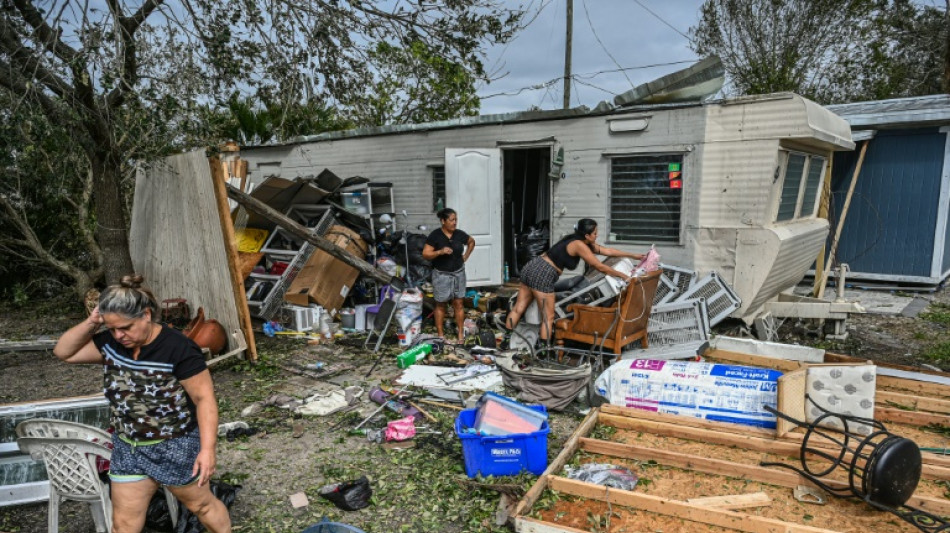
Hurricane Ian damage toll in the billions, will slow US growth / Photo: Giorgio VIERA - AFP

 Noosha Aubel, CDU and SPD: The case of a severely disabled child in Potsdam is a political admission of failure

 Rybakina ensures rise to No.1 by reaching US Open semis

 Evacuations in Malibu after waves open sinkhole at Nicolas Cage's house

 England on top in third Test after latest Pakistan collapse

 England edge ahead in third Test after latest Pakistan collapse
 'Alarm bells ringing': US summer heat shatters record

 IAEA board refers Iran to UN Security Council

 Rubio pushes extraditions, anti-drug fight in Ecuador
 Amboss and Aureo Connect the Lightning Network to Mexico's Banking System

 Brent oil passes $100 on Mideast flare-up, stoking inflation fears

 Israeli settlement winemaker defiant after UK-led trade sanctions

 Josh Kerr: I pick my races and never get 'greedy'

 Carrick confident Man Utd can go far in 'magical' Champions League

 France far right expels policeman member over racist remarks

 Pakistan collapse to 133 all out against England in 3rd Test

 Heat forces French champagne makers to stiffen their drink

 Iran war drives oil prices to $100 per barrel as Tehran strikes ships

 Pakistan collapse to 100-7 against England in 3rd Test

 Workers, migrants focus of documentaries by Oscar winners at Venice

 Nepal seeks survivors two weeks after deadly floods

 Bangladesh measles crisis kills more than 1,000 children

 Pakistan collapse to 26-4 against England in 3rd Test

 EU helps cities tighten screws on Airbnb, holiday rentals

 Courtois to put Belgium career on hold
 RavenDB Launches Quill to Bring Production AI Agents to Enterprise SQL Systems, No Migration Required

With homes and infrastructure wrecked by wind or flooding and businesses shut down, the destruction left in the wake of Hurricane Ian is expected to cost Florida tens of billions of dollars and hit the broader US economy.
The devastation will weigh on insurance companies in the southern US state, and poses a danger to uninsured homeowners as well.
After making landfall on the southwest coast of Florida on Wednesday, Ian brought strong winds and torrential rains, sometimes turning streets into rivers.
The damage estimates remain very preliminary, but it is clear "the hurricane is expected to severely disrupt economic activity over 10 days, with power cuts, flight cancellations, suspension of energy production, impact on farms agricultural crops, in particular oranges," Gregory Daco, economist at EY-Parthenon, told AFP.
He predicted that Ian will slow Florida's economic activity by six percentage points in the third quarter, and shave three-tenths off US GDP.
As with all natural disasters, this economic impact will gradually lessen over time, especially when reconstruction efforts get underway, he said.
CoreLogic, a firm that specializes in property analysis, said wind-related losses from residential and commercial properties could cost insurers up to $32 billion while losses related to flooding could go as high as $15 billion.
- Top 10 list -
"This is the costliest Florida storm since Hurricane Andrew made landfall in 1992 and a record number of homes and properties were lost due to Hurricane Ian's intense and destructive characteristics,” CoreLogic's Tom Larsen said in a statement.
Fitch Ratings and S&P Global Ratings estimate the total cost could amount to $40 billion.
Meanwhile, Moody's projects losses for insurers could reach $55 billion, and economic activity lost in Florida could total $10 billion.
The average damage estimate, adjusted for inflation, is $46 billion, making Ian among the top 10 most costly hurricanes in the United States, according to Moody's, led by Katrina in 2005 ($160 billion), and Harvey ($124 billion) and Maria ($111 billion) in 2017.
These initial estimates do not take into account properties without flood insurance, which represent the vast majority of real estate in Florida, where insurance premiums outstrip those in many other states.
Many large insurance companies have reduced their exposure in the state, while smaller firms have gone bankrupt. National and state agencies often provide emergency aid, such as temporary housing, for impacted families, but the help is limited.
According to data from risk-management firm Milliman provided to AFP on Friday, only 18.5 percent of houses in the counties subject to evacuation orders have policies with the National Flood Insurance Program.
The federal government program is available in areas prone to flooding, and offers coverage many private insurance companies do not provide.
"Obviously, Florida has more environmental risks than a lot of other states just because of its geography, and because of the way the climate is changing, with more damaging storms and sea level rising," Denise Rappmund of Moody's Analytics told AFP.
This situation is complicated by the fact that lawyers and contractors frequently encourage Florida residents to file damage claims, which insurers then challenge, she said.
Rappmund noted that in 2019 the state accounted for just eight percent of insurance claims nationwide but more than 75 percent of the claims that went to litigation.
"It stands to reason that we would probably see a few more liquidations" of insurance firms in Ian's wake, Rappmund said.
P.Hernandez--AT