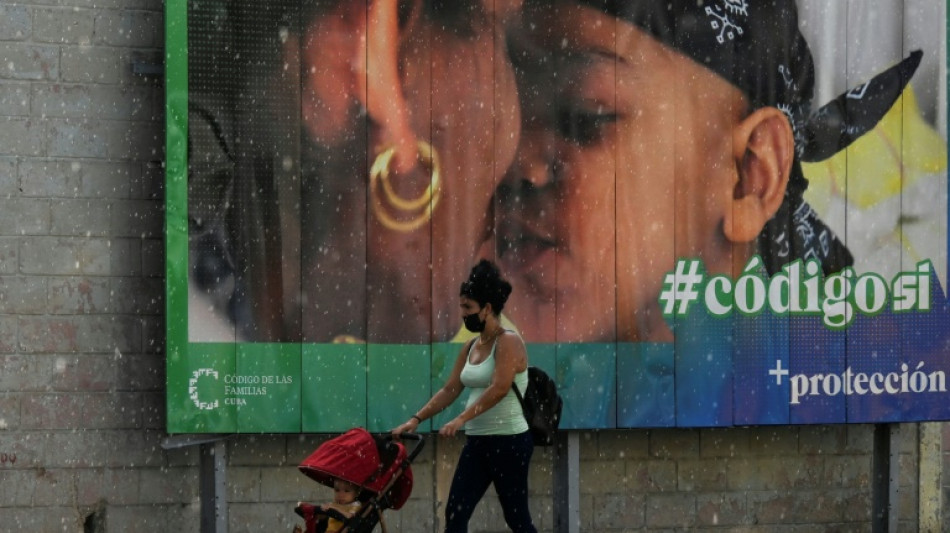
Cubans to vote in referendum on same-sex marriage / Photo: YAMIL LAGE - AFP

 Forex Expo Dubai to Take Place as Scheduled on 22–23 September 2026

 Russia pounds Kyiv, ending three-day halt for US talks

 Flights resume gradually in Indonesia after volcanic eruption
 French AI firm Mistral valued at 21 bn euros after latest funding
 Sweden heads to the polls in close election race
 Australia's Big Bash T20 teams face sale to private investors

 Russia resumes strikes on Kyiv after three-day halt

 Canada's counter-tariffs take effect on various US goods

 China's trade booms as focus turns to expected Trump-Xi summit

 Is Champions League three-peat really possible for PSG?
 Russia pummels Kyiv after three-day halt
 Mongolians wait hours for fuel as reliance on Russia bites

 Blockx first Belgian man to reach US Open quarter-finals
 Praying for rain as fires, haze plague Indonesian Borneo

 Rybakina tops Osaka, sets US Open quarter-final clash with Zheng

 Apex Expands Trinity Zone with Step-out Hole Returning 197.5 m Interval of 2.12% REO at the Rift Rare Earth Project in SE Nebraska
 BioNxt Advances Sublingual Everolimus ODF for Organ Transplant Rejection with Initiation of Large-Animal Pharmacokinetic Study
 Genflow Biosciences PLC Announces Primary Endpoint in SLAB Clinical Trial Met

 Gaming Realms PLC Announces Interim Results

 Panama Canal considering more cuts in transits due to El Nino

 Maresca agrees with Haaland that players started season jaded

 Hurricane warning issued for westernmost Hawaiian islands

 UK PM denounces 'politics of poison' after anti-migrant protests

 Comeback queen Zheng strikes again for US Open quarter-final berth

 Third absence for injured Hadjar as Lawson fills in again in Spain

Cubans on Sunday will vote in a landmark referendum on whether to legalize same-sex marriage and adoption, allow surrogate pregnancies and give greater rights to non-biological parents.
The new family code, promoted by the communist government, would represent a major shift in Cuba, where the culture of machismo is strong and where the LGBTQ community was ostracized by authorities in the 1960s and 1970s.
More than eight million Cubans over 16 are invited to vote "Yes" or "No" amid the country's worst economic crisis in 30 years, and experts say the referendum could turn into an opportunity to voice opposition against the government.
If approved, the new family code would replace a law in effect since 1975 and define marriage as the union between two people, rather than that of a man and a woman.
It would also permit surrogate pregnancies, as long as no money changes hands, while boosting children's rights and those of the elderly and people with disabilities.
"The family code sets out above all respect for human beings, respect for each (person) and everyone," said President Miguel Diaz-Canel.
Polling stations will be open from 7:00 am to 6:00 pm local time.
- 'I'm Christian, I have other ideas'-
The official attitude toward homosexuality has changed significantly over the past 20 years, and the government has put much effort into the "Yes" campaign on television and social media.
"I couldn't care less if two men marry or two women marry, I don't have that prejudice," 67-year-old retiree Reinaldo Orgalles told AFP. "I'm from another era, but I don't have that prejudice."
In 2019, the government sought to include same-sex marriage rights in the country's new constitution but balked after criticism from the Catholic and Evangelical Churches.
The Conference of Bishops recently reiterated its opposition to some of the key provisions of the new code, such as allowing surrogate pregnancies.
"It is unethical... when a woman who has carried a baby in her womb for nine months must hand it over to others straight after birth," the bishops said.
Zulika Corso, 65, a teacher in central Havana agrees.
"I'm Christian, I have other ideas, I don't accept this," she said.
- 'More important subjects' -
Between February and April, a vast public debate took place across Cuba, with more than 79,000 neighborhood meetings held to discuss the new family rights.
That resulted in more than half the original text being modified, according to official media.
Still, political scientist Rafael Hernandez calls it the "most important human rights legislation" in Cuba since the 1959 revolution.
The law would be one of the most progressive in Latin America, where same-sex marriage is only legal in eight other countries: Argentina, Brazil, Colombia, Ecuador, Costa Rica, Chile, Uruguay and some Mexican states.
But experts also say the sheer size of the code -- it contains some 500 articles -- could work against it.
Some Cubans, for example, have expressed support for same-sex marriage but oppose surrogate pregnancies.
"I still haven't decided because there are some things I consider good and many others I don't consider good," said Airam Zulueta, a restaurant owner.
Six decades after the revolution, Cuba is experiencing its worst economic crisis in 30 years, fueled by ramped-up US sanctions and a tourism collapse due to the coronavirus pandemic.
Many Cubans are struggling to access medicine, electricity, fuel and basic foodstuffs amid critical import shortages and staggering inflation.
The country erupted in historic anti-government protests last summer by citizens clamoring for food and greater freedoms.
Hundreds were detained and jailed, but crackdown has not stopped repeated demonstrations in recent months in a country notoriously intolerant of dissent.
Many voters could use this occasion to express disapproval of the government, experts have said.
"There are many other subjects that are more important than the family code, like the fact there is no food, that many people are hungry," concierge Julio Cesar Vazquez told AFP.
Dissidents and the banned opposition, short of other means to express themselves, have called on citizens to reject the new code or to abstain from voting.
The law needs more than 50 percent of the vote to be adopted.
W.Stewart--AT