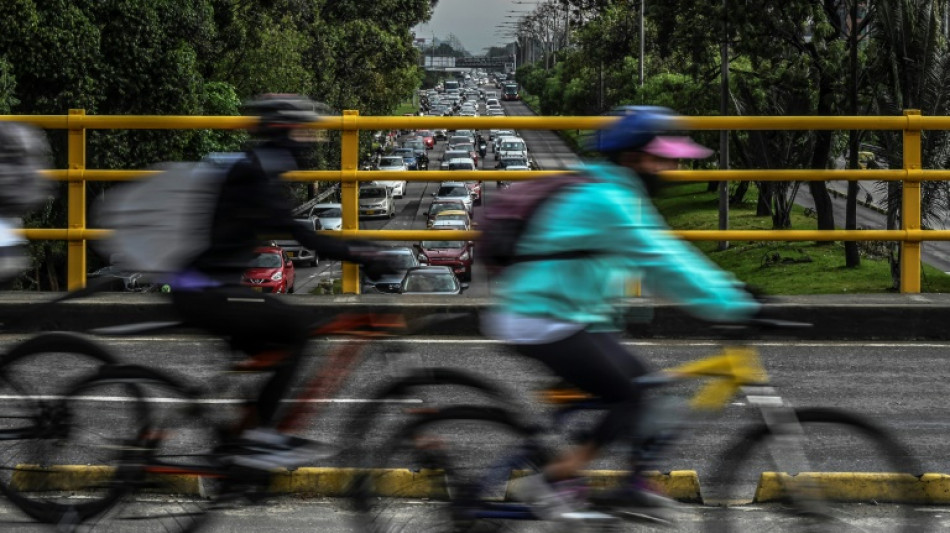
The bicycle making its way through Bogota's hellish traffic / Photo: JOAQUIN SARMIENTO - AFP/File

 Rubio launches Latin America tour to cement US influence
 France tries 14 over deadliest Channel migrant crossing disaster

 Australia threatens hefty fines if big tech fails 'duty of care'
 Zverev romps into quarter-finals as Darderi downed
 Kauai on tornado watch as Hurricane Lowell nears Hawaiian islands
 Pakistan roll the dice in search of consolation win over England

 Yen extends gains as traders eye rate hike, tech rallies again

 'The ber months': Christmas arrives early in the Philippines
 N. Korea calls Russia bridge a sign of tighter ties

 US sanctions threaten to crush Iranian students' dreams
 Former champ Gauff holds off Jovic to reach US Open quarter-finals

 Guardian Metal Resources PLC Announces Admission to FTSE AIM 50 Index
 InterContinental Hotels Group PLC Announces Transaction in Own Shares - September 08

 Osaka seeks answers to nagging achilles injury after US Open exit
 Flight data recorders recovered from Amazon cargo plane crash
 Super Bowl rematch kicks off NFL season as league expands global reach

 Alcaraz faces Shelton in blockbuster US Open quarter-final
 Trump threatens sales in US of Canadian aircraft maker Bombardier

 Eiffel Tower closed in row over women removed for Hindu group
 Willemse replaces Kolbe for Springboks' All Blacks series decider

 Zheng shocks Swiatek in another incredible US Open comeback

 Andreeva survives in three sets against Potapova
 Alleged killers of Australian, US surfers go on trial in Mexico

 King Charles classes Harry and Meghan as 'private citizens'
 Bowling coach Noffke says Pakistan's off-field issues are nothing new

Each morning, hundreds of cyclists ride through the socially disadvantaged neighborhood of Kennedy in southern Bogota.
Gripping their handlebars, laborers, seamstresses and students are choosing pedal power over cars and buses.
A cheap alternative to public transportation and an effective way to beat Bogota's horrendous traffic jams, the bicycle has taken off in one of the world's most congested cities.
"It's a practical way to get around for the people of Bogota, also because we are poor," said Carlos Felipe Pardo, founder of Despacio, an NGO that supports alternative forms of mobility.
Ricardo Buitrago's bicycle repair business has taken off in the six years since he started it.
Hands blackened with grease, he says up to 10,000 cyclists use the bicycle lane in front of his workshop every day.
One of them is Maria Ellis. She lives close to her office in Bogota, but it still takes her more than 1.5 hours to get to work.
"By bike it takes 25 minutes, so the bicycle is much better," she smiled.
- Traffic nightmare -
Bogota's eight million residents dread every car journey. At rush hour, crossing the city can take up to three hours.
In 2019, 880,000 daily journeys were made by bicycle in Bogota, according to the mayor's office, amounting to close to seven percent of all such movement in the capital.
And that figure jumped to 13 percent during the pandemic, according to Pardo.
Bogota was one of the first cities to create temporary cycle lanes during the pandemic to aid mobility while respecting distancing protocols.
It was a move that was replicated throughout the world, including Paris.
Bogota has close to 600 kilometers (370 miles) of dedicated cycle lanes, the most comprehensive cycle network in Latin America, and the government is working on expanding it further, said mobility minister Avila Moreno.
Not all of these are in a good condition. Some are only separated from the intense traffic by plastic bollards while others have been deformed by tree roots.
But at least they exist.
- Cheap but dangerous -
Unlike in many European capitals, where riding the bicycle is sometimes seen as trendy, in Colombia, which has a minimum wage of only $220 a month, it is considered a reliable and affordable form of transportation.
"Many view the bicycle as a cheap way to avoid public transport," said Moreno.
Security guard Pedro Quimbaya, 53, says he saves 150,000 pesos ($35) a month in bus fare.
The flip side is that it can be dangerous.
"At rush hour the traffic is very heavy, there are too many bicycles, the lanes aren't very good, you have to be very careful," said Ellis.
Over the first half of 2022, 50 cyclists were killed in traffic incidents in Bogota.
Then there is the risk of theft. Quimbaya says he has been attacked several times and his bicycle worth $270, more than a month's salary, was stolen by a gang.
Nearly 11,000 bicycles were stolen in 2020, according to the mayor's office and theft continues to rise.
Pardo says the capital needs more infrastructure, better security and better trained drivers.
"Bogota has progressed on all these fronts but still needs to improve," he added.
- Next Copenhagen? -
Moreno, the recently appointed mobility minister, says the city has "huge potential."
"It's a work in progress that other big cities like Copenhagen have already been through," she said. "Bogota is following the same path."
The municipality will roll out 3,300 public free-to-use bicycles in October.
Colombia has long been in love with the bicycle, not least thanks to its great cycling champions such as Egan Bernal, who won the Tour de France in 2019, and Nairo Quintana, a two-time Grand Tour winner.
The last three Bogota mayors, including incumbent Claudia Lopez and current President Gustavo Petro, have promoted bicycle use.
Ever since 1974, the city's main avenues have been closed off to vehicles for several hours on Sundays to be replaced by thousands of bicycles.
Bogota "could become the world bicycle capital. It's possible, even though we're still far from that," said Pardo, the NGO head.
"We can get people out of their cars and onto bicycles," said Moreno.
Buitrago, the bicycle repairman, agrees: "The bicycle is the future."
P.A.Mendoza--AT