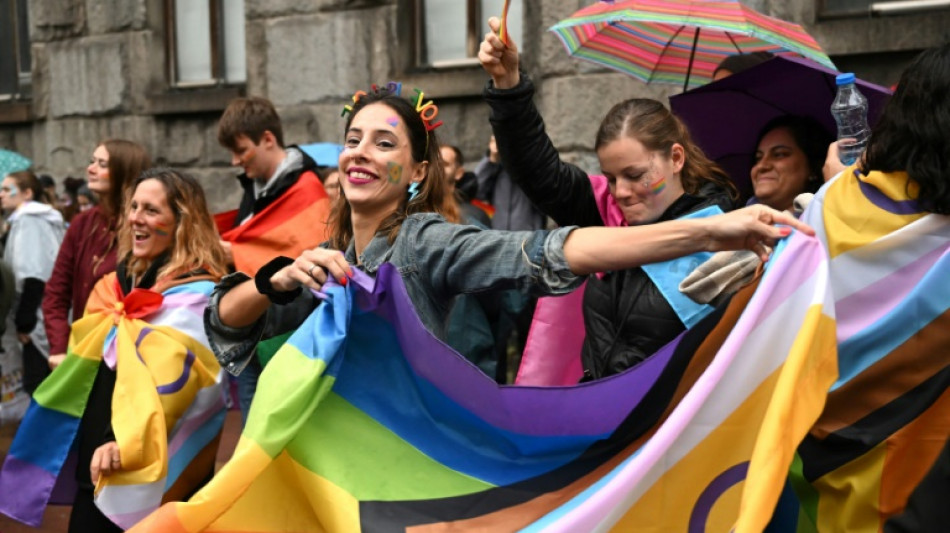
Arrests in Belgrade EuroPride gathering after ban / Photo: ANDREJ ISAKOVIC - AFP

 Zach Hickerson Recounts Hayden Panettiere's Final Moments in New Interview

 Luxembourg Housing Petition Passes Threshold for Parliamentary Consideration

 Raheem Sterling Receives Suspended Sentence After Lamborghini Crash

 Audience to Choose the Set List at Luxembourg's First FAMIL Jukebox Night

 Luxembourg Pay Rise Delayed as Regional and World Headlines Develop

 Chennai Urbanist Sashna Develops 'Anniki' Card Game to Gamify Tamil Nadu History

 Transport Minister Defends Land Seizure Powers for Toronto-Quebec City High-Speed Rail

 UAE Weather Forecast: Scattered Showers and Fog Expected as Temperatures Drop
Police detained 64 people in Belgrade on Saturday as LGBTQ activists gathered for a EuroPride march despite a government ban.
The event had been intended as the cornerstone event of the EuroPride gathering. But the interior ministry banned the march earlier this week, citing security concerns after right wing groups threatened to hold protests.
Despite the official ban, demonstrators were able to march in the rain a few hundred metres from the Constitutional Court to a nearby park, a much shorter route than organisers had originally planned.
Serbian interior minister Aleksandar Vulin insisted that the ban was enforced, and that the people were merely "escorted to a concert".
Local media reported skirmishes erupted outside the event, and a group of hooligans threw flares at the police.
Balkan country's prime minister Ana Brnabic -- who is openly gay -- said 64 people were arrested and ten police officers injured on Saturday, but underlined that she was "proud" that the day ended with "no major incidents".
Gay marriage is not legally recognised in Serbia, where homophobia remains deep-seated despite some progress over the years in reducing discrimination.
"This is much bigger than a gay pride", Luka Mazzanti Jovicevic, a Serbian attendee, told AFP.
"We are fighting for the future of the country."
Model and activist Yasmin Benoit said she had been to many gay pride parades "but this one is slightly more stressful than the others".
"I'm from the UK where everyone is more supportive and it's more commercial," she told AFP.
"But here, this is really what Pride should be ... standing up to the forces that want to stop us."
There was a heavy police presence around the Pride rally, with officers pushing back the small groups of counter-demonstrators waving crosses and religious insignia.
"I am here to preserve Serbian traditions, faith and culture which are being destroyed by sodomites," Andrej Bakic, 36, a counter-protester in a group surrounded by riot police told AFP on Saturday.
The Balkan country, a candidate for EU membership, had been under intense international pressure to allow the march.
More than 20 embassies -- including the US, France and Britain -- have issued a joint statement urging the authorities to lift the ban.
"We, as activists, will use our democratic right to civil disobedience and will protest," the Belgrade Pride organisers said Saturday, after a court rejected their appeal to overturn the ban.
The interior ministry had also barred any counter protests but some far-right groups gathered in front of several Belgrade churches.
Interior Minister Aleksandar Vulin warned in a statement that "we will not tolerate any violence in Belgrade streets, any more than illegal marches."
The US embassy urged its citizens to avoid the event "because of the potential for unruly crowds, violence, as well as possible fines".
Human rights groups and the European Union have called on the Serbian government to rescind the ban.
"The Serbian government's decision to cancel EuroPride is a shameful surrender to, and implicit sanctioning of, bigotry and threats of unlawful violence," said Graeme Reid, director of the LGBT rights programme at Human Rights Watch.
At least 15 members of the European Parliament joined the Pride march in a show of solidarity.
Since 2014, the parade has been organised regularly without any notable unrest but were protected with a large law enforcement presence.
The formal ban came just days after thousands took part in an anti-Pride demonstration in Belgrade, with biker gangs, Orthodox priests and far-right nationalists demanding the EuroPride rally be scrapped.
N.Mitchell--AT


